Chords & Harmony
Primary Chords (I, IV, V)
The primary chords are the triads built on degrees 1, 4 and 5 of a scale: I, IV and V. In C major they are C, F and G. Together they contain every note of the scale, so they can harmonize most simple melodies.
The primary chords are the three triads built on the first, fourth and fifth degrees of a scale: the tonic chord (I), the subdominant chord (IV) and the dominant chord (V). In C major they are C, F and G; in G major, G, C and D. In a major key all three are major chords, which is why they are written with capital Roman numerals.
Why these three?
Between them, the three primary chords contain every note of the scale: C–E–G, F–A–C and G–B–D cover all seven notes of C major. So almost any note of a simple melody belongs to at least one of them. They also stand for the three harmonic functions: home (I), moving away (IV) and pulling back home (V). That is why so many folk songs, hymns, country songs and early rock and roll songs need only these three chords, and why guitarists call them the "three-chord trick".
Playing them in the closest positions
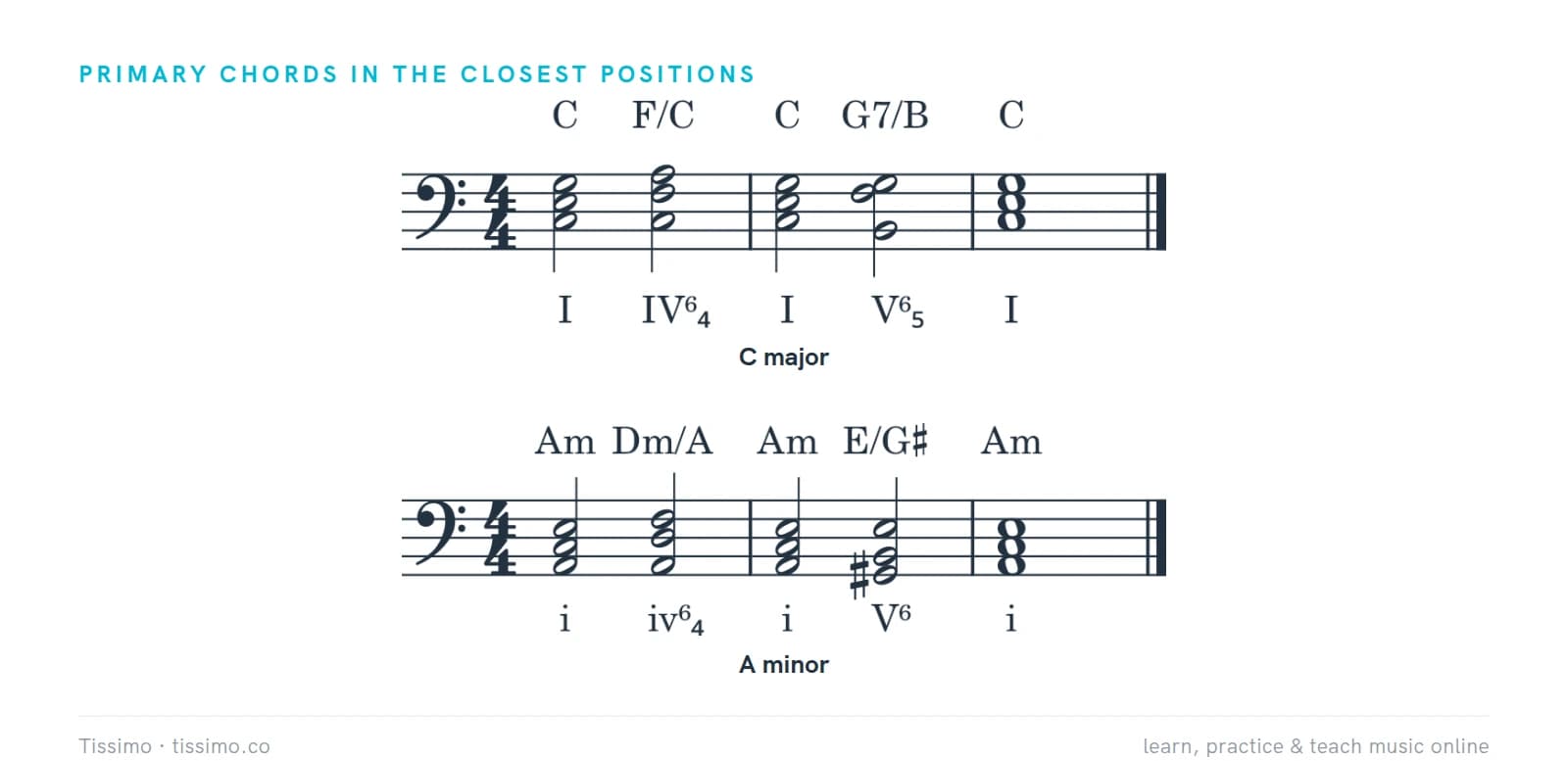
Beginning pianists usually learn the primary chords in shapes that keep the left hand in one place: C–E–G for I, C–F–A for IV (in second inversion) and B–F–G for V7 (in first inversion, without its fifth). Each change moves only one or two fingers, by a step.
Primary chords in a minor key
In a minor key the tonic and subdominant chords are minor (i and iv), while the dominant is usually major (V), thanks to the raised seventh degree of the harmonic minor scale. In A minor they are Am, Dm and E.
Harmonizing a melody with I, IV and V
- Look at the melody notes on the strong beats of each bar.
- Find the primary chord that contains them. In C major, E points to I, A to IV, and B and D to V. C and G each belong to two chords (C to I and IV, G to I and V), so let the other notes in the bar decide.
- End phrases with V–I for a full close, or stop on V for a pause (see cadence).
Harmonize a melody walks you through it, and The Primary Chords in Every Key lists them in all 24 keys.
Common questions
What are the primary chords in G major?
G major (I), C major (IV) and D major (V). Add a seventh to the last one and it becomes D7 (V7).
What are the primary chords in a minor key?
i, iv and V. In A minor they are A minor, D minor and E major; the E chord is major because the seventh degree, G, is raised to G♯.
Practice it: free worksheets
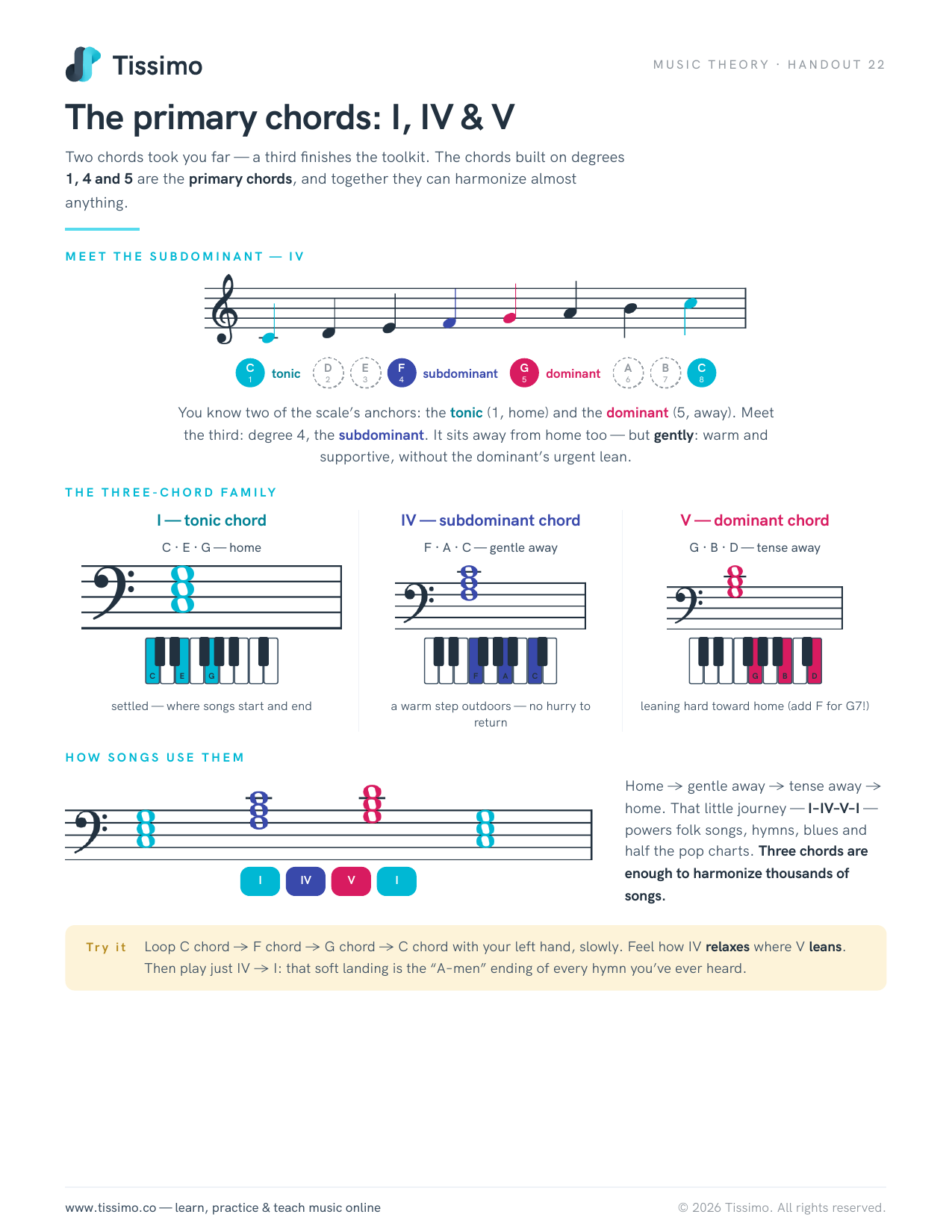 The primary chords: I, IV & VTwo chords took you far — a third finishes the toolkit. The chords built on degrees 1, 4 and 5 are the primary chords, and together they can harmonize almost anything.
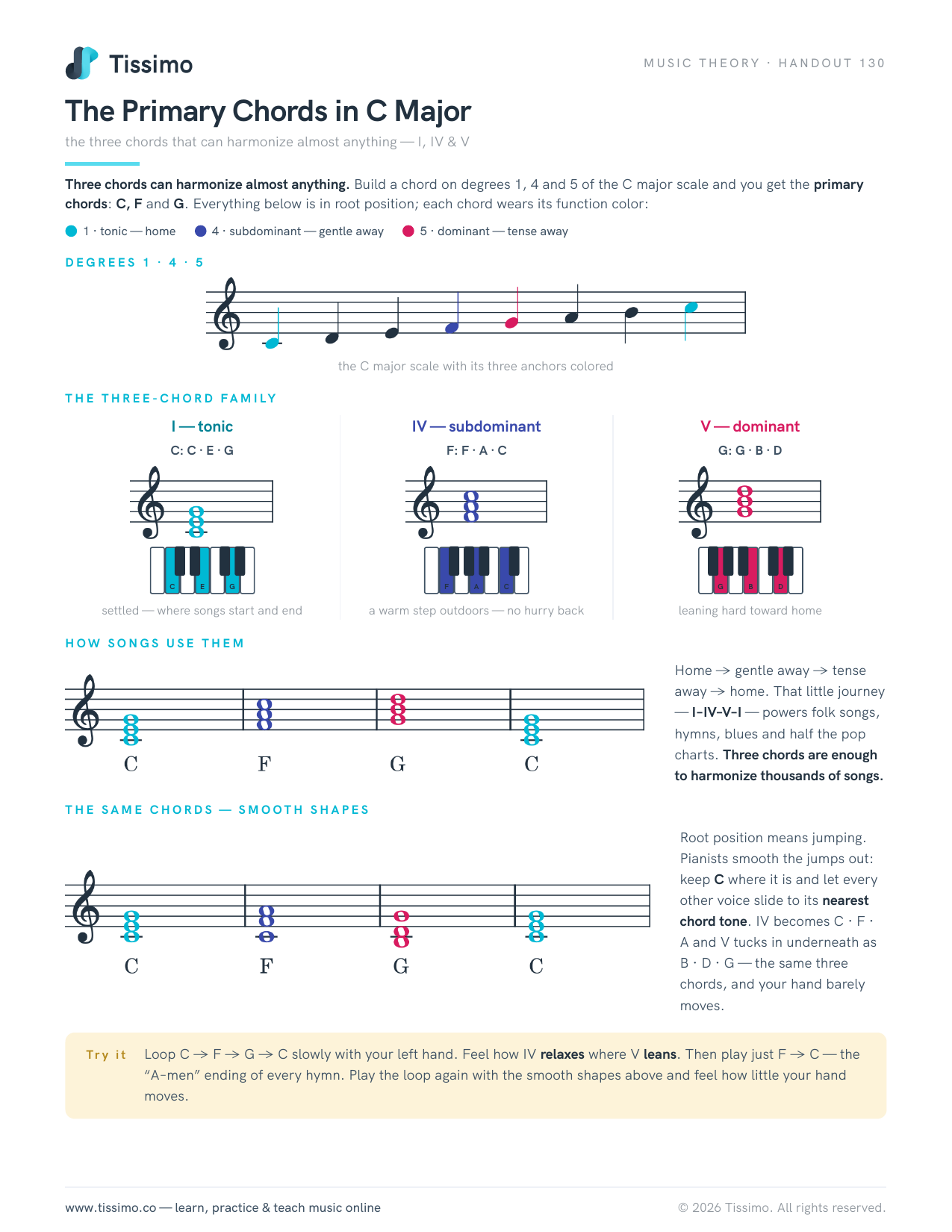 The Primary Chords in Every KeyI, IV and V — the three chords that can harmonize almost anything, in all 24 keys.
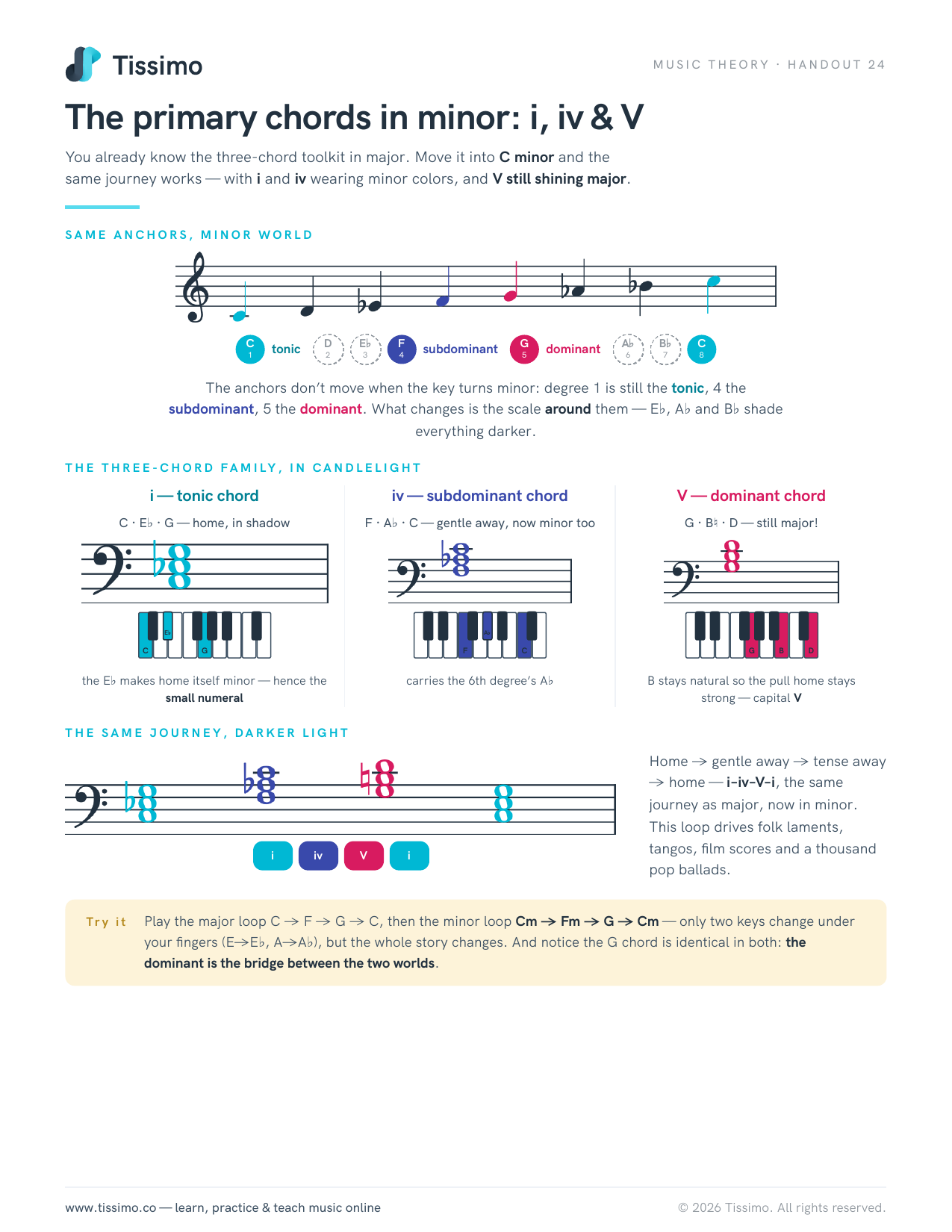 The primary chords in minor: i, iv & VYou already know the three-chord toolkit in major. Move it into C minor and the same journey works — with i and iv wearing minor colors, and V still shining major.
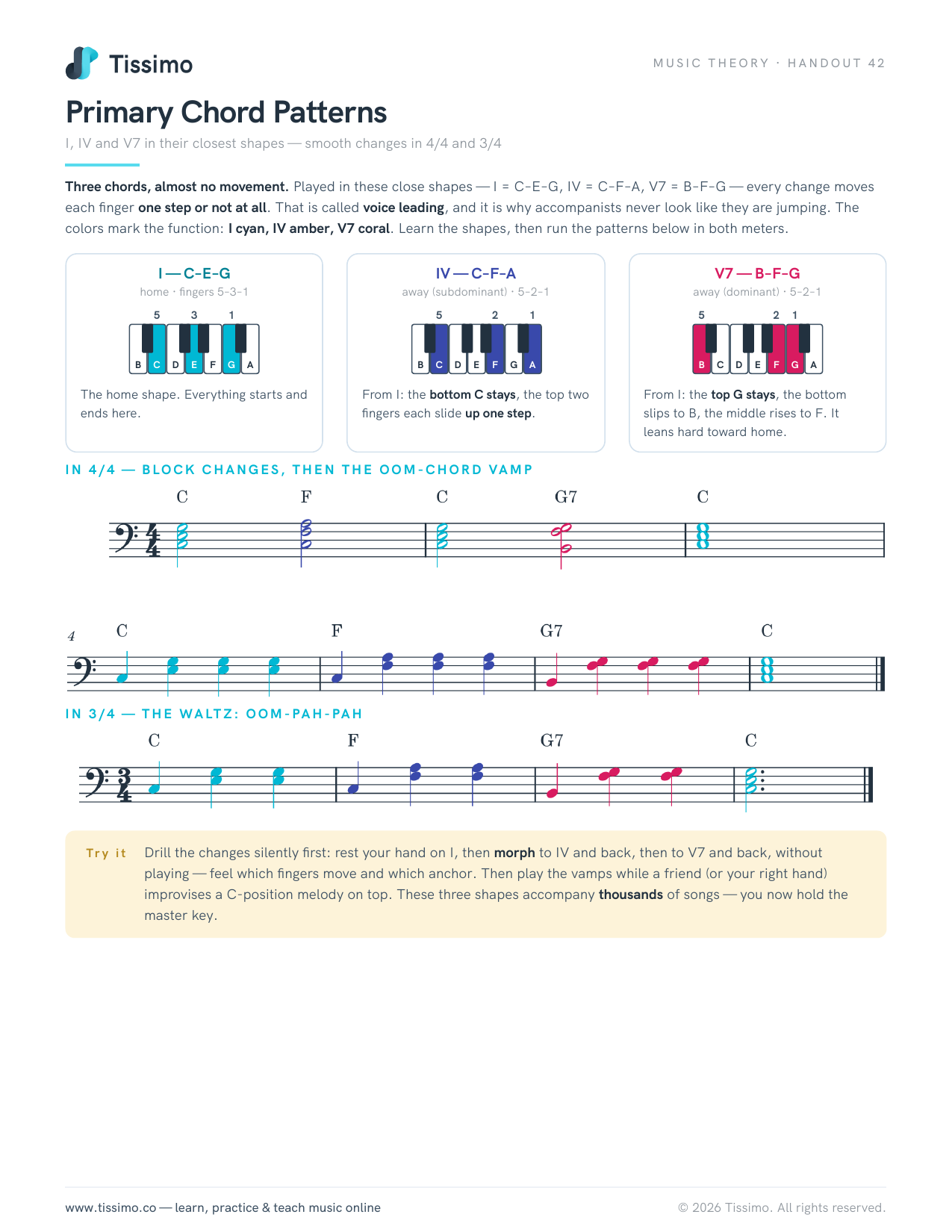 Primary Chord PatternsI, IV and V7 in their closest shapes — smooth changes in 4/4 and 3/4
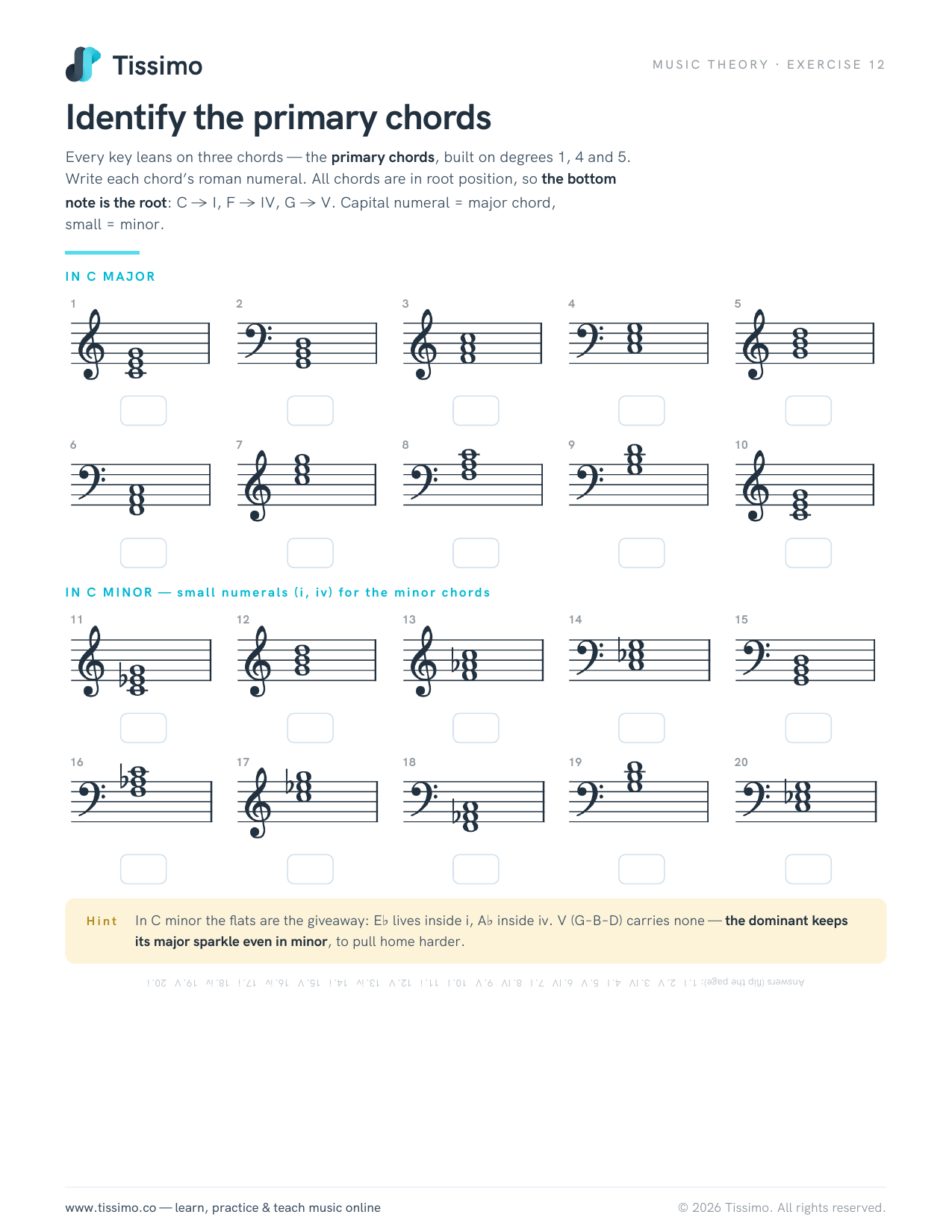 Identify the primary chordsEvery key leans on three chords — the primary chords, built on degrees 1, 4 and 5. Write each chord’s roman numeral. All chords are in root position, so the bottom note is the root: C → I, F → IV, G → V. Capital numeral = major chord, small = minor.
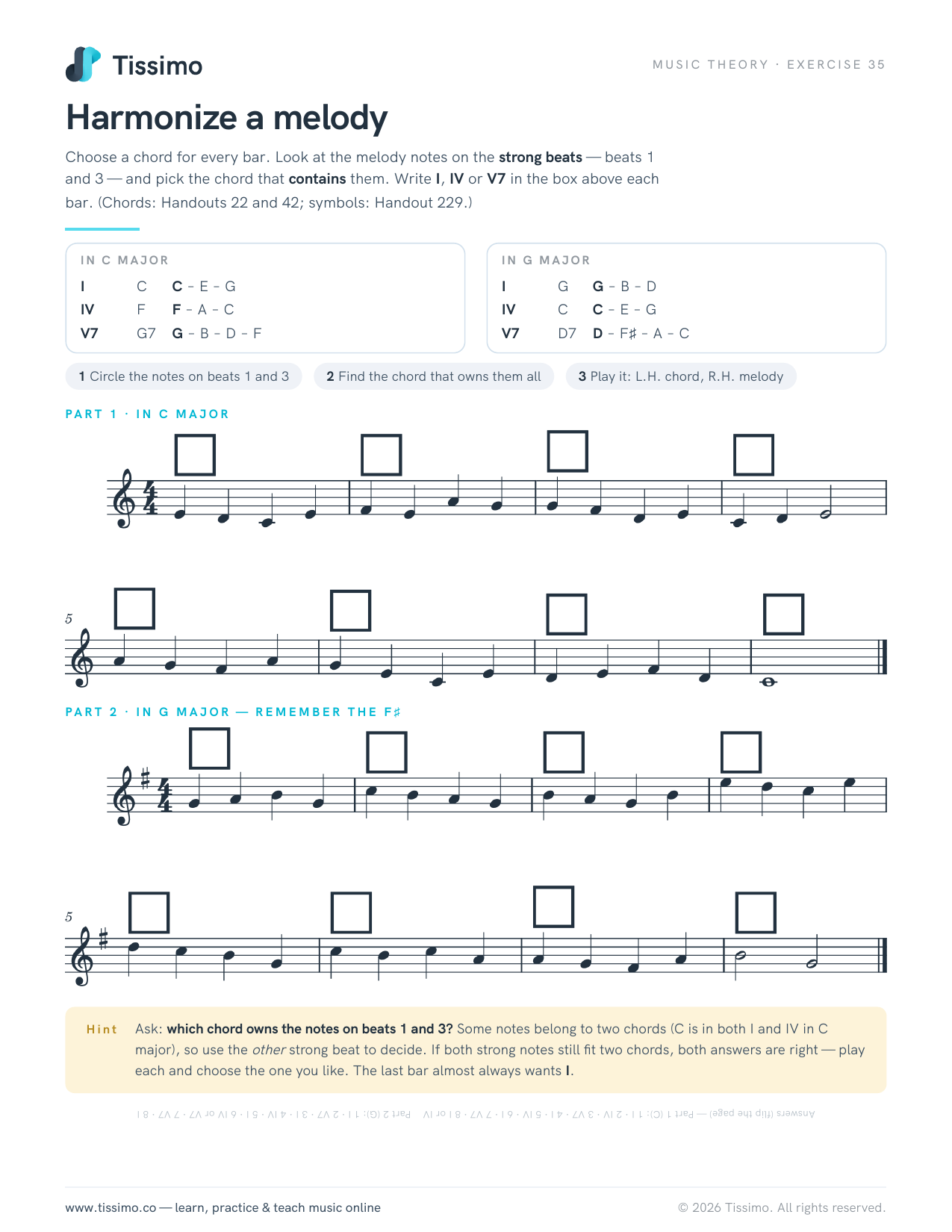 Harmonize a melodyChoose a chord for every bar. Look at the melody notes on the strong beats — beats 1 and 3 — and pick the chord that contains them. Write I, IV or V7 in the box above each bar. (Chords: Handouts 22 and 42; symbols: Handout 229; how to choose: Handout 358.) Next: Exercise 57 adds ii and vi.