Dynamics & Expression
Agitato
Pronounced ah-jee-TAH-toh
Agitato means 'agitated': play with restless, excited energy, as if the music cannot settle. It often appears with a fast tempo word, as in Presto agitato.
Agitato means "agitated" or "restless". It asks for nervous, driven energy: music that pushes forward and refuses to settle. It is usually joined to a tempo word, as in Allegro agitato or Presto agitato, and the tempo word sets the speed while agitato sets the mood.
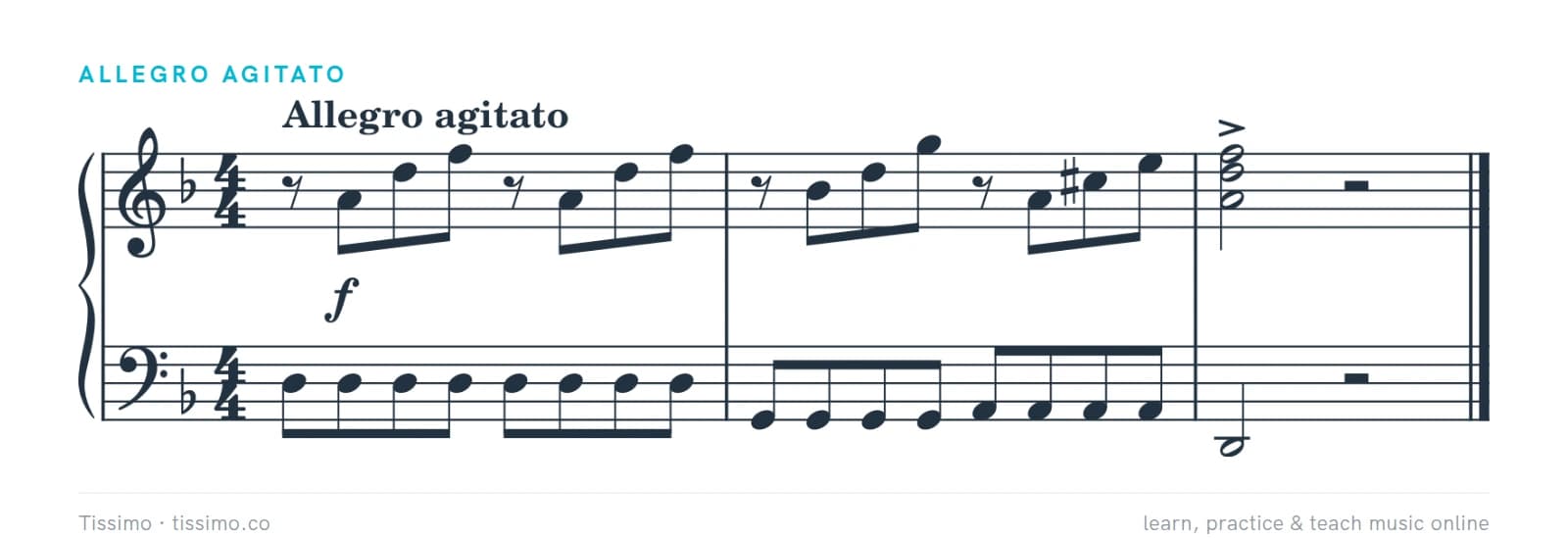
Agitato in real music
The finale of Beethoven's "Moonlight" Sonata is marked Presto agitato: rushing arpeggios, sudden accents and loud chords that make it a storm after the calm first movement. Our Moonlight Sonata study looks at the first movement, which shows the contrast.
What makes music sound agitated
Composers usually build agitation into the notes themselves, and the word tells you to bring it out:
- Off-beat entries and syncopation, so the beat feels unstable.
- Repeated notes or driving accompaniment, like a racing pulse.
- Minor keys, short phrases and sudden dynamic contrasts.
Playing agitato
- Keep the rhythm tight and pushing; do not relax at the ends of phrases.
- Make accents and off-beats sharp, so the restlessness is audible.
- Stay in control. Agitato describes the music's character, not the player's. A steady pulse underneath makes the agitation sound intentional.
Compare con fuoco (with fire), appassionato (passionate) and stringendo (pressing the tempo forward). Its calm opposite is tranquillo.
Common questions
What does presto agitato mean?
Very fast and agitated: a presto tempo played with restless, excited energy. The finale of Beethoven's "Moonlight" Sonata is the best-known example.