Instruments & Voices
Double Bass
The double bass is the largest and lowest bowed string instrument. Its four strings are tuned E–A–D–G in fourths, it is played standing or on a high stool, and its music is written in bass clef an octave above its sound.
The double bass is the giant of the string family: taller than most of its players, and the lowest-sounding bowed string instrument. In the orchestra it gives the bass line its weight; in jazz, played with the fingers, it is the instrument of the walking bass line. You will also hear it called the upright bass, string bass or contrabass.
How it makes its sound
The bass is played with a bow ("arco") or plucked (pizzicato). Classical bassists use the bow much of the time, while jazz, rockabilly and much folk playing is pizzicato. There are two kinds of bow and bow hold: the French bow, held like a cello bow, and the German bow, with a taller frog that you hold with the hand more underneath. Players stand or sit on a high stool, with the instrument resting on its endpin.
The double bass is often described as a cousin of the older viol family as well as the violin family: many basses have sloping shoulders, and it is tuned in fourths rather than in fifths like the violin, viola and cello. Fourths keep the stretches between notes manageable on such long strings.
Tuning and range
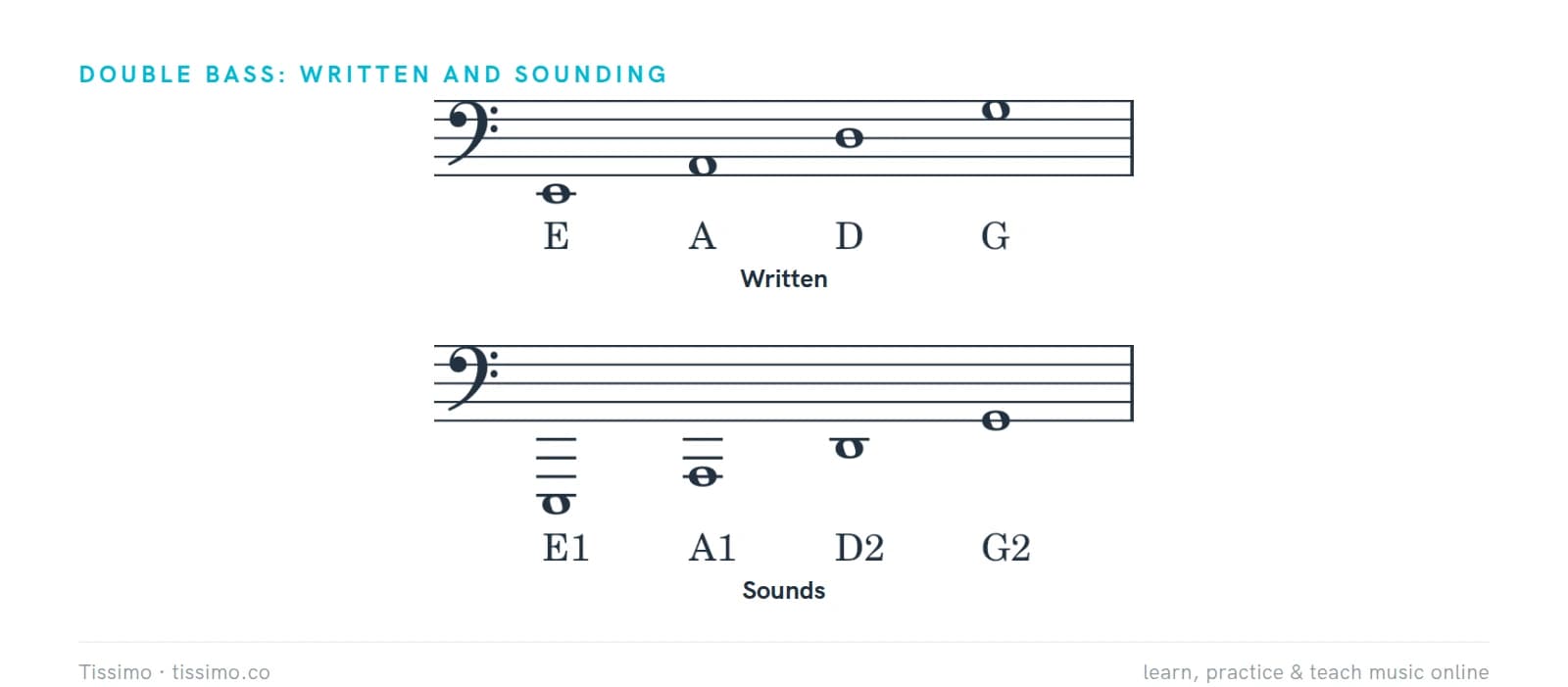
The standard tuning is E1, A1, D2, G2, each string a perfect fourth above the last: the same notes as a four-string bass guitar. Some orchestral basses have an extension that takes the E string down to C1, and some have a fifth string. In most orchestral parts the range reaches up to about G3 (sounding); solo music goes much higher.
How bass music is written
Double bass music is written in bass clef an octave higher than it sounds, which keeps the low notes on the staff. High passages move into tenor clef and occasionally treble clef, still an octave above the sound. In older orchestral scores the basses often share a staff with the cellos and simply play the same written line, which sounds an octave lower.
Its role
The basses are the foundation of the orchestra's harmony, often doubling the cellos an octave below. In jazz the bassist outlines the chords and keeps time with the drummer; in folk, bluegrass and rockabilly the bass drives the rhythm. A bass player has to listen to everyone, because every chord sits on top of the bass.
Tips for beginners
- Children and smaller adults use 1/4, 1/2 or 3/4 basses; the 3/4 size is the most common size for adults.
- The double bass is usually taught with a 1–2–4 fingering in the lower positions, skipping the third finger, because the notes are far apart.
- Let arm weight, not finger squeeze, press the strings and drive the bow.
- Transport the instrument in a padded bag, and keep it away from heaters and damp; changes in humidity can crack the wood.
Common questions
Why is it called the double bass?
The name is usually explained by its role: it doubles the bass line an octave below the cellos, or plays an octave below the normal bass range. Musicians mostly just call it "the bass."
Is the double bass a transposing instrument?
Yes, by an octave. Its music is written an octave higher than it sounds, as with the bass guitar and guitar. The note names stay the same, so bassists rarely think of it as transposing.
Practice it: free worksheets
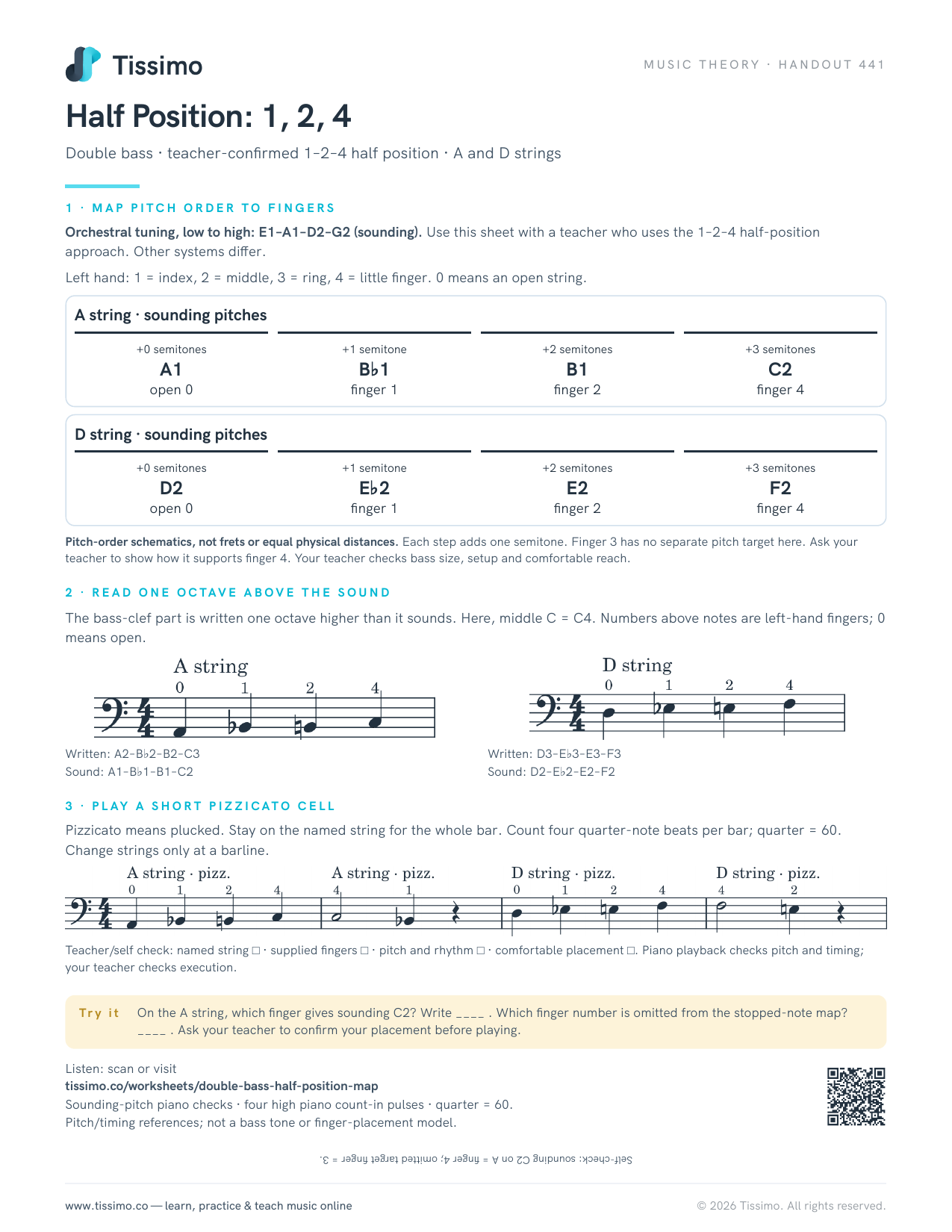 Half Position: 1, 2, 4Double bass · teacher-confirmed 1–2–4 half position · A and D strings
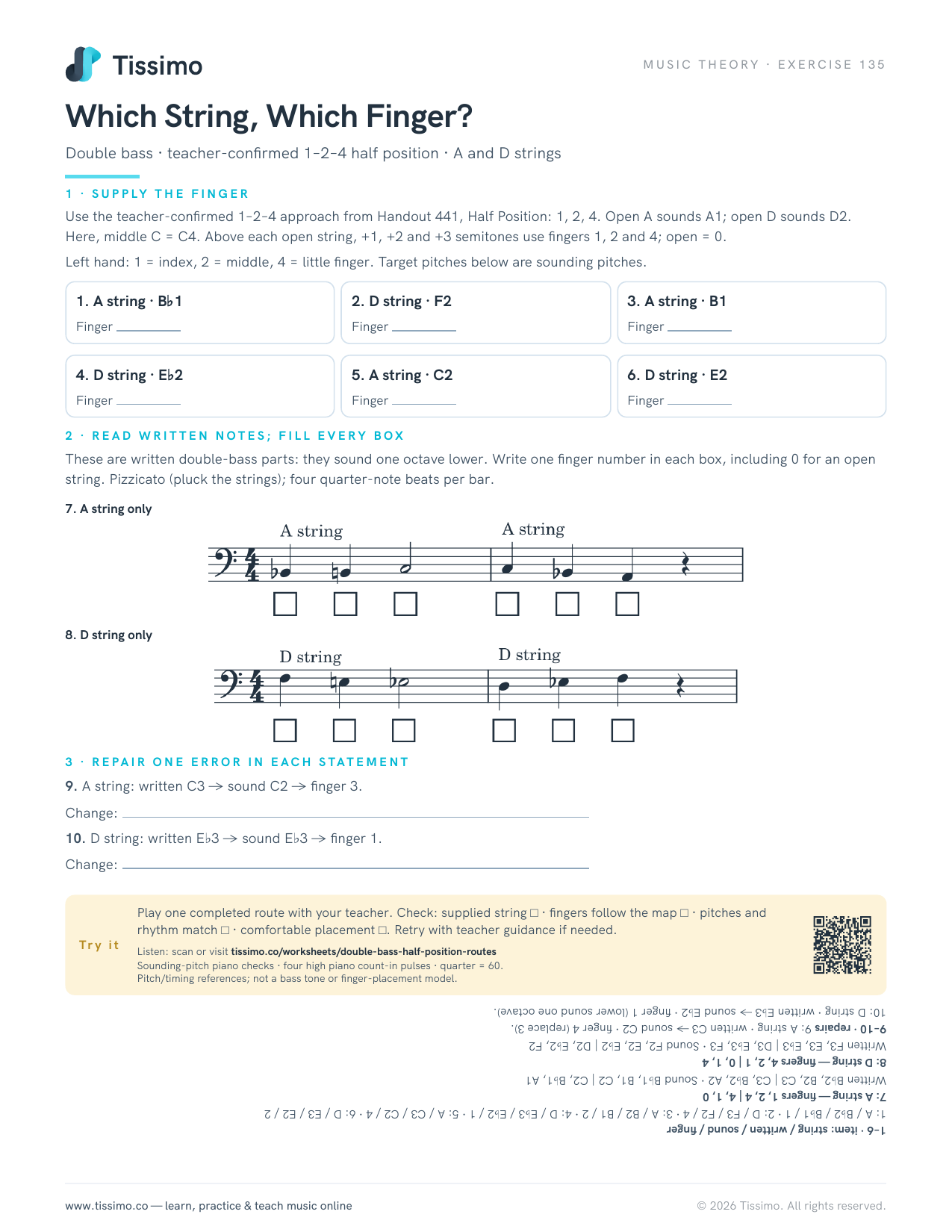 Which String, Which Finger?Double bass · teacher-confirmed 1–2–4 half position · A and D strings
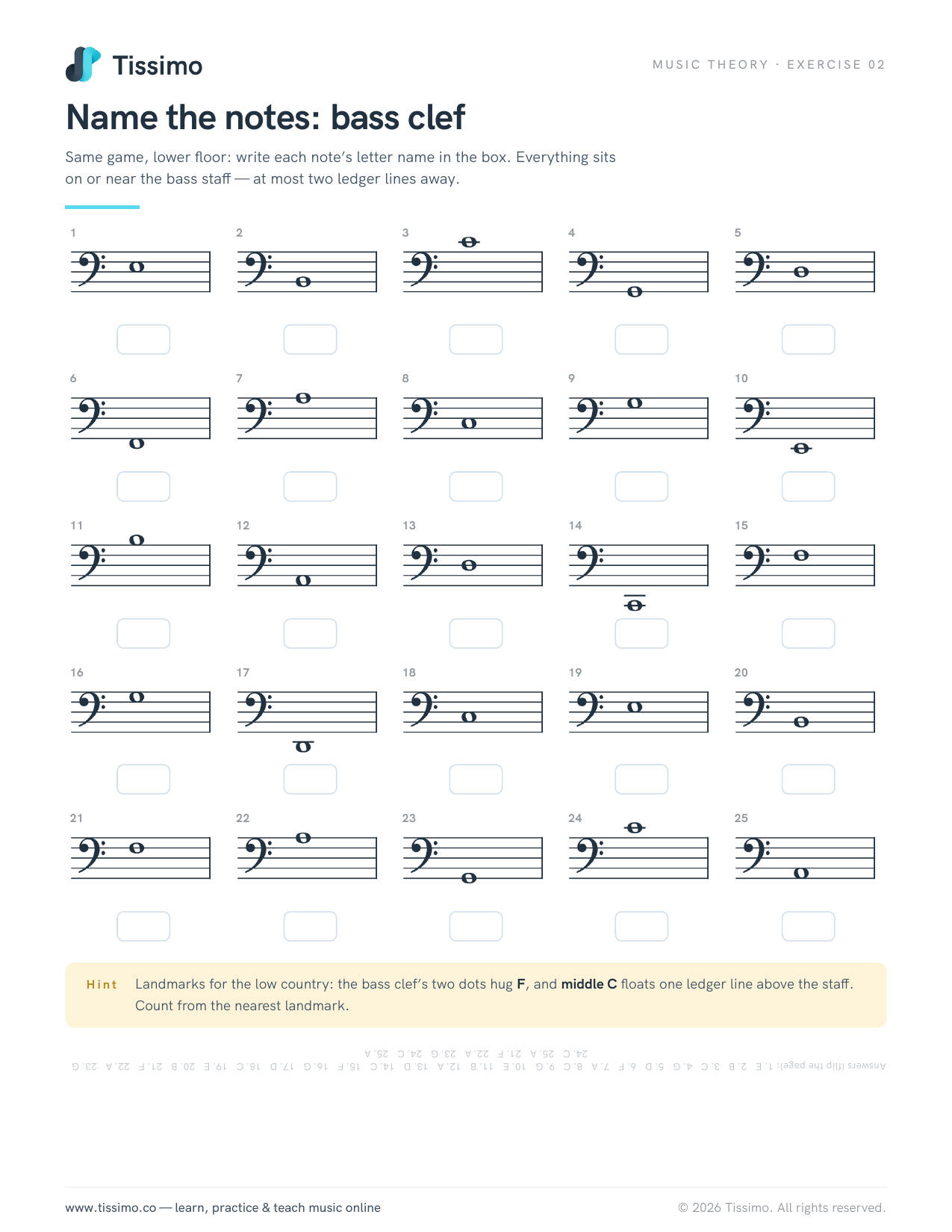 Name the notes: bass clefSame game, lower floor: write each note’s letter name in the box. Everything sits on or near the bass staff — at most two ledger lines away.