Chords & Harmony
Harmonic Rhythm
Harmonic rhythm is the rate at which the chords change in a piece, regardless of how many melody notes move above them. One chord per bar is a slow harmonic rhythm; a new chord on every beat is a fast one.
Harmonic rhythm is the speed at which the chords change. It is separate from the rhythm of the melody: a melody can race along in sixteenth notes over a single chord that lasts two bars, or move slowly while the chords change on every beat. Counting how long each chord lasts, rather than how many notes you hear, tells you the harmonic rhythm.
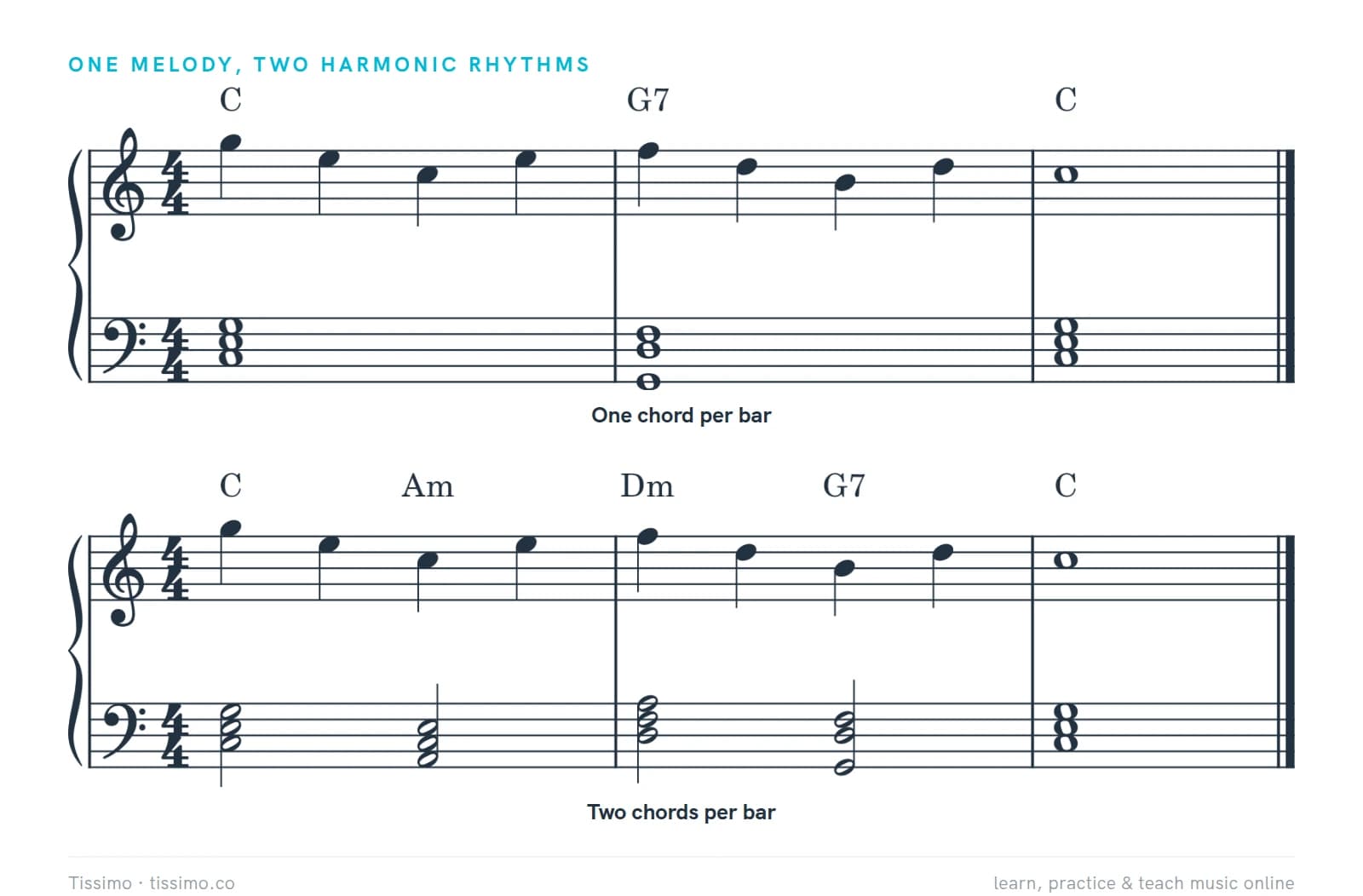
Slow and fast harmonic rhythm
A slow harmonic rhythm, one chord for a bar or more, sounds spacious and calm, or static and hypnotic when it lasts a long time. A fast harmonic rhythm, a new chord every beat or half bar, sounds busy, driven and full of direction. Hymns and chorales often change chord on nearly every beat; a lot of pop and dance music holds one chord for a bar or two; the basic twelve-bar blues changes chord no more than once a bar.
Speeding up toward the cadence
In much Classical music the harmonic rhythm speeds up as a phrase approaches its cadence. A phrase might hold one chord for a whole bar at first, then change twice per bar, then every beat just before the final V–I. That acceleration is part of what makes the cadence sound like an arrival.
Finding the harmonic rhythm
- Listen to the bass: a new bass note on a strong beat often signals a new chord.
- Notice when the melody's notes stop fitting the old chord.
- Mark each change, then look at the pattern: once per bar, twice per bar, or something irregular.
Many Notes, Fewer Chord Changes and Mark the Chord Changes, Not Every Attack train exactly this skill.
Using it when you write
When you harmonize a melody, deciding how often to change chord is as important as deciding which chords to use. Too many changes can crowd a simple tune; too few can make it sound bare. Choosing chords for a melody walks through the decision.
Common questions
What is the difference between rhythm and harmonic rhythm?
Rhythm is the pattern of note lengths you hear in the melody or accompaniment. Harmonic rhythm is the pattern of chord lengths: how long each harmony lasts before the next one arrives.
How do you find the harmonic rhythm of a piece?
Listen to the bass and mark each moment the chord changes, ignoring notes that move within the same chord. Then compare the lengths: one chord per bar, two per bar, and so on.
Practice it: free worksheets
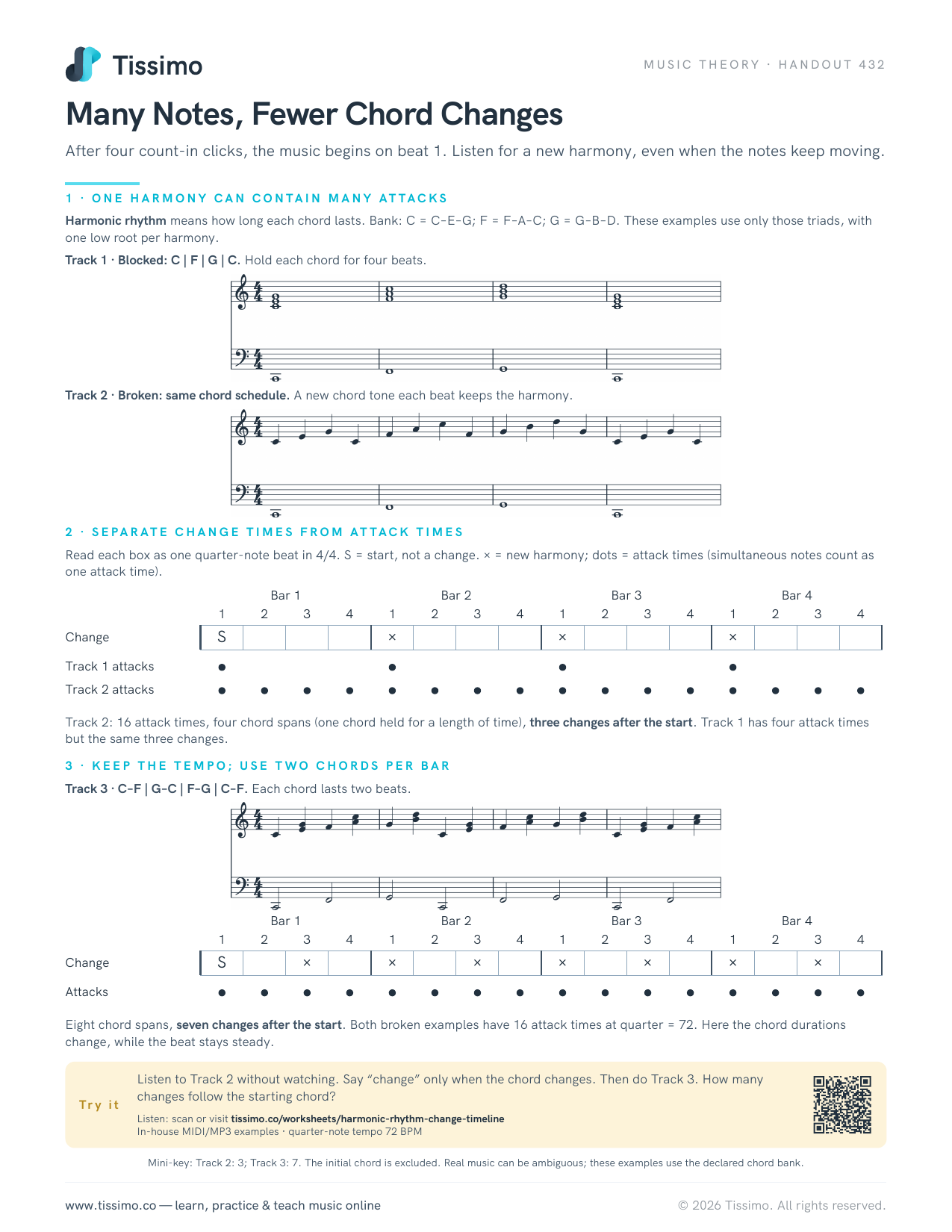 Many Notes, Fewer Chord ChangesAfter four count-in clicks, the music begins on beat 1. Listen for a new harmony, even when the notes keep moving.
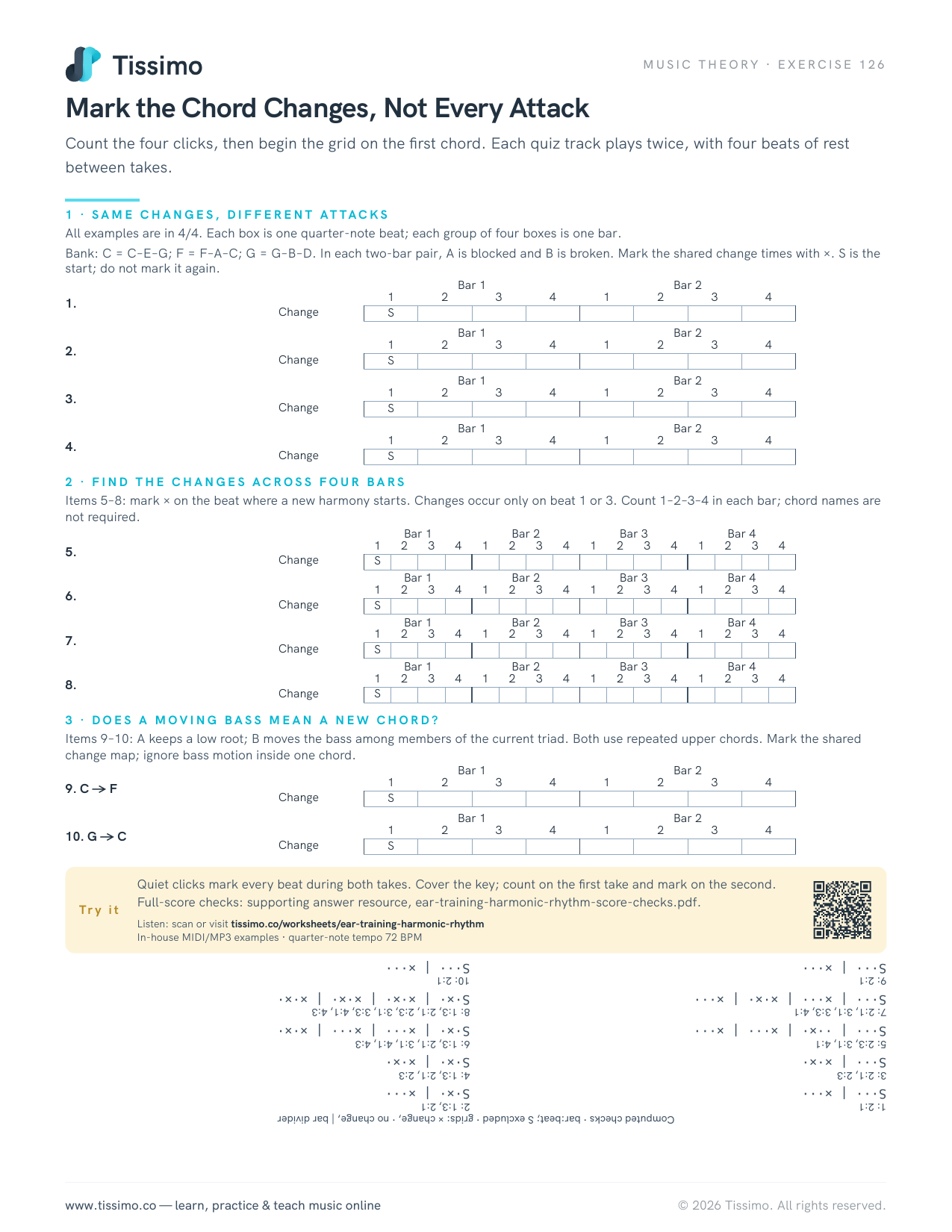 Mark the Chord Changes, Not Every AttackCount the four clicks, then begin the grid on the first chord. Each quiz track plays twice, with four beats of rest between takes.
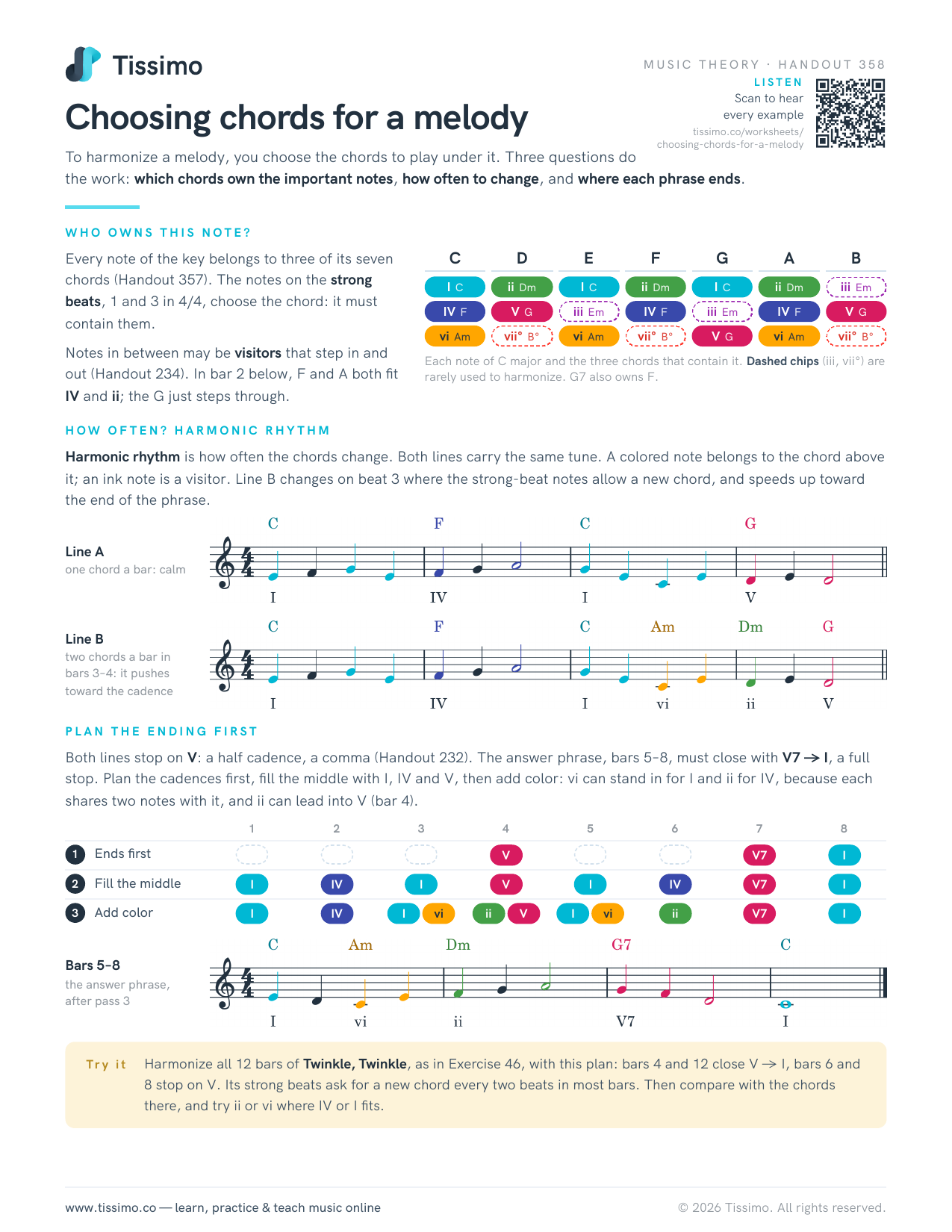 Choosing chords for a melodyTo harmonize a melody, you choose the chords to play under it. Three questions do the work: which chords own the important notes, how often to change, and where each phrase ends.
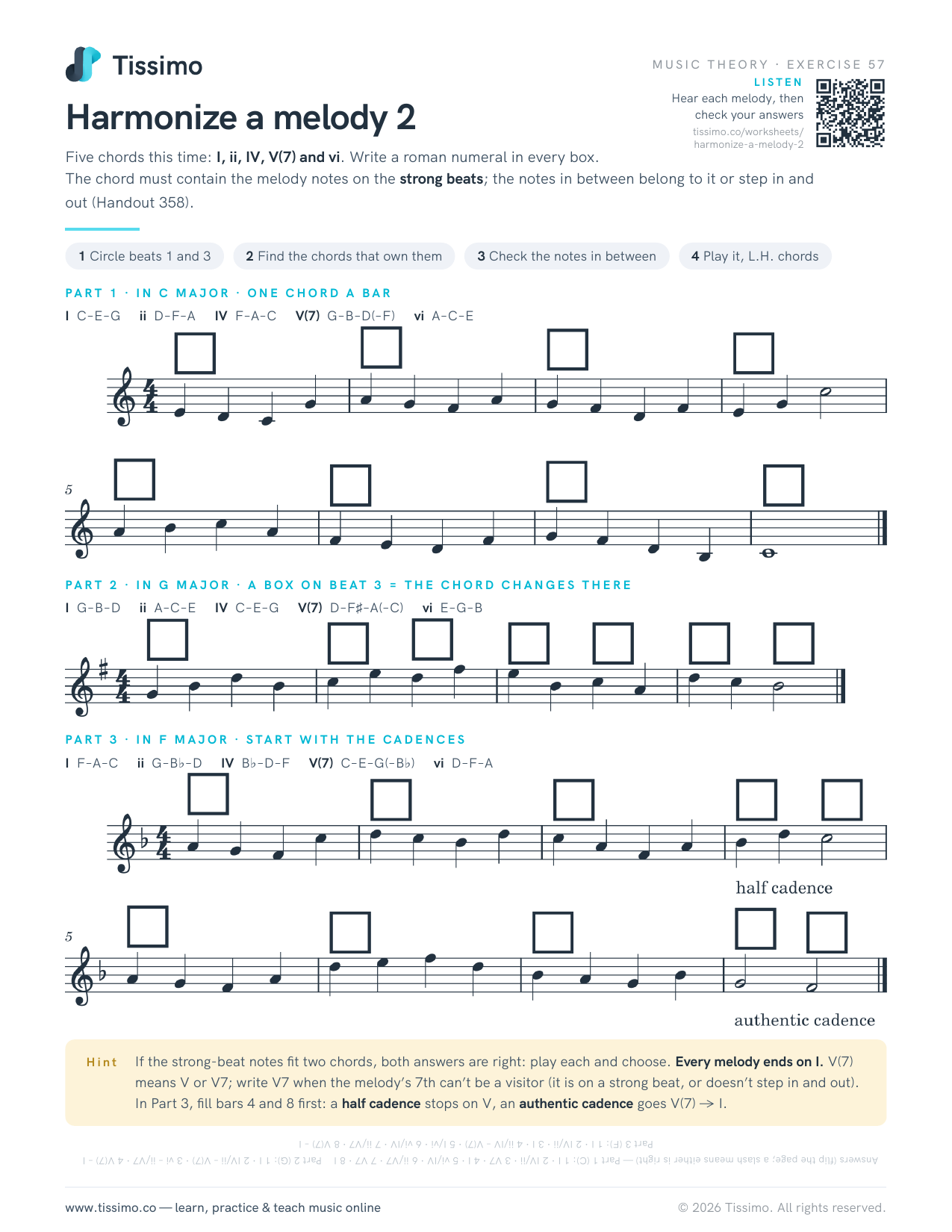 Harmonize a melody 2Five chords this time: I, ii, IV, V(7) and vi. Write a roman numeral in every box. The chord must contain the melody notes on the strong beats; the notes in between belong to it or step in and out (Handout 358).