Notation & Symbols
Sharp
Written as ♯
A sharp (♯) is a sign that raises a note by one half step. On the piano, F-sharp is the key just to the right of F. Sharps appear before single notes or, for a whole piece, in the key signature.
A sharp raises a note by one half step, the smallest step on the piano. Its sign, ♯, looks like a slanted hash mark; in typed text people often use # instead. Written before a note, the sharp is an accidental. Written at the start of each line, right after the clef, it is part of the key signature.
Finding sharps on the piano
To play a sharp, go one key to the right: the very next key, black or white. Usually that is a black key; C♯, D♯, F♯, G♯ and A♯ are all black keys. But E and B have no black key to their right, so E♯ is played on the white key F, and B♯ on the white key C. These are enharmonic equivalent spellings: two names for one key.
Reading sharps on the staff
The sharp sign sits right in front of the notehead, centered on the same line or space. You say it after the letter ("F-sharp"), but you see it before the note, so you are ready in time.
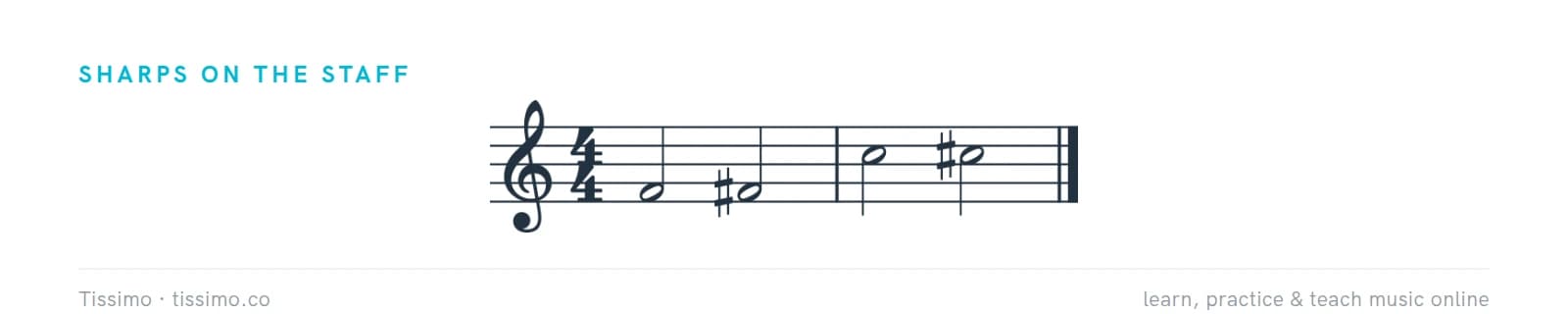
A sharp lasts until the end of the measure, for that line or space. A natural cancels it sooner.
Sharps in key signatures
Sharps in a key signature always appear in the same order: F, C, G, D, A, E, B. G major has one sharp (F♯), D major has two (F♯ and C♯), and so on, up to C♯ major with all seven. A handy trick: in a sharp key signature, the major key is a half step above the last sharp. The circle of fifths shows the whole series.
Sharp as a tuning word
Musicians also say a singer or an instrument is "sharp" when the pitch is slightly too high. That is a tuning problem, not a written sign. The opposite is flat.
Practice with The sharp: one half step up and Half steps & whole steps.
Common questions
Is a sharp always a black key?
No. Most sharps are black keys, but E-sharp is played on the white key F and B-sharp on the white key C.
What is the order of sharps?
F, C, G, D, A, E, B. Key signatures add sharps in that order.
Practice it: free worksheets
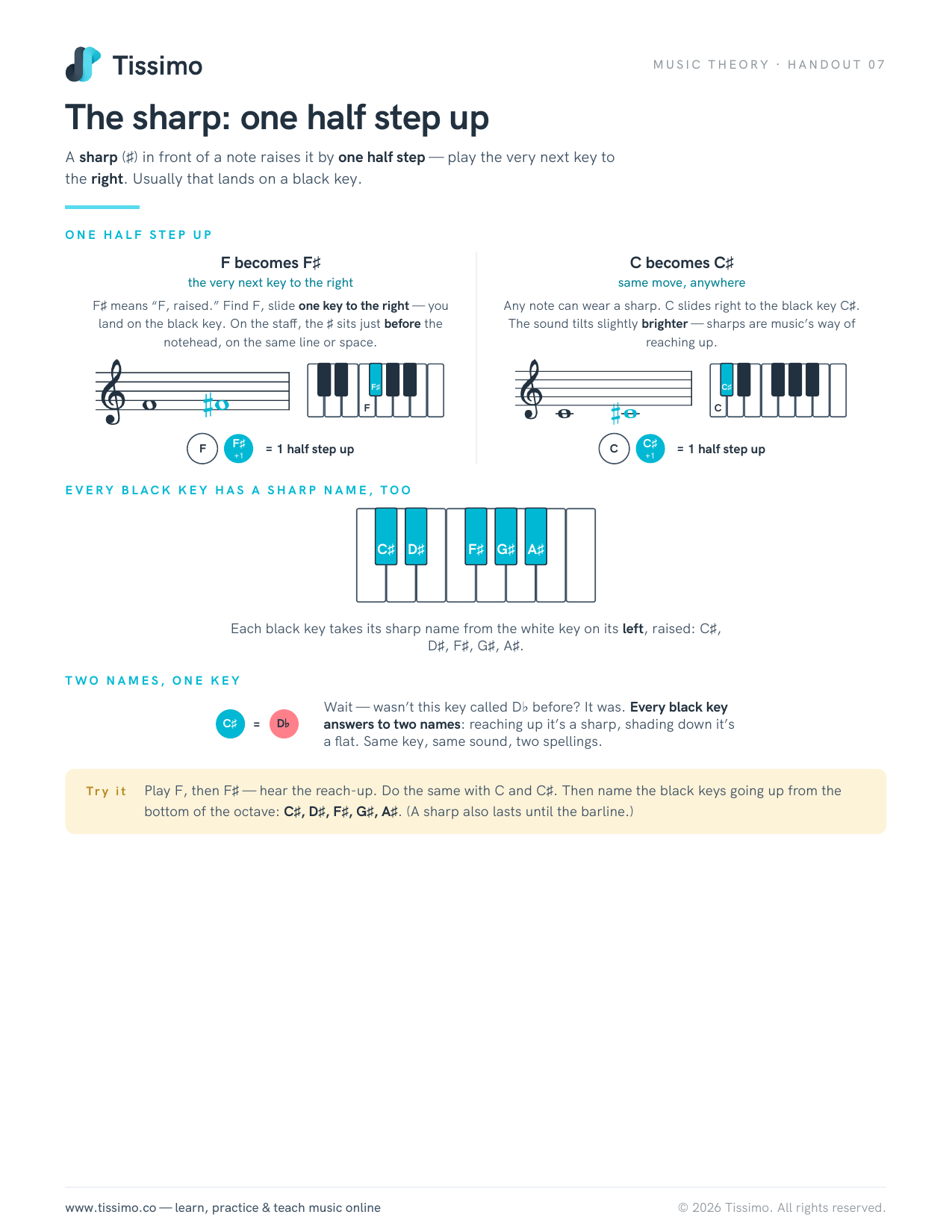 The sharp: one half step upA sharp (♯) in front of a note raises it by one half step (Handout 353) — play the very next key to the right. Usually that lands on a black key.
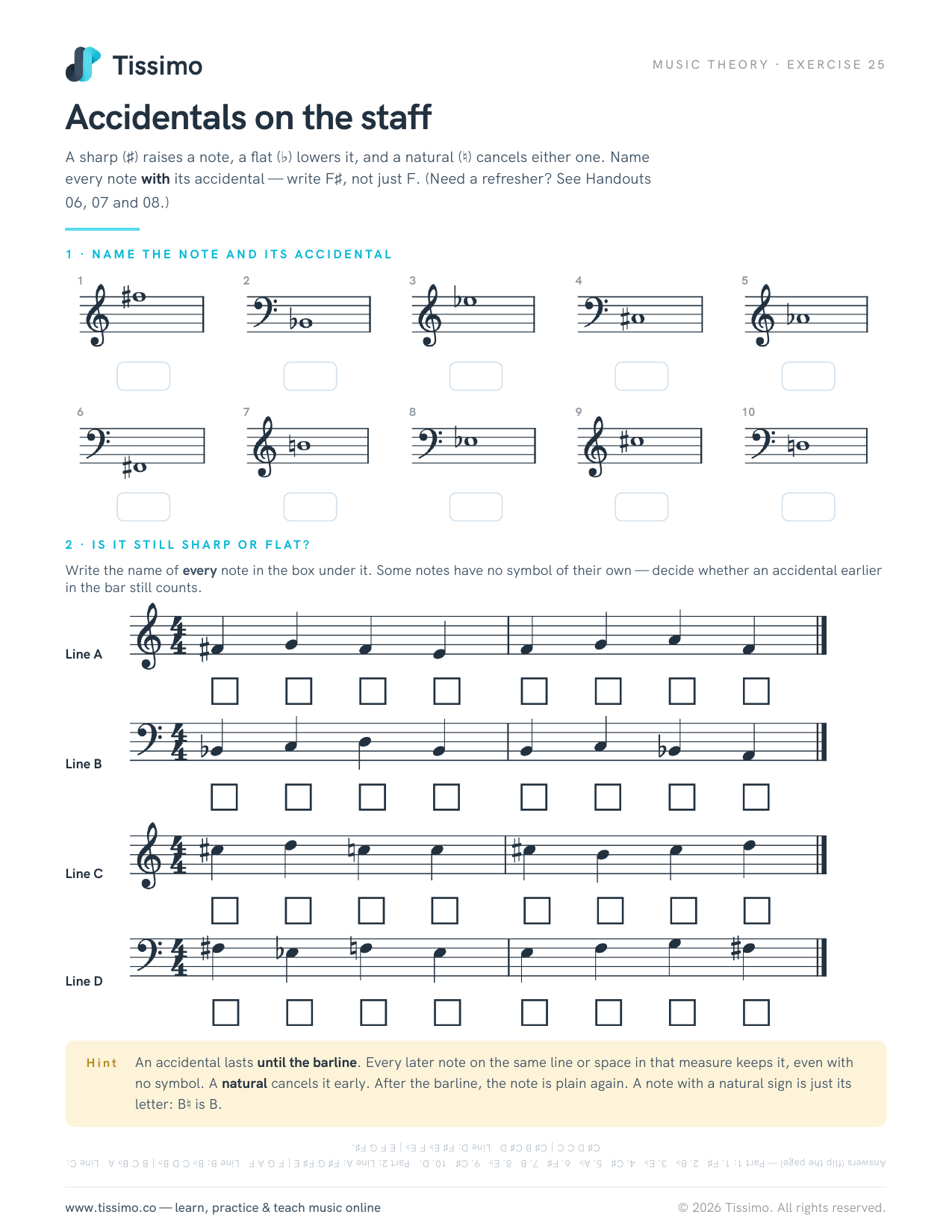 Accidentals on the staffA sharp (♯) raises a note, a flat (♭) lowers it, and a natural (♮) cancels either one. Name every note with its accidental — write F♯, not just F. (Need a refresher? See Handouts 06, 07 and 08.)
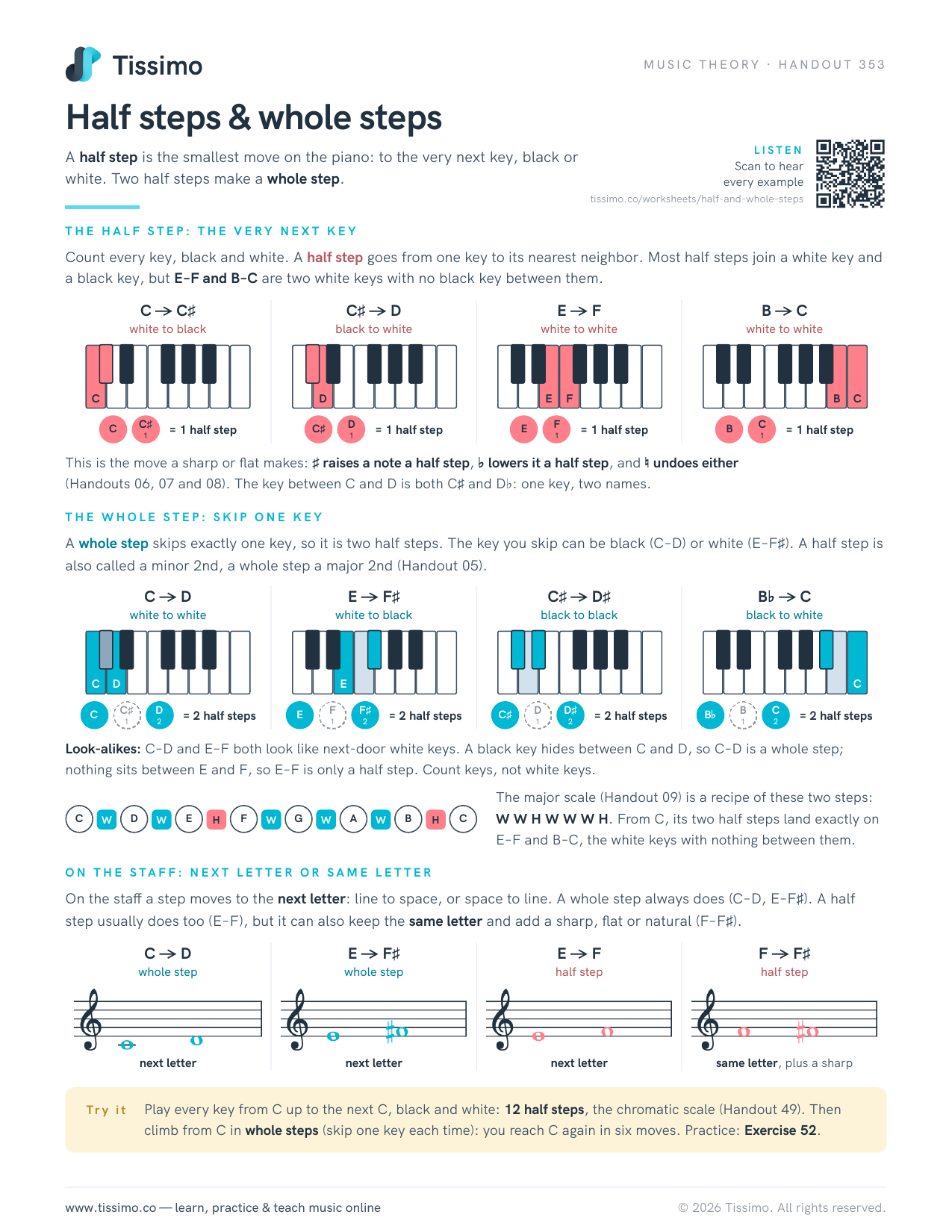 Half steps & whole stepsA half step is the smallest move on the piano: to the very next key, black or white. Two half steps make a whole step.
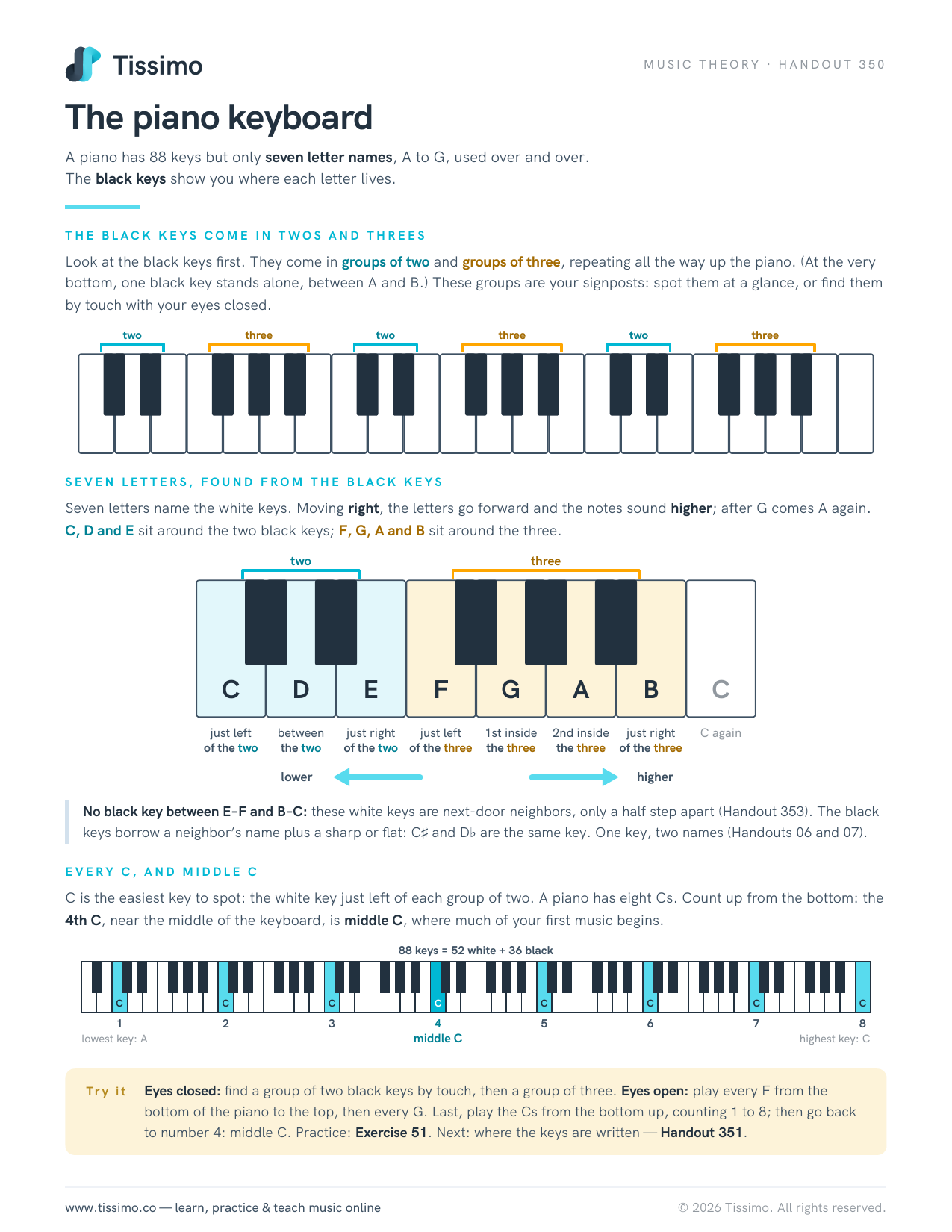 The piano keyboardA piano has 88 keys but only seven letter names, A to G, used over and over. The black keys show you where each letter lives.
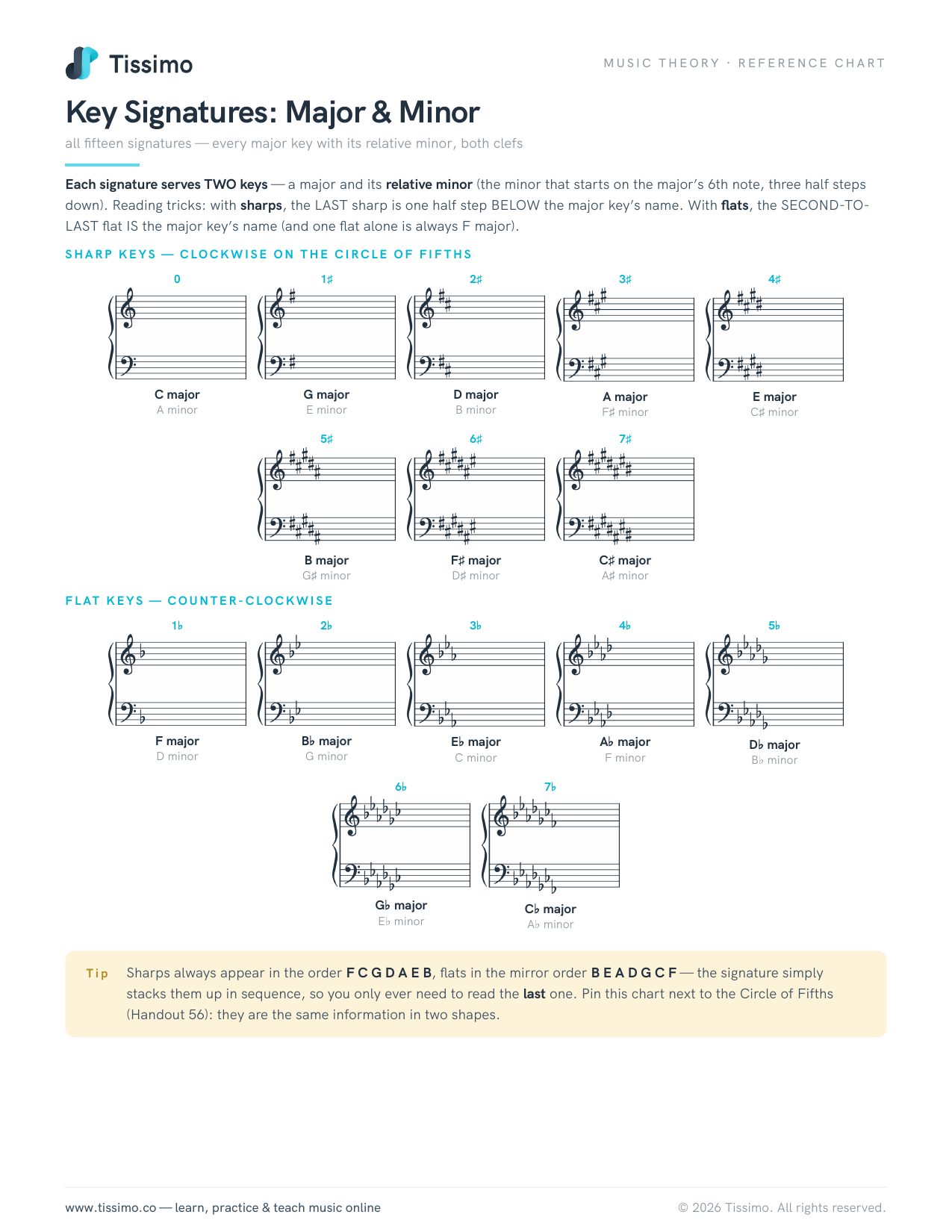 Key Signatures: Major & Minorall fifteen signatures — every major key with its relative minor, both clefs