Scales, Keys & Modes
Tonality
Pronounced toh-NAL-ih-tee
Tonality is the organization of music around a central note, the tonic, so that other notes and chords are heard in relation to it. It underpins the major and minor keys of most Western music since the 1600s.
Tonality is the system that makes one note feel like home. In tonal music, a central note, the tonic, acts as a point of rest, and every other note and chord is heard in relation to it: some lean toward it, some lead away, and the music builds tension by moving away and releases it by coming back.
How tonality works
Two hierarchies work together. The first is a hierarchy of notes: in C major, C is the most stable note, followed by G (the dominant) and E (the mediant), while notes such as B (the leading tone) and F feel unstable and tend to move. The second is a hierarchy of chords: the tonic chord is home, the dominant chord pulls strongly toward it, and the other chords prepare the dominant or extend the tonic. That is what musicians mean by harmonic function.
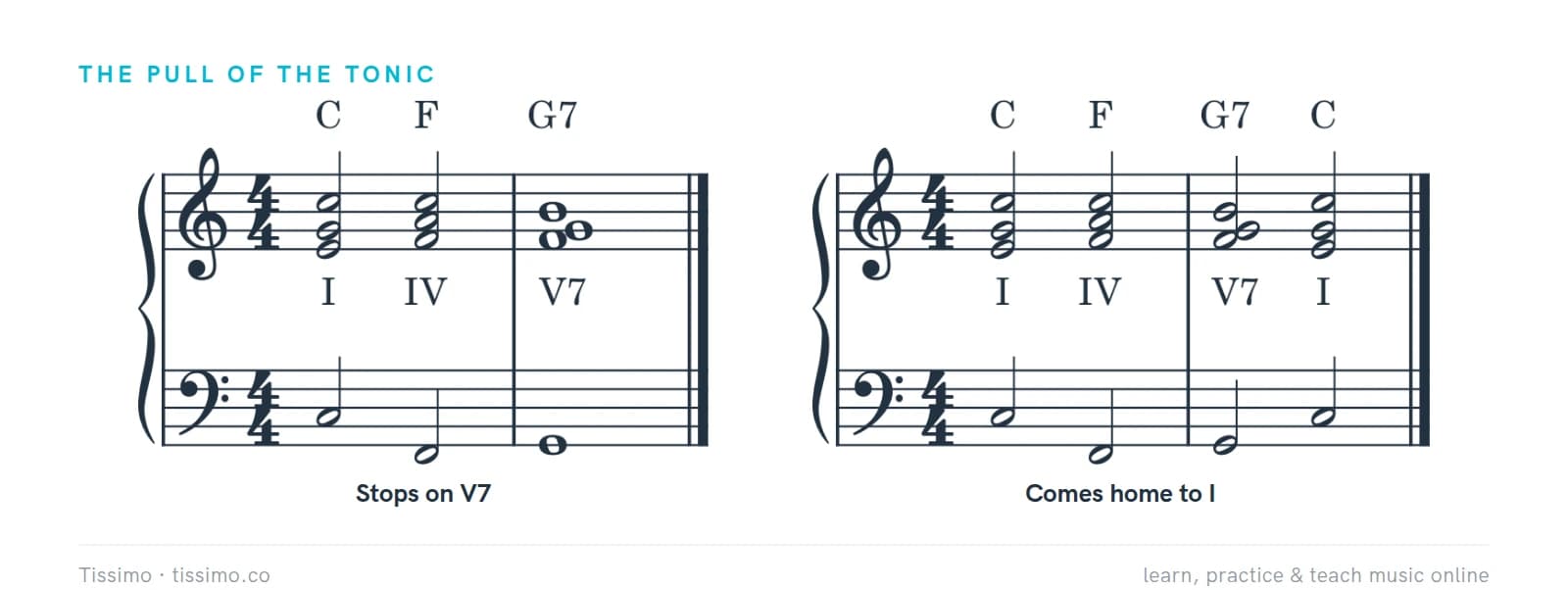
A cadence is where the two hierarchies meet: the dominant chord resolving to the tonic chord tells your ear, without any words, that a phrase has ended.
Major-minor tonality
The tonality of Western classical music from roughly the late 1600s to the late 1800s, often called the common-practice period, is built on two kinds of key, major and minor, and on the dominant–tonic relationship. Composers of that time organized whole pieces around it: a piece establishes its home key, travels to related keys through modulation, and returns home at the end. Most folk, pop, rock, jazz and film music today is tonal too, even when its harmonies are richer.
Tonality and key
People sometimes use tonality simply to mean key: "the tonality of this movement is D minor". In theory, though, tonality is the larger idea, the whole way of organizing music around a center. A piece can be tonal while changing key many times.
Other centers, and no center
Modal music, such as Gregorian chant or a tune in the Dorian mode, also has a home note but organizes its notes differently, without the strong dominant–tonic pull of major and minor keys; some writers call that modality rather than tonality. Music that deliberately avoids any tonal center is atonal, a path a great deal of 20th-century concert music explored.
Common questions
What is the difference between tonality and key?
A key is one specific home, such as C major or A minor. Tonality is the broader system of organizing music around a home note. A tonal piece can pass through many keys; an atonal piece has no key at all.
Is pop music tonal?
Almost all of it is. Pop songs center on a tonic and use major and minor chords that lead back to it, even when they borrow modal colors or skip the classical V–I cadence.
Practice it: free worksheets
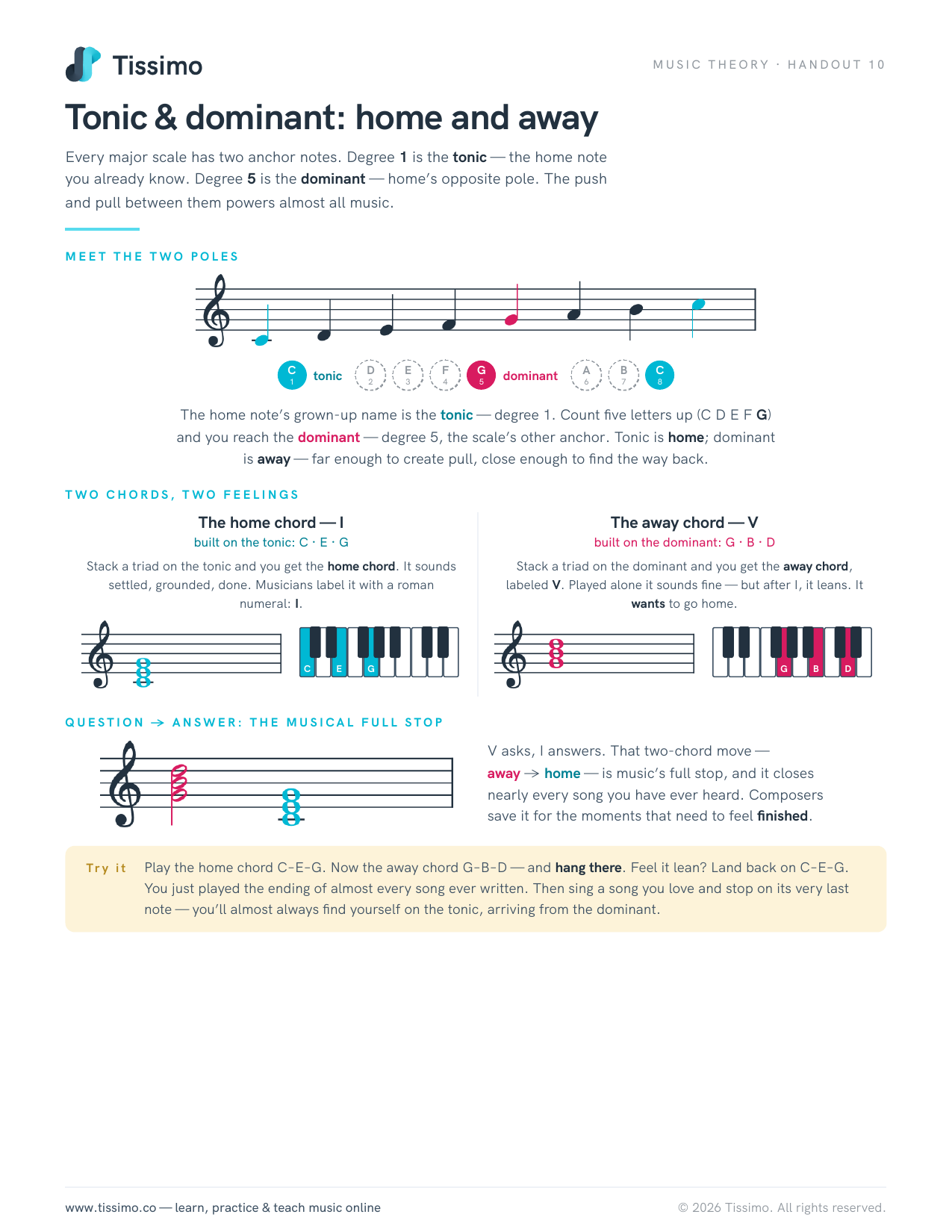 Tonic & dominant: home and awayEvery major scale has two anchor notes. Degree 1 is the tonic — the home note you already know. Degree 5 is the dominant — home’s opposite pole. The push and pull between them powers almost all music.
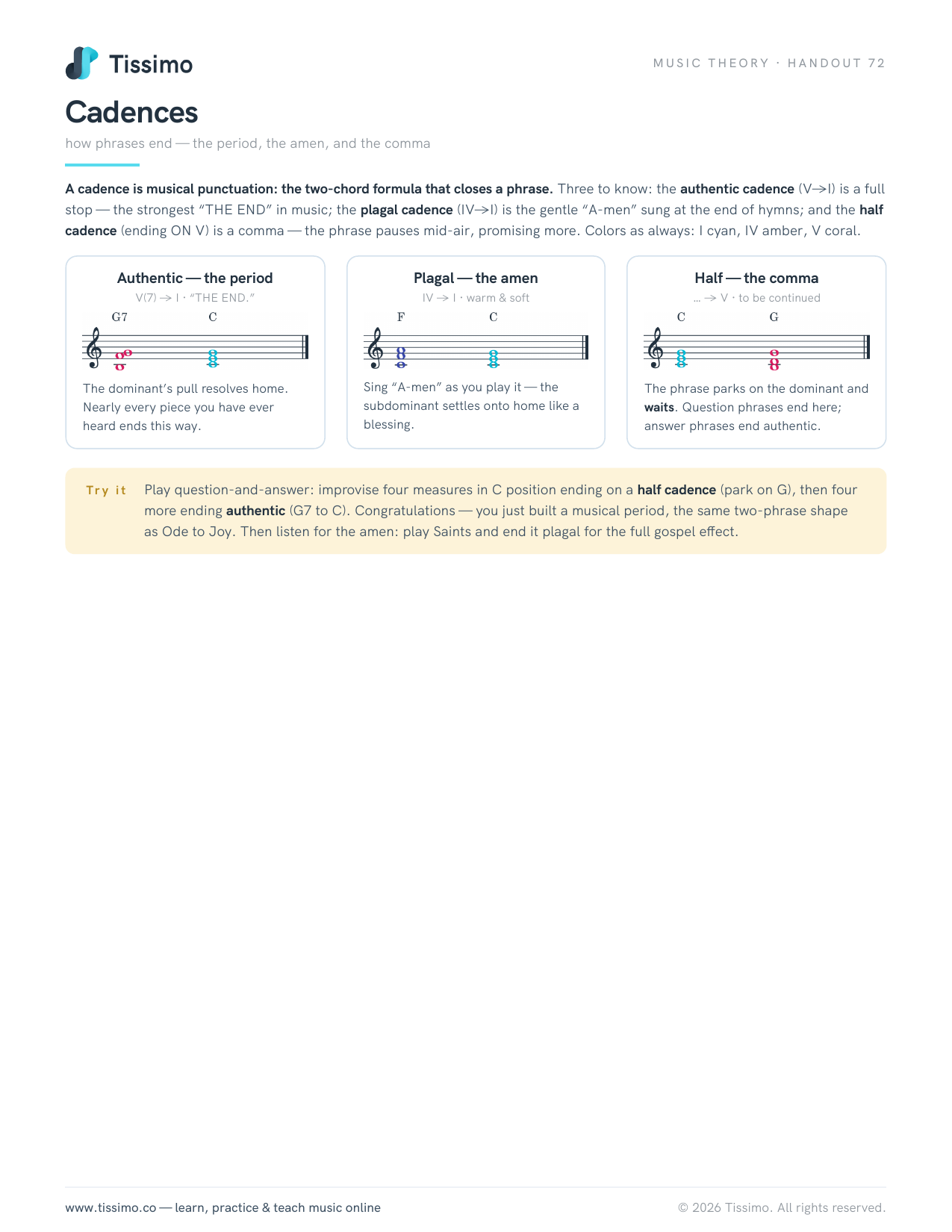 Cadenceshow phrases end — the period, the amen, and the comma
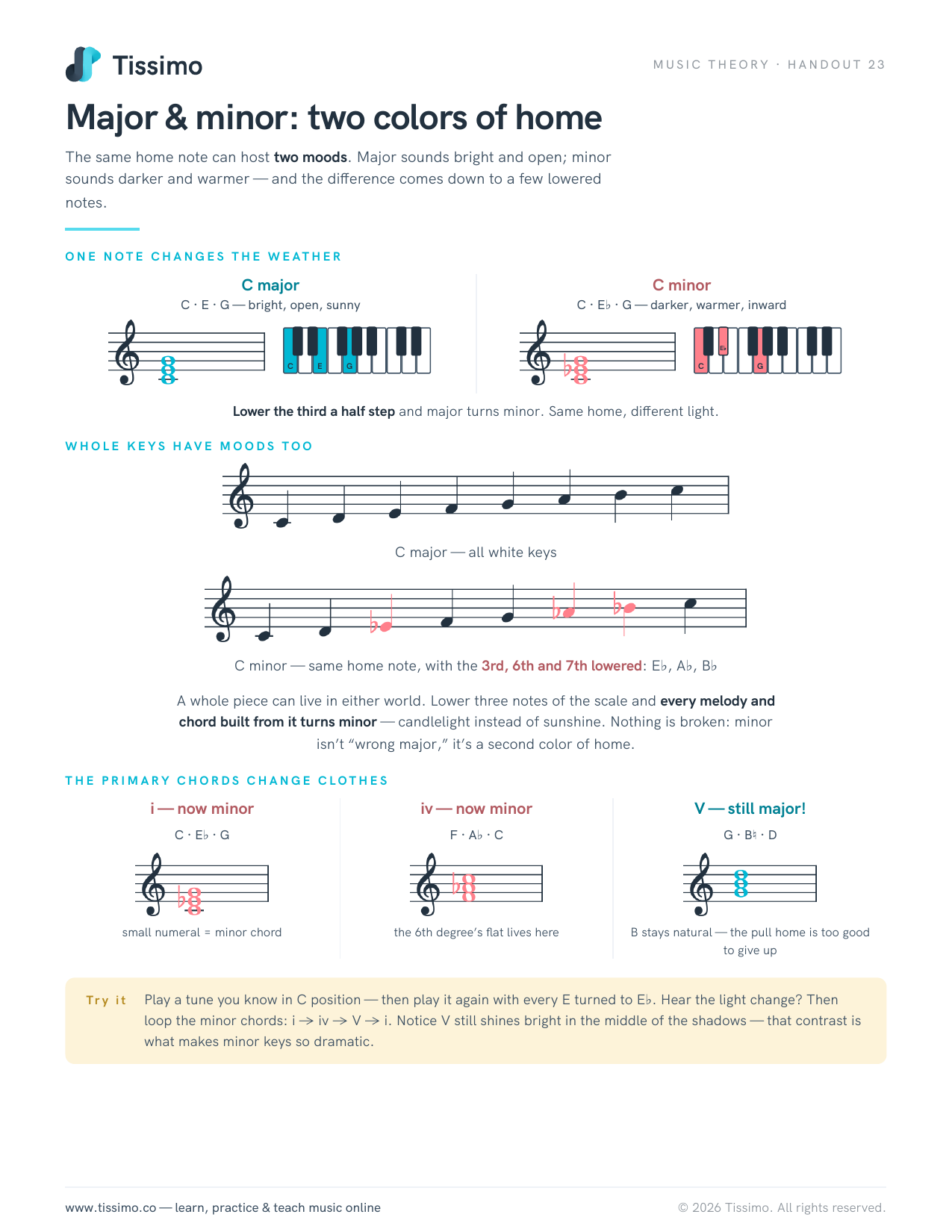 Major & minor: two colors of homeThe same home note can host two moods. Major sounds bright and open; minor sounds darker and warmer — and the difference comes down to a few lowered notes.
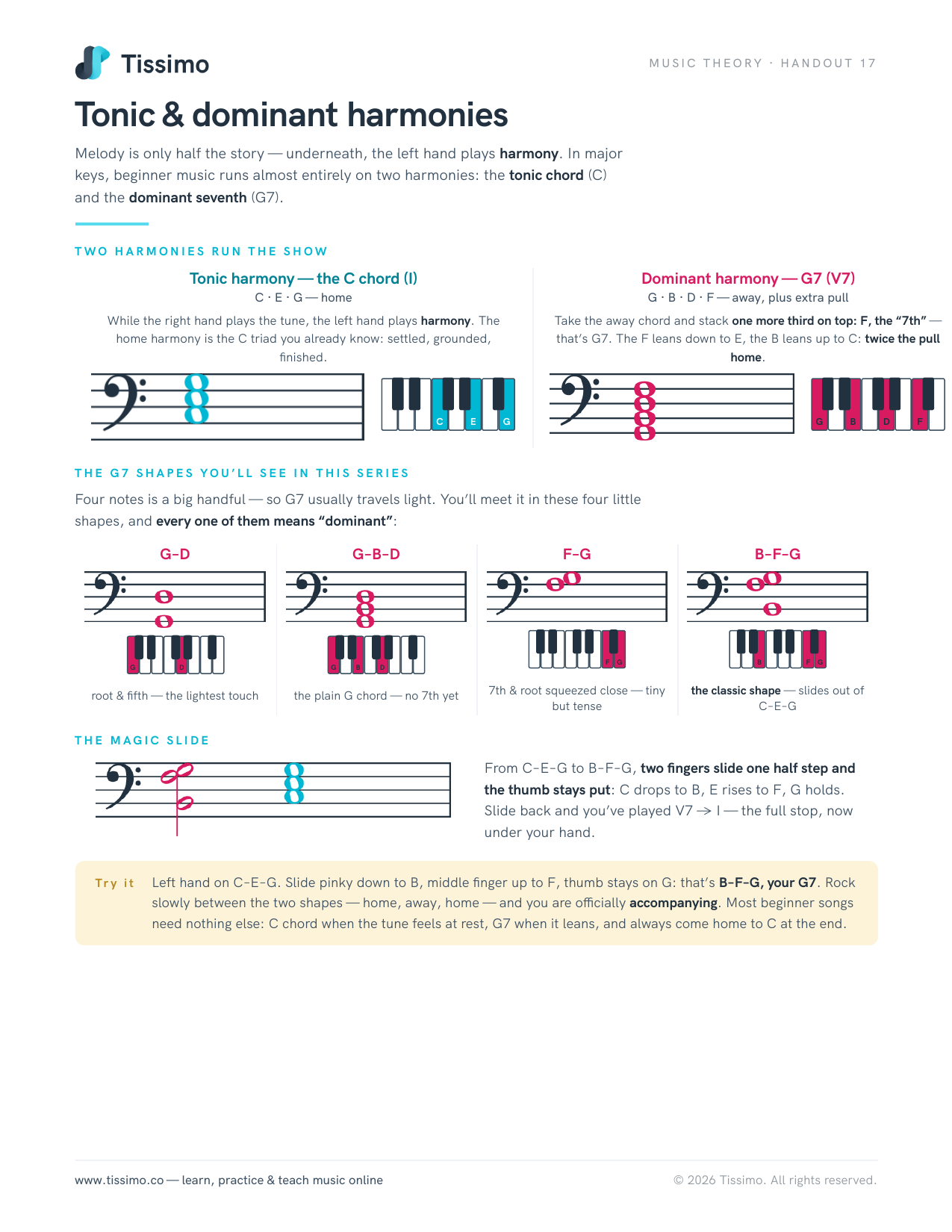 Tonic & dominant harmoniesMelody is only half the story — underneath, the left hand plays harmony. In major keys, beginner music runs almost entirely on two harmonies: the tonic chord (C) and the dominant seventh (G7).
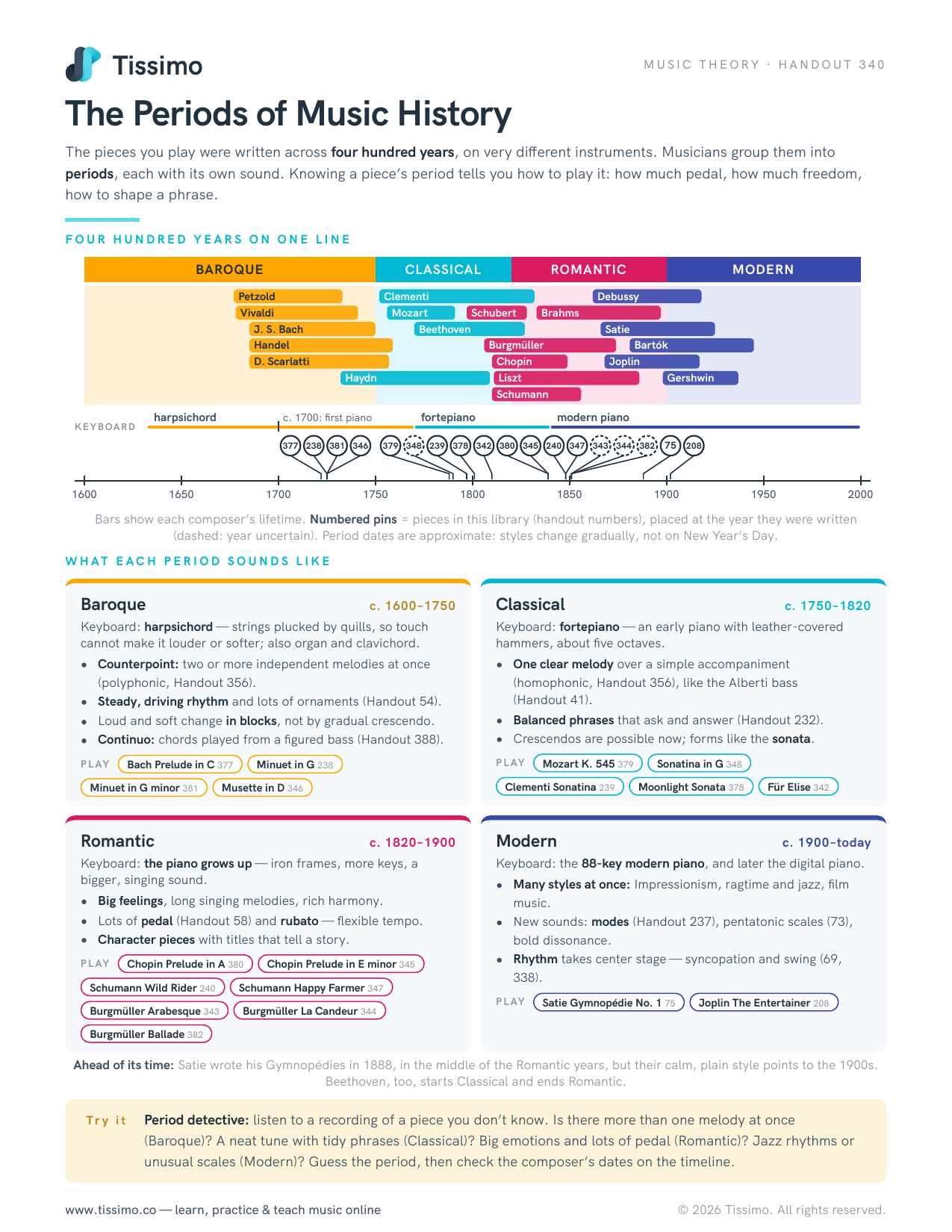 The Periods of Music HistoryThe pieces you play were written across four hundred years, on very different instruments. Musicians group them into periods, each with its own sound. Knowing a piece’s period tells you how to play it: how much pedal, how much freedom, how to shape a phrase.