Chords & Harmony
Four-Part Harmony (SATB)
Four-part harmony is music for four independent voices, soprano, alto, tenor and bass (SATB), that form a chord on each beat. It is the texture of hymns and chorales, and the classic way to study harmony.
Four-part harmony is music written for four voices: soprano, alto, tenor and bass, usually shortened to SATB. Each voice sings its own line, and on every beat the four notes together make a chord. Hymns and chorales are written this way, and harmony courses use it as their main exercise, because it shows both the chords and the way each line moves from one chord to the next.
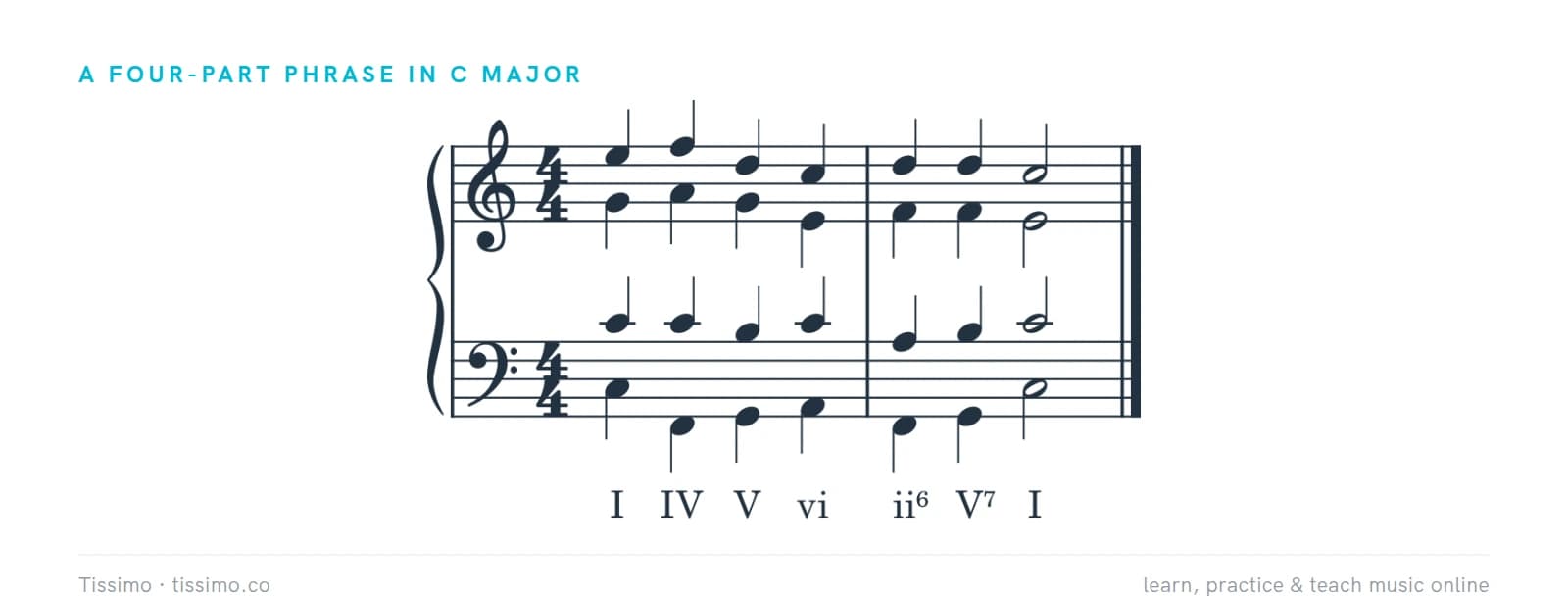
On the page
Four-part harmony is usually written on a grand staff. Soprano and alto share the treble staff (soprano stems up, alto stems down); tenor and bass share the bass staff (tenor stems up, bass stems down). Each voice keeps to a comfortable singing range. Textbooks differ by a step or two, but roughly: soprano C4–G5, alto G3–D5, tenor C3–G4, bass E2–D4.
Building each chord
A triad has three notes, so one of them has to be doubled for four voices:
- In a root-position triad, the root is usually the note to double.
- Don't double the leading tone, since both copies would want to rise to the tonic.
- In a seventh chord all four notes can be present, so nothing needs doubling. A chord can also leave out its fifth and double the root instead.
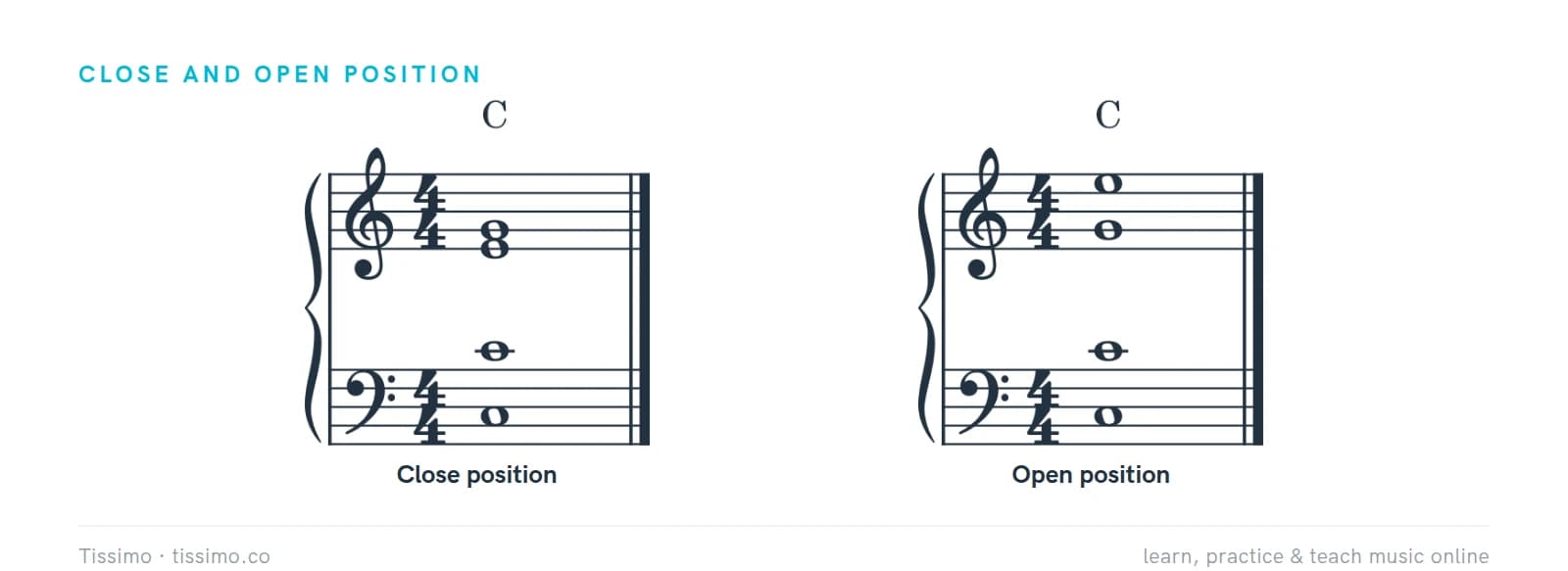
Keep the upper voices close: soprano and alto, and alto and tenor, no more than an octave apart. When the soprano, alto and tenor fit within an octave the chord is in close position; when they spread wider it is in open position.
Moving from chord to chord
The voice leading principles apply to every pair of chords: hold common tones, move the other voices by step where you can, resolve the leading tone up and chord sevenths down, and avoid parallel fifths and octaves. Moving the bass and soprano in contrary motion makes the outer voices sound especially strong.
Why it is worth learning
Bach's four-part chorales have served as models for generations of students. Even if you never write a hymn, four-part writing trains you to hear harmony as moving lines, which helps with arranging for choir or band, writing piano accompaniments and reading figured bass.
Practice with Four-part harmony, then test yourself with Find the voice-leading errors.
Common questions
What does SATB stand for?
Soprano, alto, tenor and bass: the four standard voice parts of a choir, from highest to lowest. A score marked SATB has one line for each.
Which note do you double in four-part harmony?
In a root-position triad, usually the root. Avoid doubling the leading tone or a chord's seventh.
Practice it: free worksheets
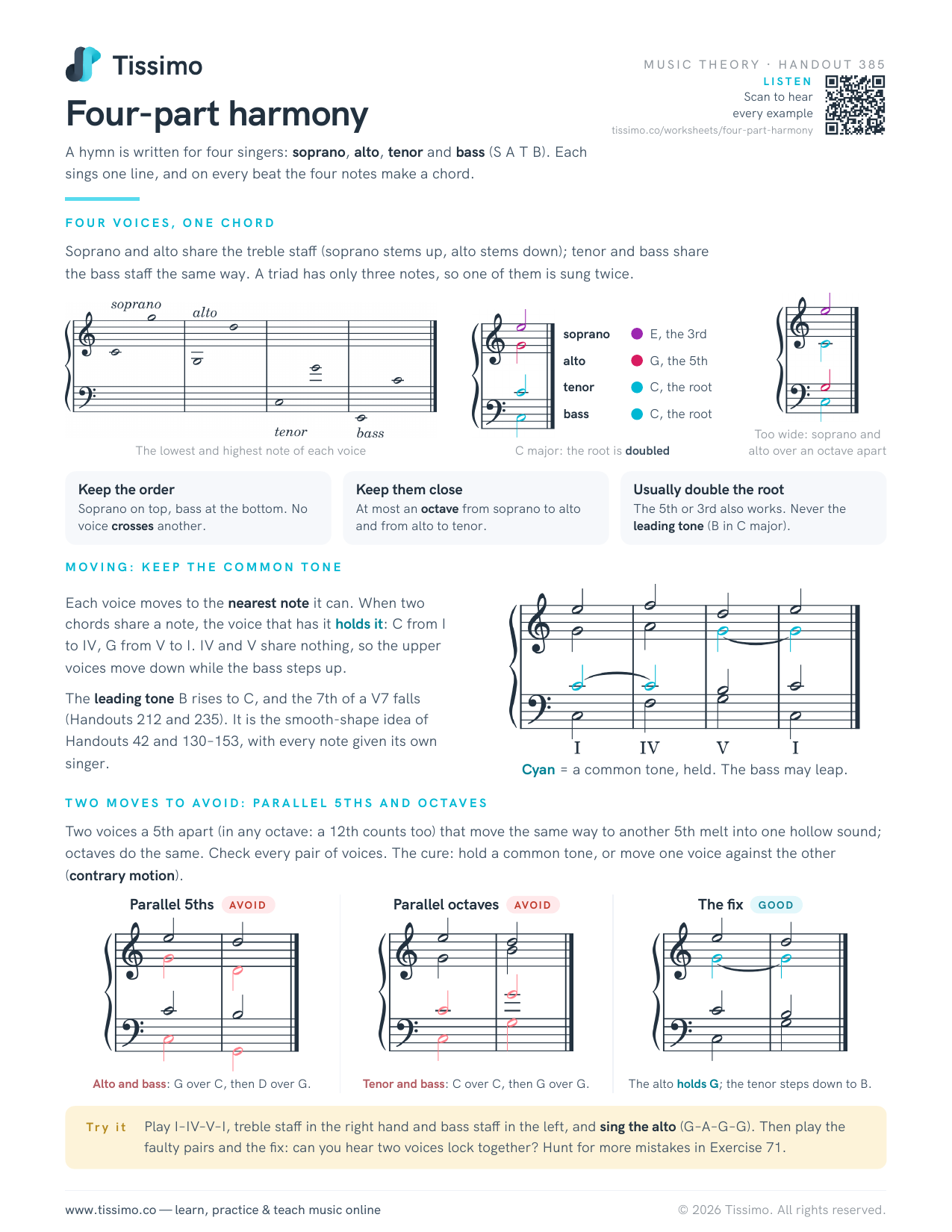 Four-part harmonyA hymn is written for four singers: soprano, alto, tenor and bass (S A T B). Each sings one line, and on every beat the four notes make a chord.
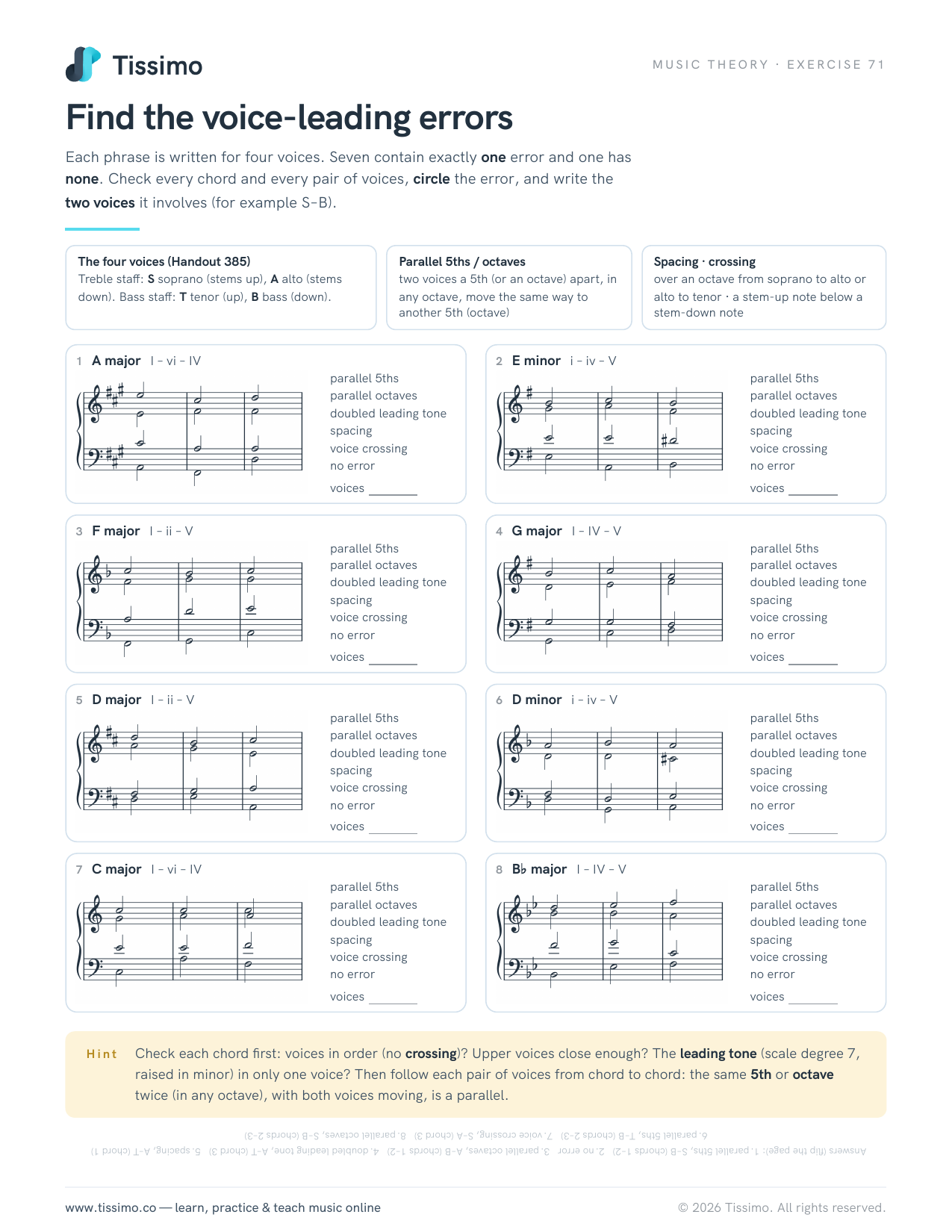 Find the voice-leading errorsEach phrase is written for four voices. Seven contain exactly one error and one has none. Check every chord and every pair of voices, circle the error, and write the two voices it involves (for example S–B).
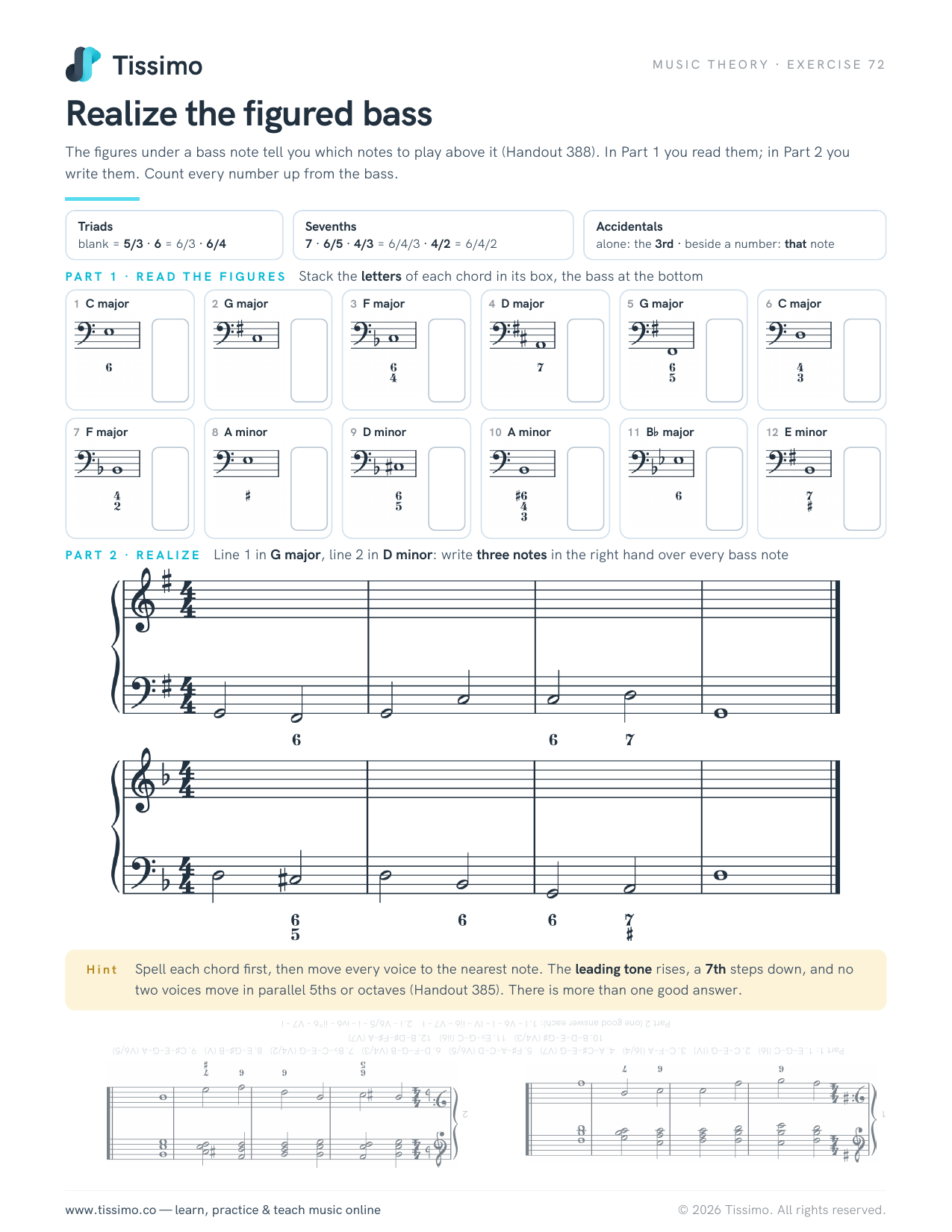 Realize the figured bassThe figures under a bass note tell you which notes to play above it (Handout 388). In Part 1 you read them; in Part 2 you write them. Count every number up from the bass.
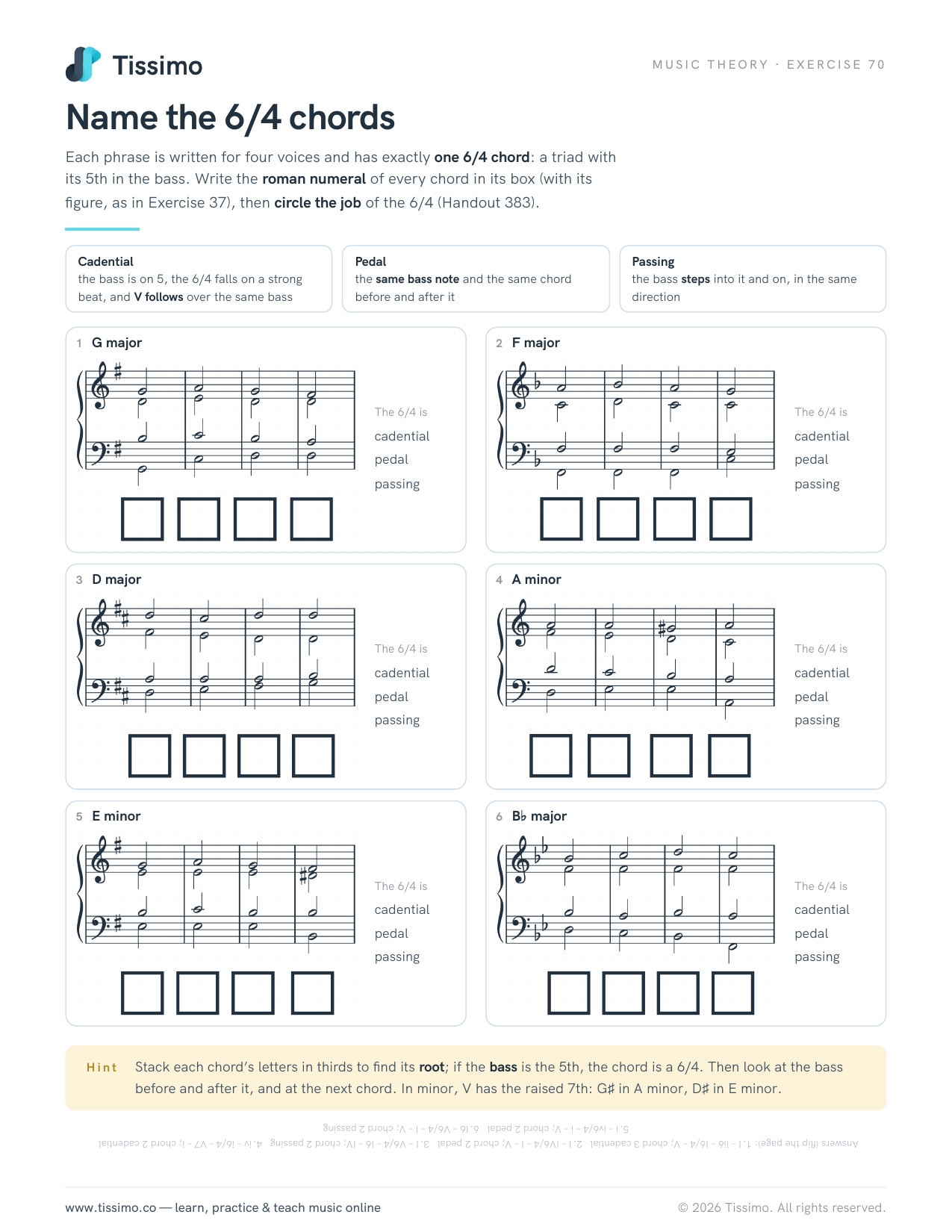 Name the 6/4 chordsEach phrase is written for four voices and has exactly one 6/4 chord: a triad with its 5th in the bass. Write the roman numeral of every chord in its box (with its figure, as in Exercise 37), then circle the job of the 6/4 (Handout 383).
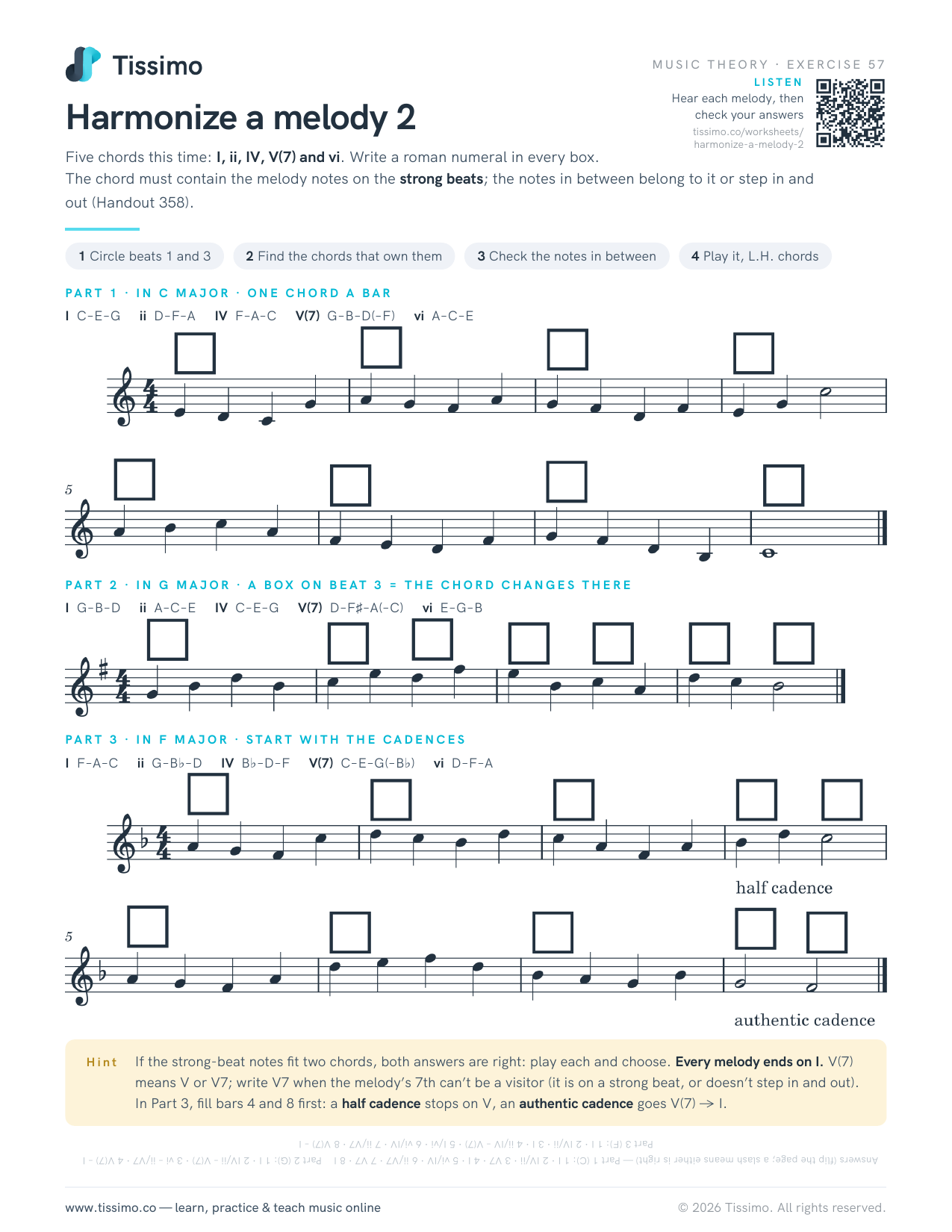 Harmonize a melody 2Five chords this time: I, ii, IV, V(7) and vi. Write a roman numeral in every box. The chord must contain the melody notes on the strong beats; the notes in between belong to it or step in and out (Handout 358).