Scales, Keys & Modes
Chromaticism
Pronounced kroh-MAT-ih-siz-um
Chromaticism is the use of notes from outside the key's scale, such as F♯ or B♭ in C major, in a melody or in its chords. It adds color and tension while the music stays in its key.
Chromaticism is the use of notes that lie outside the key you are in. In C major the diatonic notes are the seven white keys, C D E F G A B. The other five notes, the black keys C♯/D♭, D♯/E♭, F♯/G♭, G♯/A♭ and A♯/B♭, are chromatic in that key. A piece can stay firmly in C major and still use them: chromatic notes color the music and add tension without changing its home.
The word comes from the Greek chroma, color, the same root as the chromatic scale.
Chromatic notes in a melody
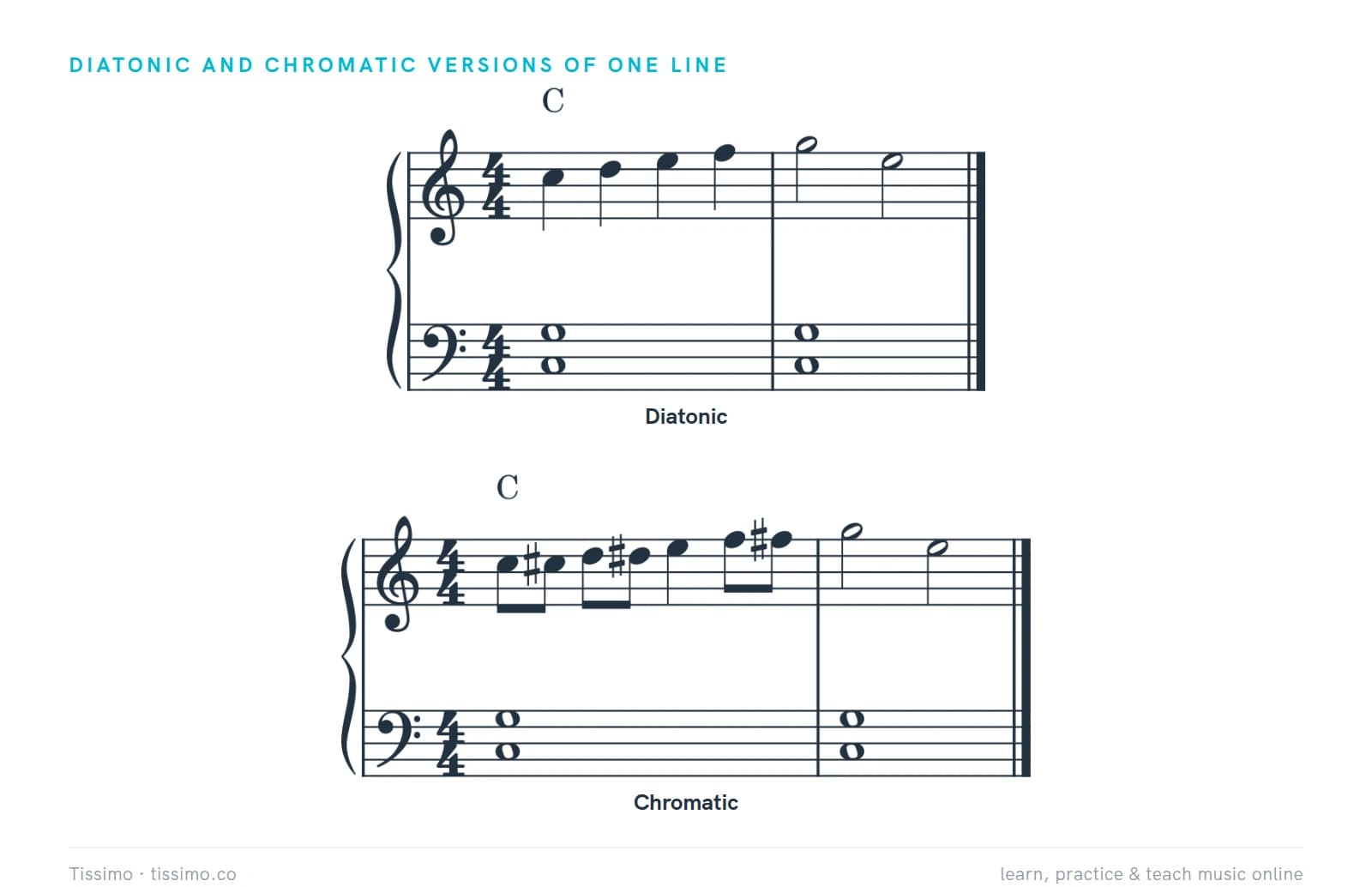
The simplest chromatic notes fill a gap. A chromatic passing tone splits a whole step into two half steps: D–D♯–E, or F–F♯–G. It belongs neither to the chord nor to the key, but the ear hears it as a step on the way somewhere, so it sounds smooth rather than wrong. Neighbor tones can be chromatic too, as when a melody steps from G down to F♯ and straight back to G. Both are non-chord tones: see passing tone and neighbor tone.
Chromatic chords
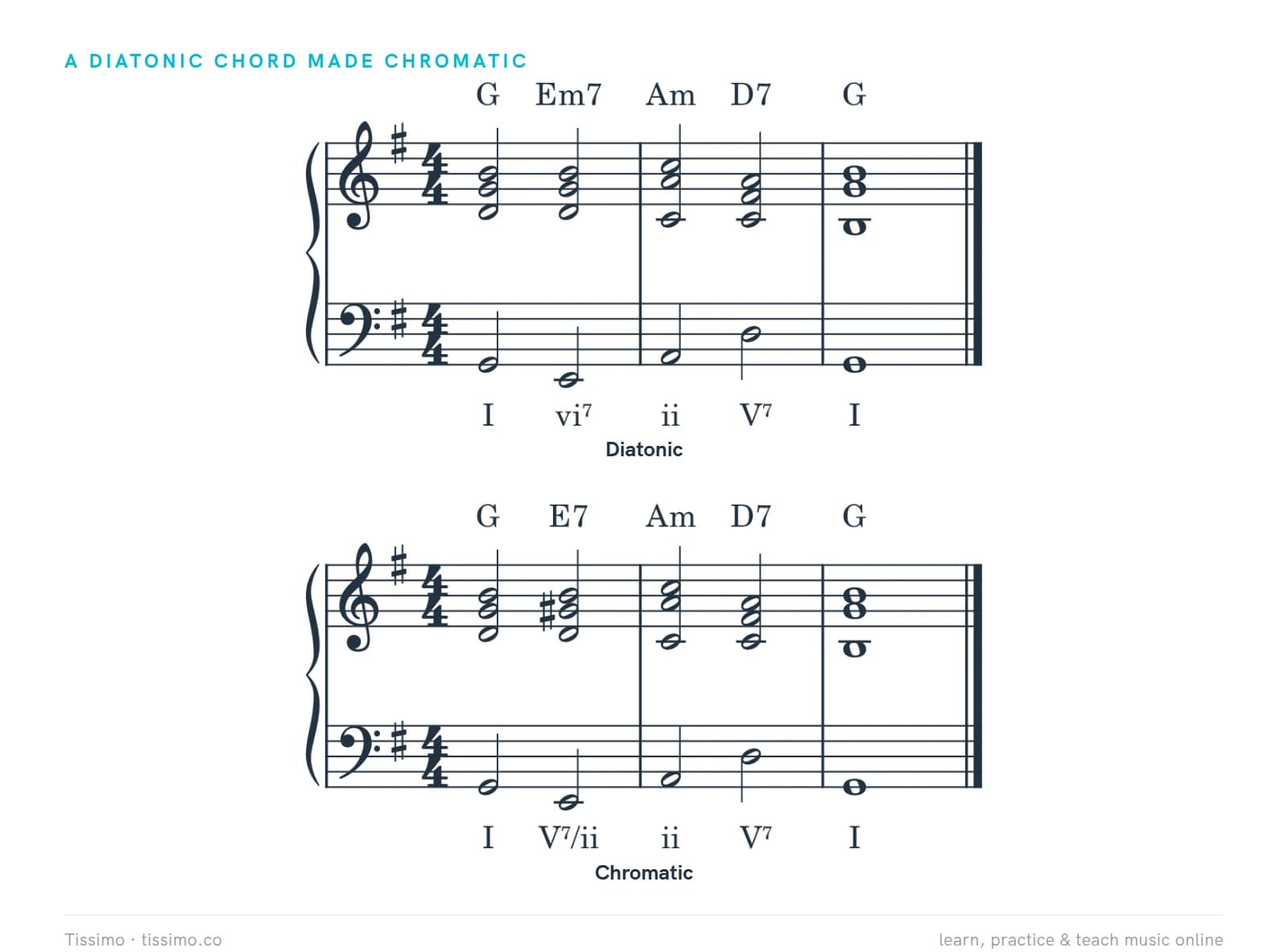
Chromatic notes can also change a chord. A chromatic chord contains at least one note from outside the key. The main families are:
- Secondary dominants, which borrow a dominant for another chord of the key: E7, with its G♯, leading to A minor in G major.
- Secondary diminished chords, built a half step below the chord they lead to.
- Mode mixture, or borrowed chords, taken from the parallel minor: F minor, with its A♭, in C major.
- The Neapolitan sixth and the augmented sixth chords, which color the approach to a cadence.
Practice naming them in Label the chromatic chords, and find secondary dominants in Secondary dominants and Spot the secondary dominants.
A matter of degree
Some music uses no chromatic notes at all; much tonal music uses a few for color. Gesualdo was already writing advanced chromatic music around 1600, and Bach's chromatic writing stays anchored in the key. Composers of the Romantic era pushed chromatic harmony much further for its expressive power; Wagner's opera Tristan und Isolde is the classic example. In the early 20th century some composers left the key behind altogether, and music without a tonal center is atonal.
Accidentals, keys and the chromatic scale
Three confusions are common:
- Not every accidental is chromatic. In a minor key the raised sixth and seventh degrees, F♯ and G♯ in A minor, are printed as accidentals but count as part of the key.
- A chromatic note does not by itself change the key. One that keeps coming back and is confirmed by a cadence may signal a modulation instead.
- Chromaticism is not the chromatic scale. The chromatic scale runs through all twelve notes in half steps; a single F♯ in a C major tune is already chromatic. You can practice the full scale in The Chromatic Scale.
Common questions
What is the difference between chromatic and diatonic?
Diatonic notes and chords belong to the key's scale; chromatic ones come from outside it. In C major, F is diatonic and F♯ is chromatic. Most tonal music is mainly diatonic, with chromatic notes for color.
Does chromatic music have no key?
No. Chromatic notes usually decorate a key that stays clear, as a secondary dominant does. Music that abandons a tonal center altogether is called atonal.
Practice it: free worksheets
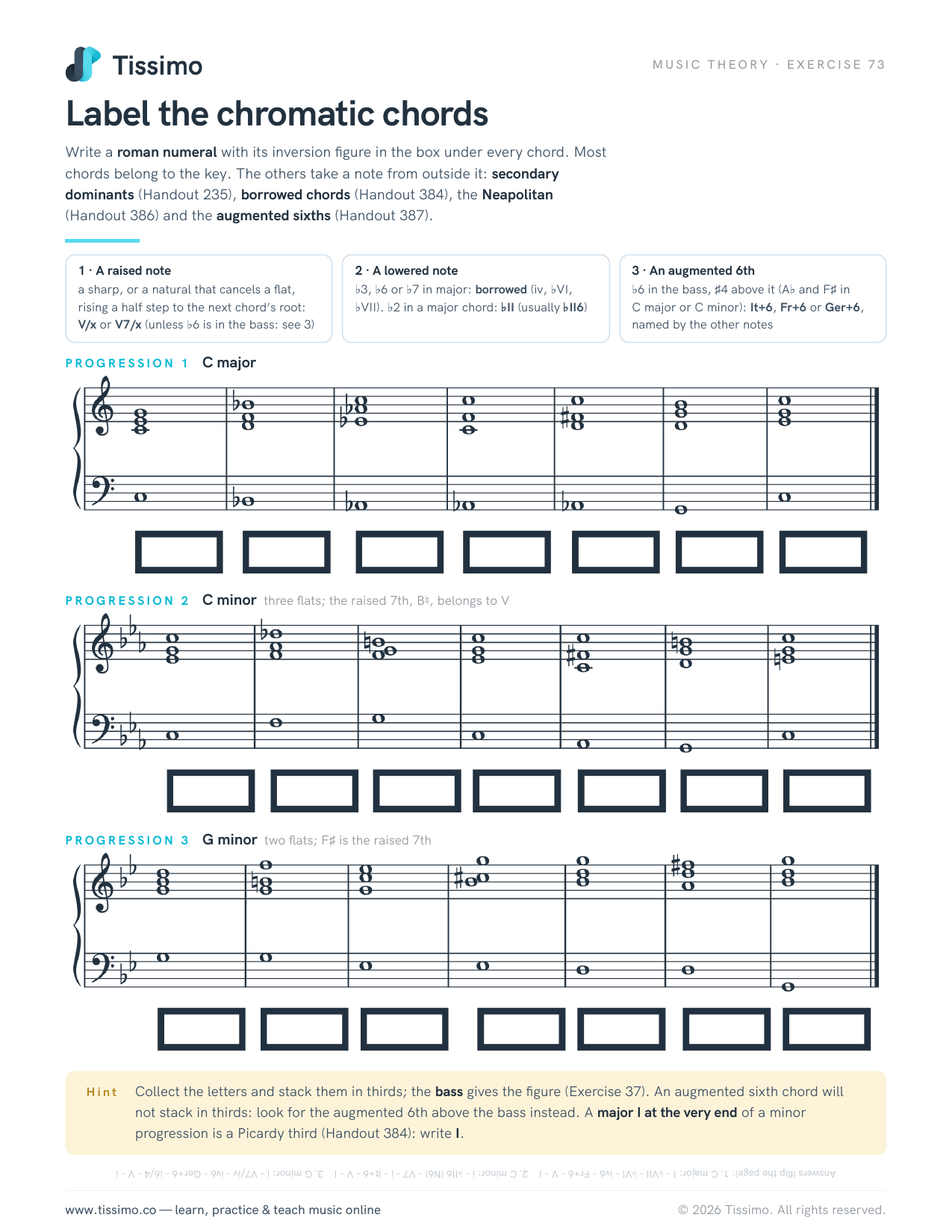 Label the chromatic chordsWrite a roman numeral with its inversion figure in the box under every chord. Most chords belong to the key. The others take a note from outside it: secondary dominants (Handout 235), borrowed chords (Handout 384), the Neapolitan (Handout 386) and the augmented sixths (Handout 387).
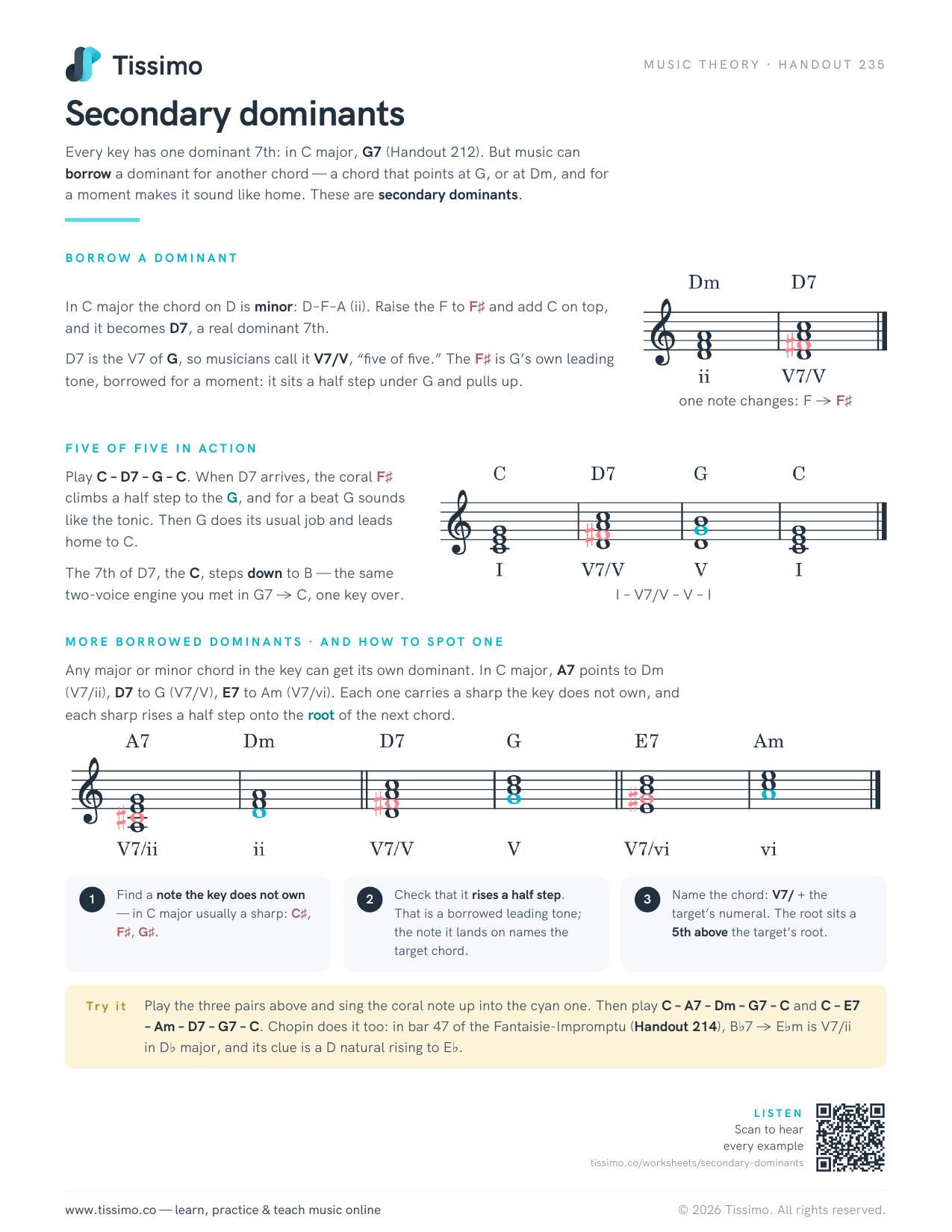 Secondary dominantsEvery key has one dominant 7th: in C major, G7 (Handout 212). But music can borrow a dominant for another chord — a chord that points at G, or at Dm, and for a moment makes it sound like home. These are secondary dominants. (Borrowing a chord from the parallel minor is different: Handout 384.)
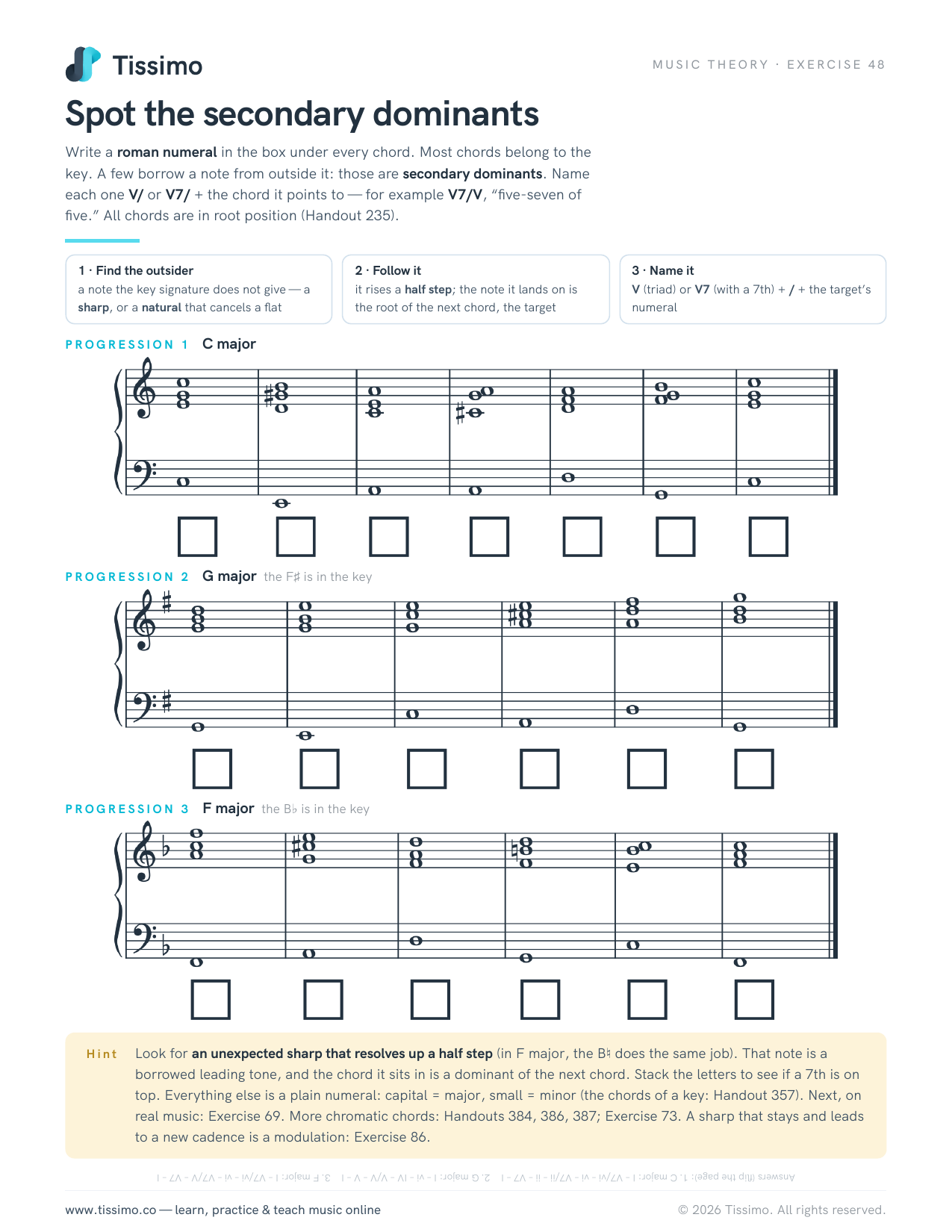 Spot the secondary dominantsWrite a roman numeral in the box under every chord. Most chords belong to the key. A few borrow a note from outside it: those are secondary dominants. Name each one V/ or V7/ + the chord it points to — for example V7/V, “five-seven of five.” All chords are in root position (Handout 235).
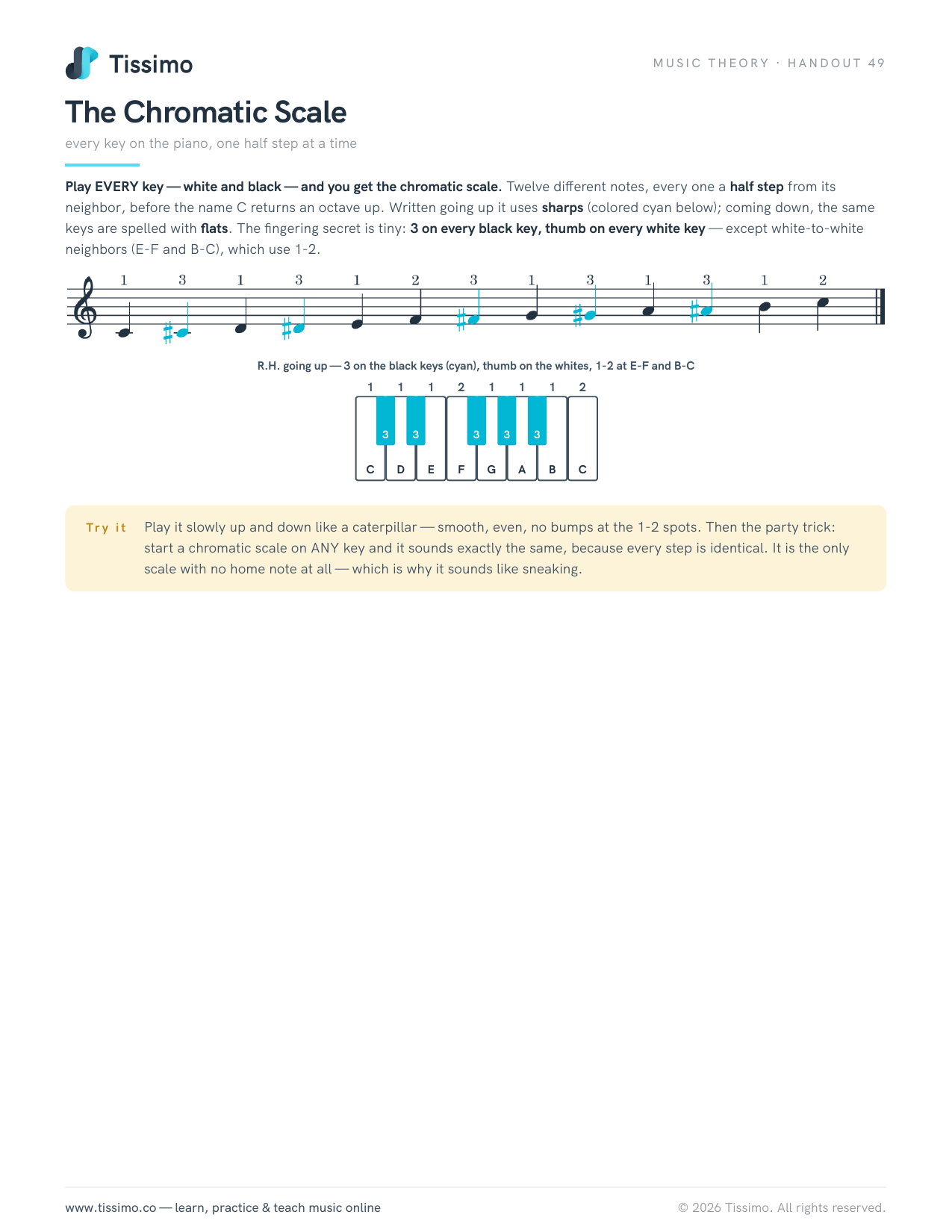 The Chromatic Scaleevery key on the piano, one half step at a time
Comments