Instruments & Voices
Viola da Gamba (Viol)
Pronounced vee-OH-lah dah GAHM-bah
The viola da gamba, or viol, is a bowed string instrument with frets and usually six strings, held upright on or between the legs. Viols were played across Europe in the Renaissance and Baroque, in matched sets called consorts.
The viola da gamba, or viol (it rhymes with "smile"), is a bowed string instrument with frets, usually six strings, held upright on or between the legs. Gamba is Italian for "leg": the name means "viol for the leg", as opposed to the viola da braccio, "viol for the arm", the old name of the violin family. Viols came in a family of sizes and were played across Europe in the Renaissance and Baroque eras.
Not a cello
The bass viol is about the size of a cello, but the two belong to different families:
- A viol usually has six strings (some basses have seven), tuned in fourths with a major third in the middle. The cello has four strings tuned in fifths.
- A viol has frets of gut tied around the neck, usually seven. The player stops the string just behind a fret, which gives the stopped notes some of the ring of an open string.
- The bow is held underhand, palm up. The strong stroke is the push, the opposite of the violin family's bowing.
- Viols usually have a flat back with a bend near the top, sloping shoulders and C-shaped sound holes.
- The tone is quieter and less focused than the cello's, with a wide, resonant sound that fills a room.
The two families grew up side by side: viols appeared in the 15th century, violins in the 1520s, and neither descends from the other.
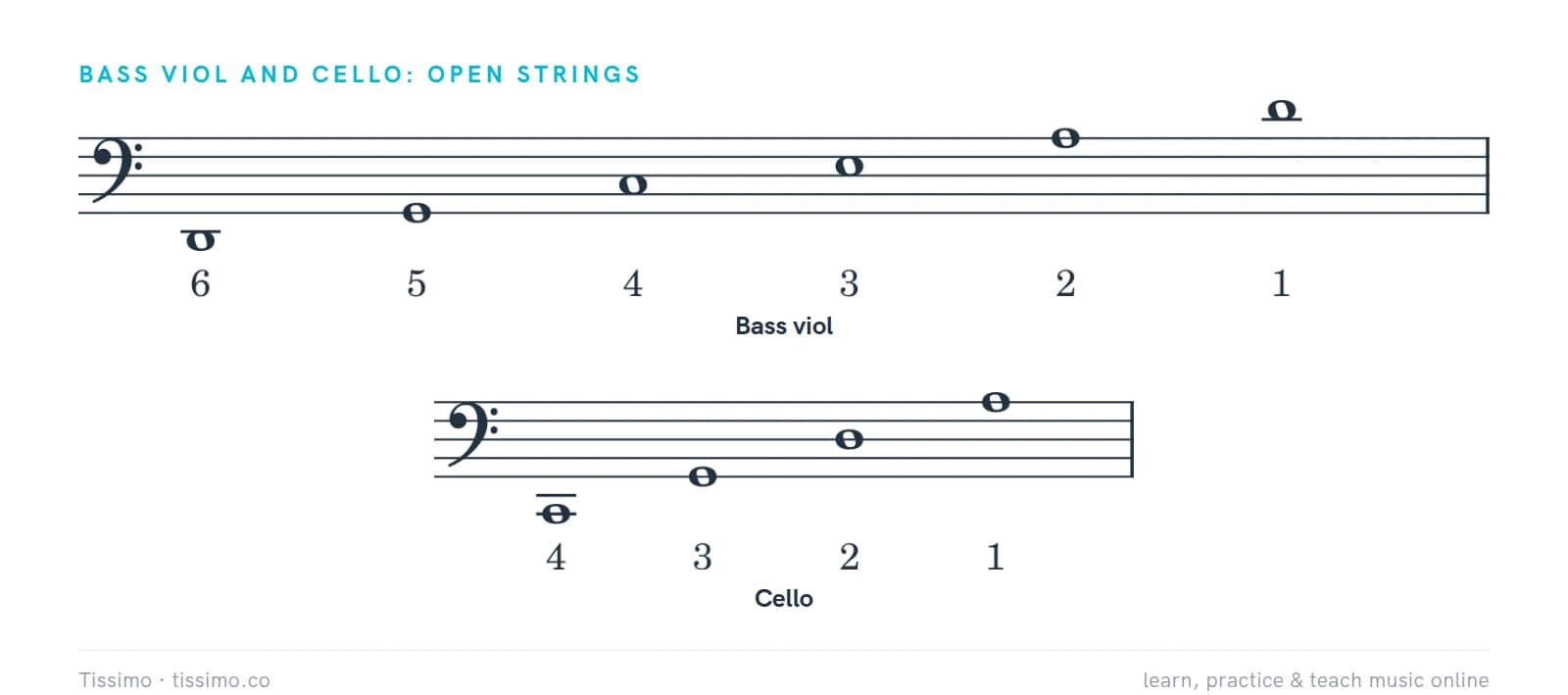
Sizes, tuning and clefs
The three main sizes are treble, tenor and bass, all tuned in the same pattern. The six-string bass is tuned D2, G2, C3, E3, A3 and D4, the treble an octave higher, and the tenor in G (G2 to G4), the same notes as a Renaissance lute. In late 17th-century France a seventh string, the A below the bass's low D, was added to the bass. Viols sound as written. The bass viol reads bass clef, with the alto clef for high passages; the tenor usually reads alto clef, and the treble viol treble clef.
Its music
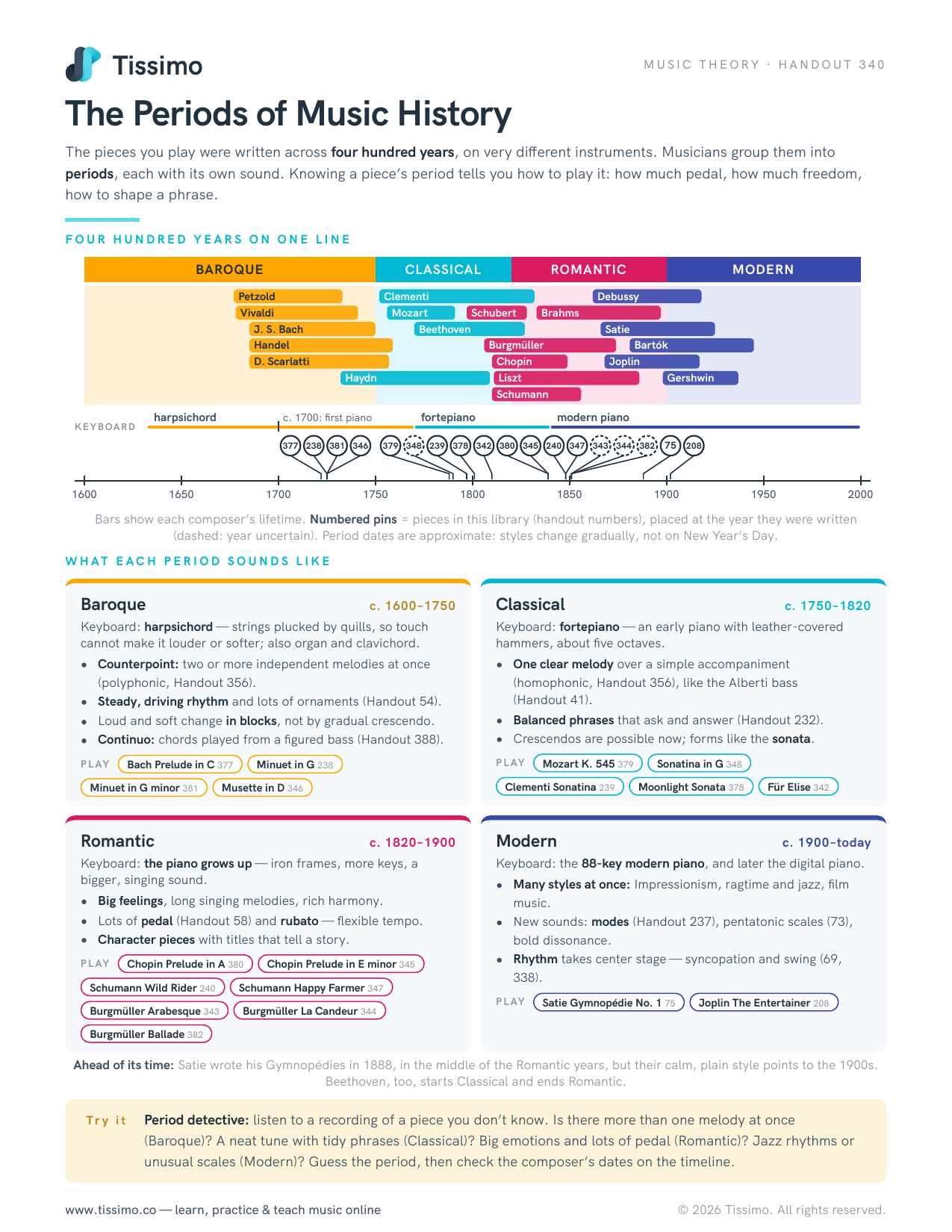
A consort of two to eight viols of different sizes, each playing its own line, was a favorite ensemble from about 1500 to 1680 (see The Periods of Music History); William Byrd, Orlando Gibbons, John Dowland, William Lawes and Henry Purcell all wrote for it. In the Baroque the bass viol also became a solo instrument, especially in France, and played the bass line in basso continuo into the 18th century. The largest viol, the violone, is an ancestor of the double bass. Viols became rare in the 19th century, were revived in the early 20th, and are now played by professionals and amateurs alike.
A common confusion
Despite its name, the viola da gamba is not a kind of viola. In 16th-century Italy the word viola could name an instrument of either family, played da braccio (on the arm) or da gamba (on the leg).
Common questions
What is the difference between a viola da gamba and a cello?
The viol usually has six strings tuned in fourths with a third in the middle, tied-on frets and an underhand bow grip; the cello has four strings tuned in fifths, no frets and an overhand grip. The viol's tone is quieter and more resonant. They are from different families, even though both are held between the legs.
How many strings does a viola da gamba have?
Usually six. Many French bass viols from the late 17th century on have a seventh string, tuned to the A below the low D.
Comments