Instruments & Voices
Fret (Fretboard)
A fret is one of the thin metal strips across the neck of a guitar, bass or ukulele. Pressing a string just behind a fret sets the note; on a guitar each fret up raises the pitch by one half step.
Frets are the thin strips, usually of metal wire, set across the neck of a guitar, bass guitar, ukulele, banjo or mandolin. The fingerboard that holds them is the fretboard. When you press a string down just behind a fret, the string rests on that fret, and the fret becomes the end of the vibrating part of the string. A shorter string sounds higher, so each fret gives a different note.
One fret, one half step
On most guitars the frets are placed for equal temperament, which divides the octave into twelve equal half steps. Each fret raises the pitch of a string by one half step, two frets by a whole step. Twelve frets up, at the halfway point of the string, you reach the octave of the open string. Because every step shortens the string by the same fraction, the frets get closer together as you move up the neck.
Frets are counted from the end of the neck where the strings start, the nut: an open string is fret 0, and the first fret is the one nearest the nut. Many guitars mark some frets with dots or other inlays, most often frets 3, 5, 7, 9 and 12, with a more prominent marker at the 12th.
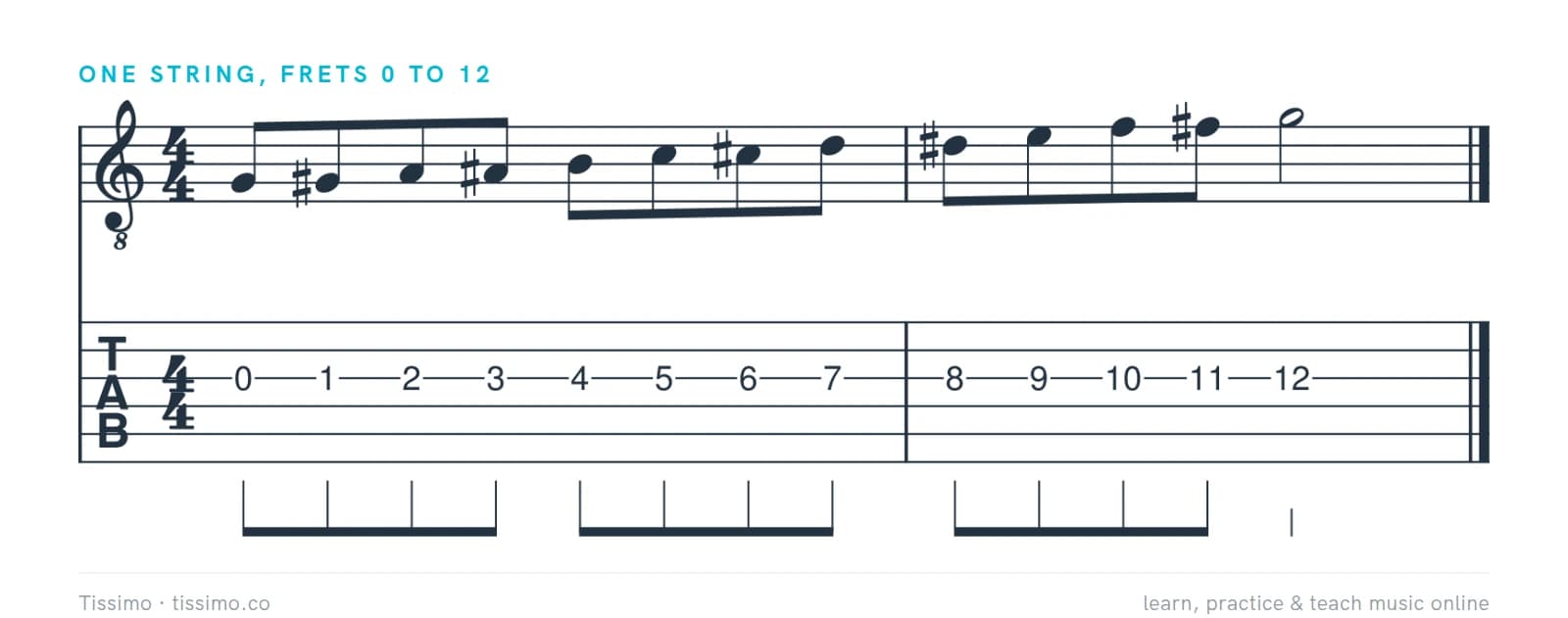
Fret numbers on the page
In tablature, every number is a fret: 0 is the open string, 3 the third fret. Chord diagrams show the same thing as dots on a grid. Practice reading fret numbers in One Guitar Phrase, Two Notations and TAB Detective.
The same note in several places
The strings overlap in pitch, so many notes can be played in two or three places. In standard tuning, the fifth fret of each string gives the same pitch as the next higher open string, except on the G string, where the fourth fret gives B. Guitarists use these pairs to tune by ear, and the bass guitar works the same way with its four strings.
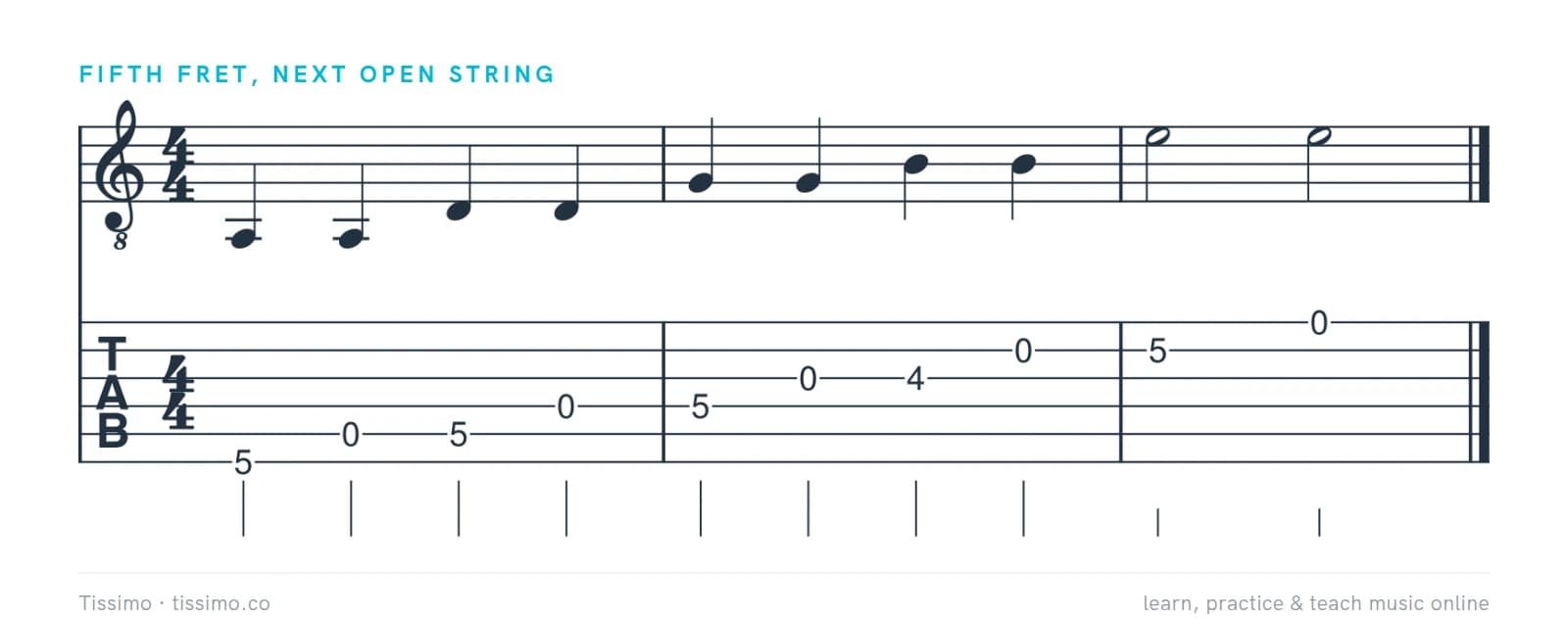
How to fret a note
Put your fingertip in the space just behind the fret, on the side toward the nut, not on top of the metal. Close to the fret, a light press gives the clearest note. Further back you need more pressure, and the string may buzz against the fret. Shapes built this way move up and down the neck, as in Fret Check: The Major Scale Shape and Bass Root, Fifth, Octave: Fret Check.
A common confusion
"Playing at the third fret" means pressing in the space just before the third metal strip, not on the strip. Not every string instrument has frets, either: the violin family and the double bass have smooth fingerboards, and fretless bass guitars exist too. On the lute and the viol, frets were traditionally loops of gut tied around the neck.
Common questions
Why does the 12th fret sound an octave higher?
The 12th fret sits at the middle of the string, so pressing there halves the vibrating length, which doubles the frequency: one octave higher. It is twelve half steps above the open string.
Should I press on the fret or between the frets?
Between them, with your fingertip just behind the fret you want (on the nut side). The fret itself stops the string, so the clearest sound comes from just behind it, as close as you can get without touching the metal.
Practice it: free worksheets
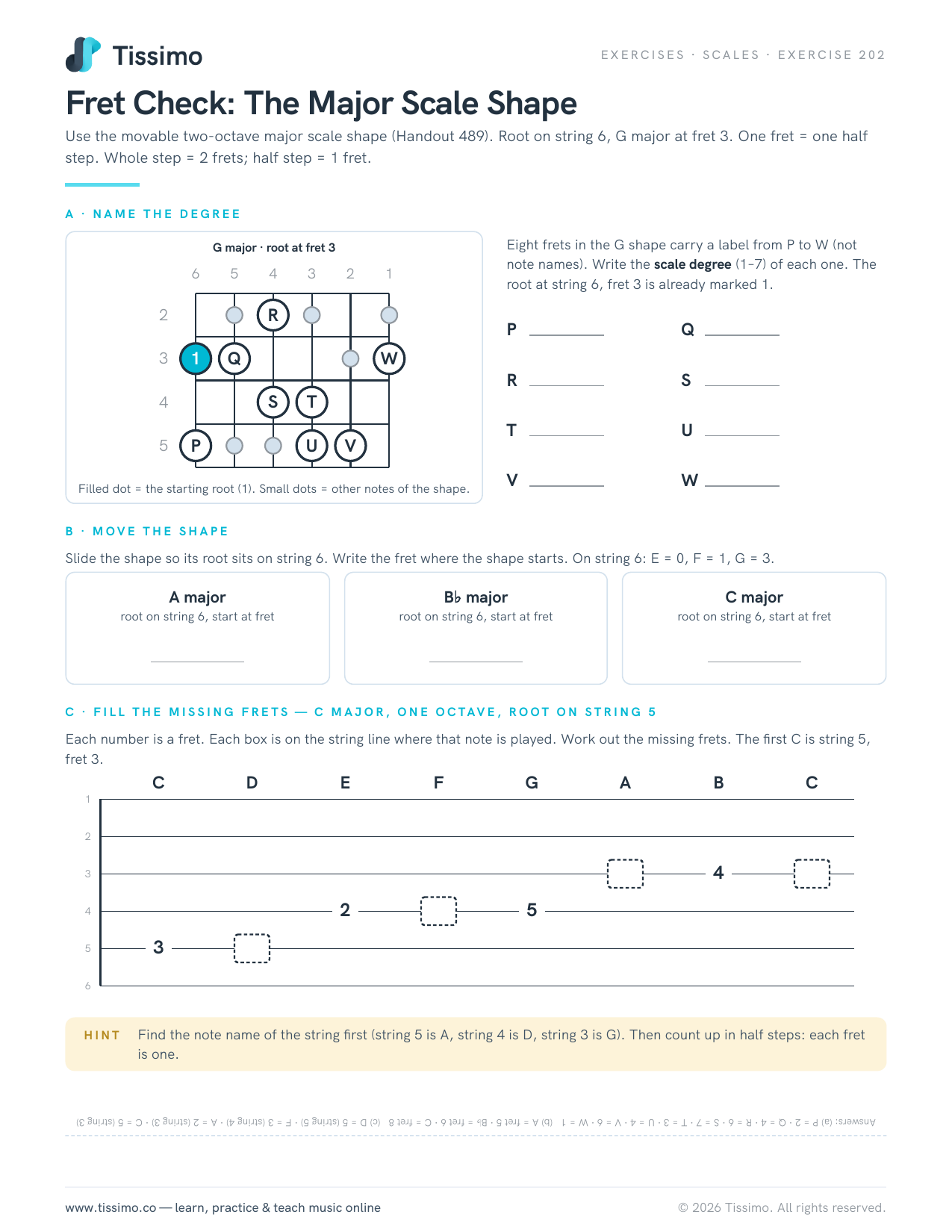 Fret Check: The Major Scale ShapeUse the movable two-octave major scale shape (Handout 489). Root on string 6, G major at fret 3. One fret = one half step. Whole step = 2 frets; half step = 1 fret.
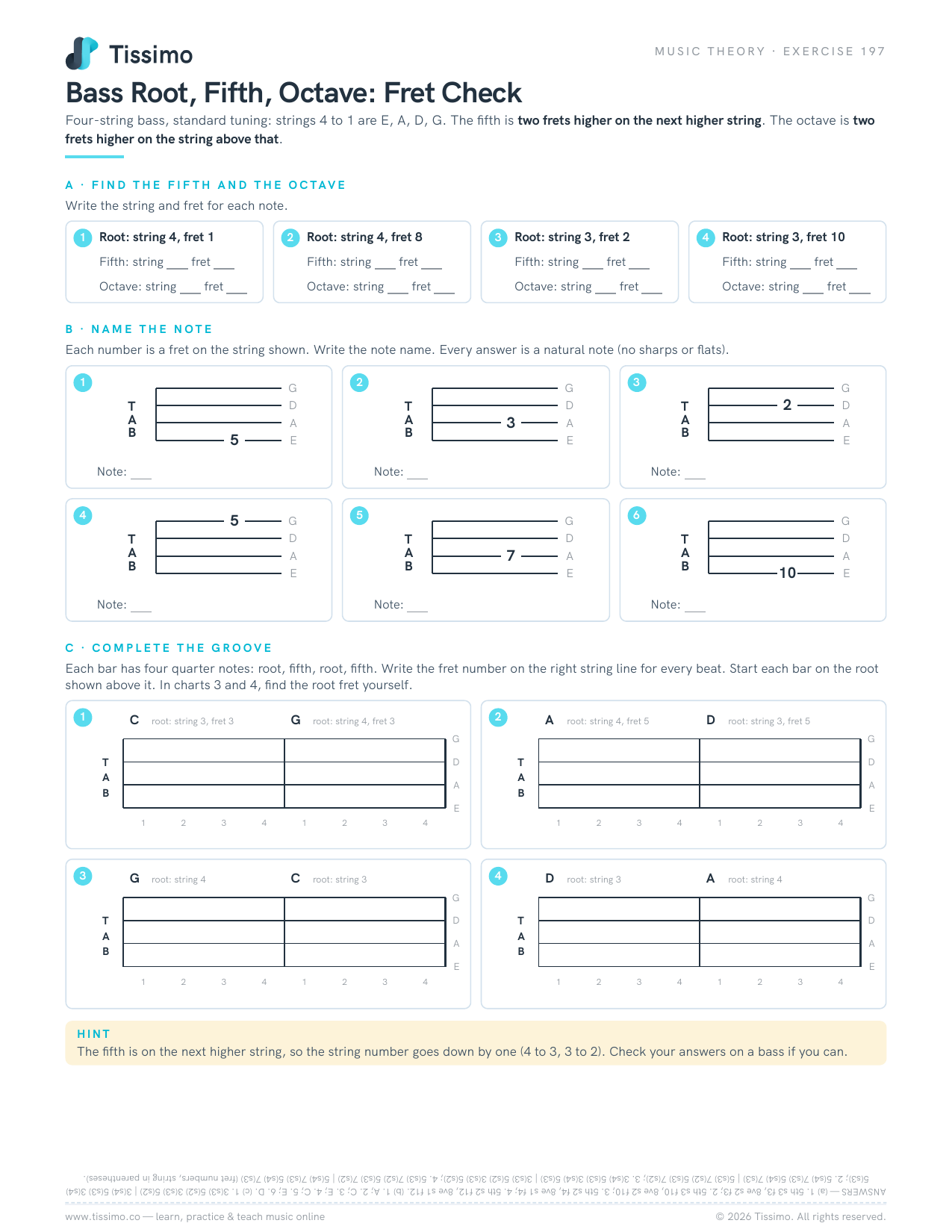 Bass Root, Fifth, Octave: Fret CheckFour-string bass, standard tuning: strings 4 to 1 are E, A, D, G. The fifth is two frets higher on the next higher string. The octave is two frets higher on the string above that.
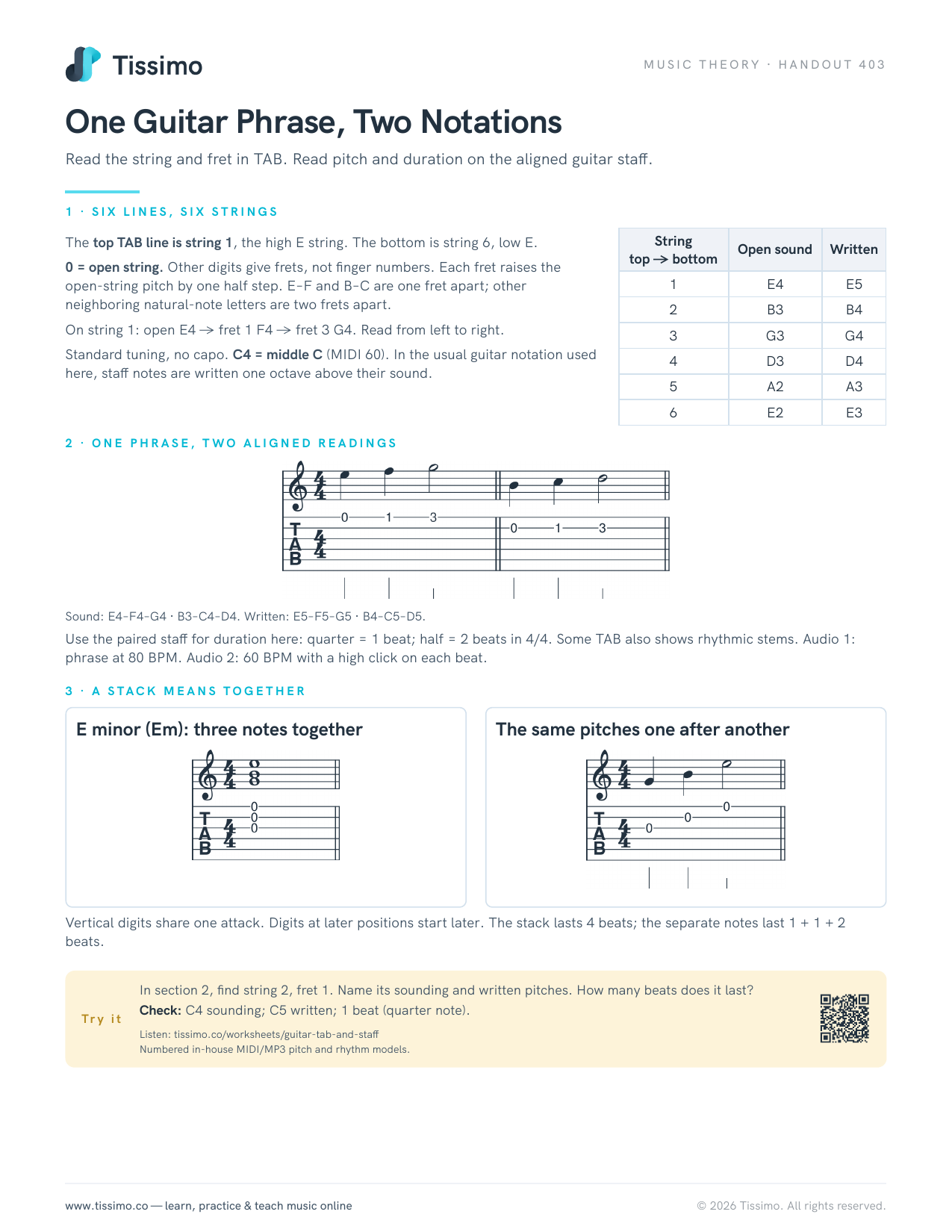 One Guitar Phrase, Two NotationsRead the string and fret in TAB. Read pitch and duration on the aligned guitar staff.
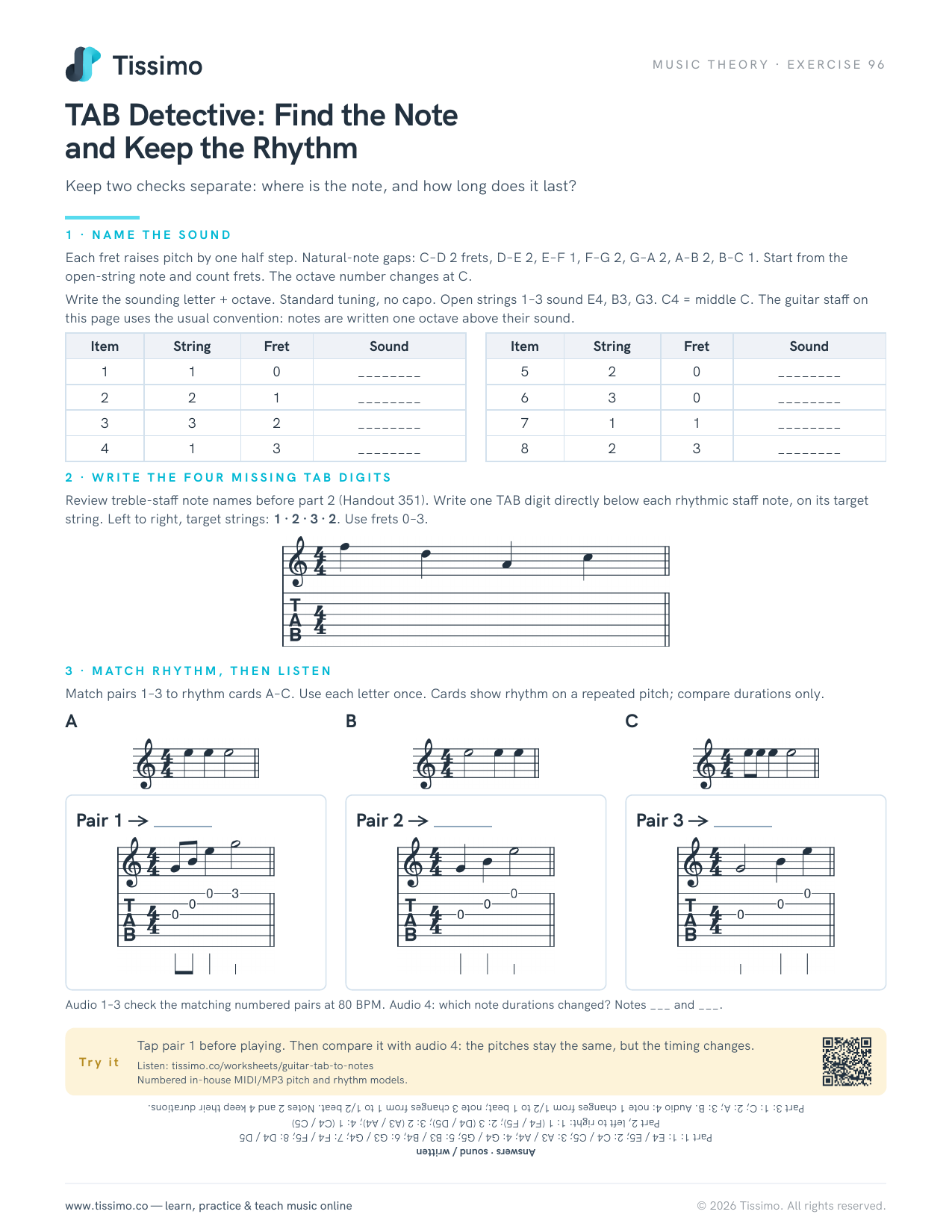 TAB Detective: Find the Note and Keep the RhythmKeep two checks separate: where is the note, and how long does it last?
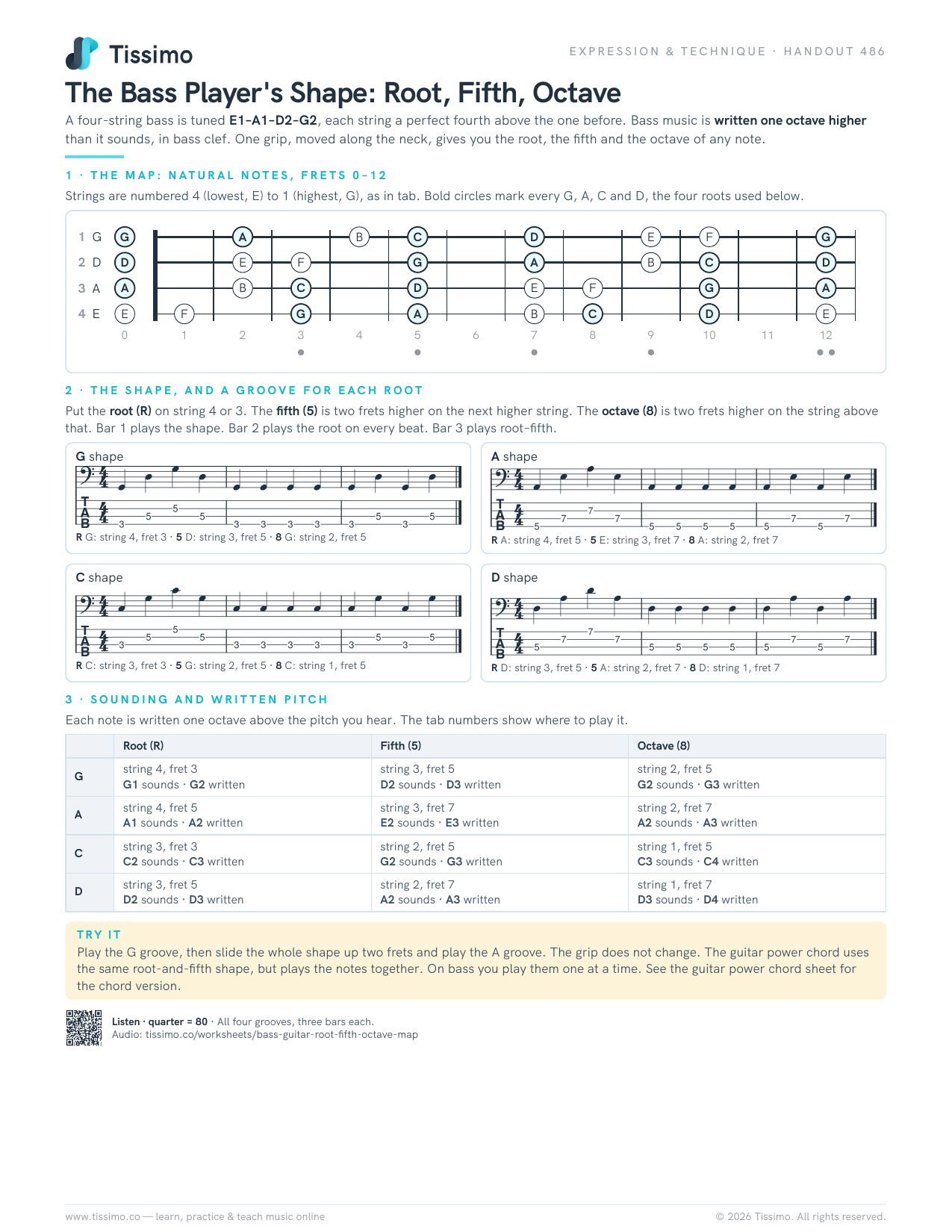 The Bass Player's Shape: Root, Fifth, OctaveA four-string bass is tuned E1–A1–D2–G2, each string a perfect fourth above the one before. Bass music is written one octave higher than it sounds, in bass clef. One grip, moved along the neck, gives you the root, the fifth and the octave of any note.
Comments