Technique & Performance
Capo
Pronounced KAY-poh
A capo is a clamp that presses all the strings of a guitar or similar fretted instrument at one fret. It raises every string by the same number of half steps, so familiar chord shapes sound in a higher key.
A capo is a small clamp that you fix across the neck of a guitar, banjo or similar fretted instrument. It presses every string down at one fret, so the strings sound from the capo instead of from the nut. Each fret raises a string by one half step, so a capo at the 2nd fret raises every string, and every chord you play, by two half steps (a whole step).
The name is short for the Italian capotasto, "head of the fingerboard". Capos come in several designs, such as spring-loaded trigger capos and screw capos that you tighten by hand, but they all do the same job.
Shape names and sounding names
With a capo on, every chord has two names. The shape name is the chord your fingers make, as if the capo were the nut. The sounding name is the chord everyone hears. Your fingers do nothing new; only the names move.
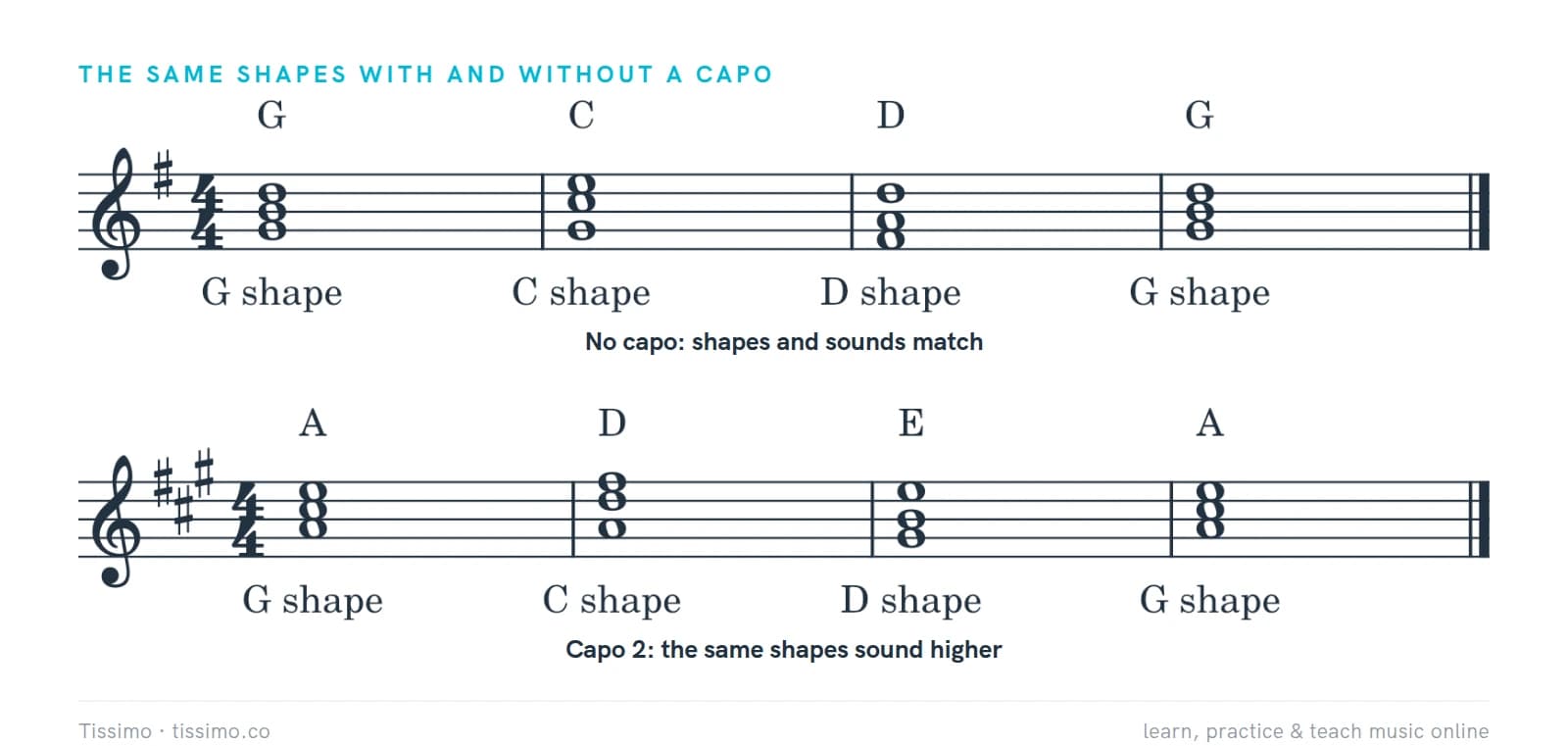
To get from one name to the other, count half steps:
- From shape to sound: move the root of the shape up by the capo's fret number. With the capo at fret 2, a G shape sounds A, a C shape sounds D and an E minor shape sounds F♯ minor. Major stays major and minor stays minor.
- From the key you need to the fret: to play a song in A with the G-shape chords you know, count the half steps from G up to A. There are two, so the capo goes on fret 2.
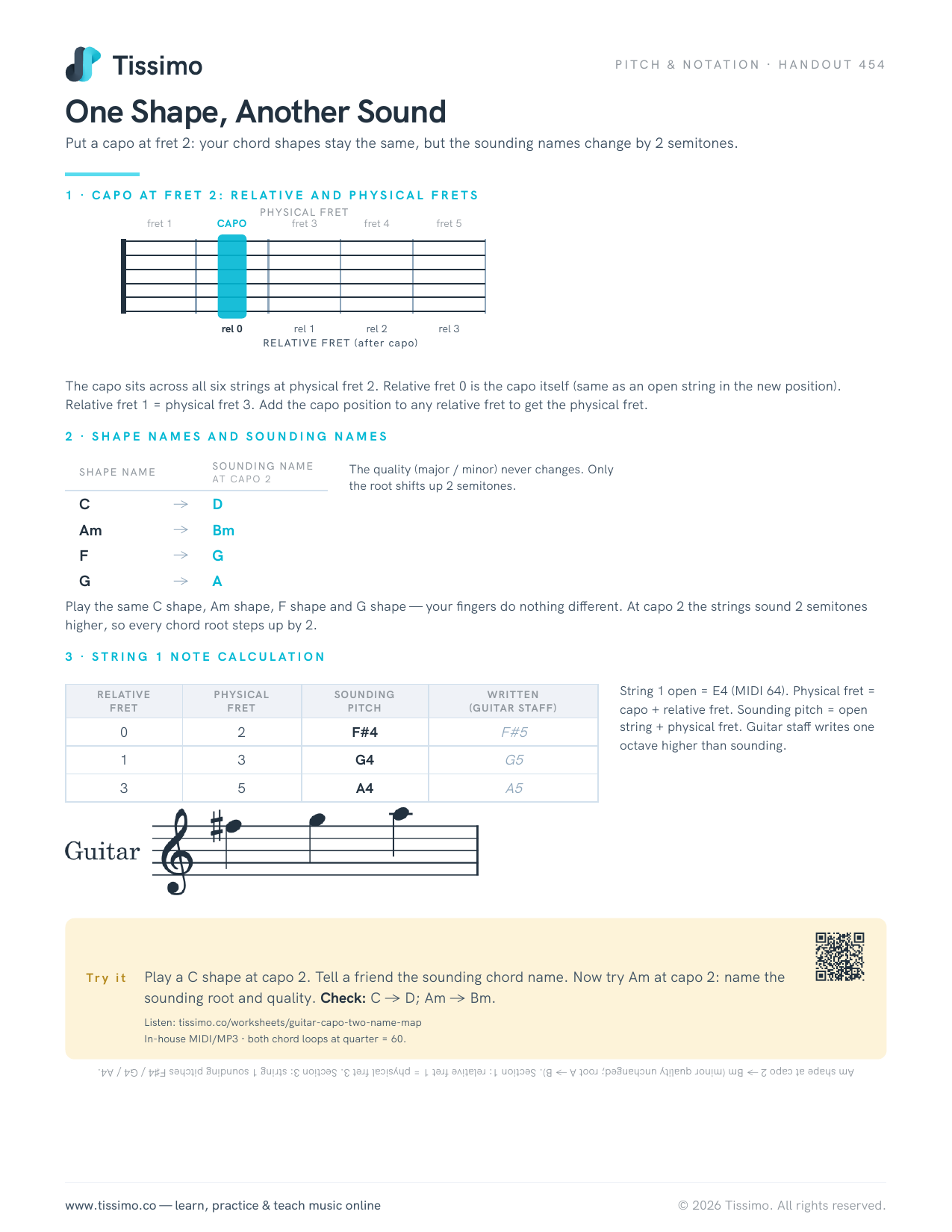
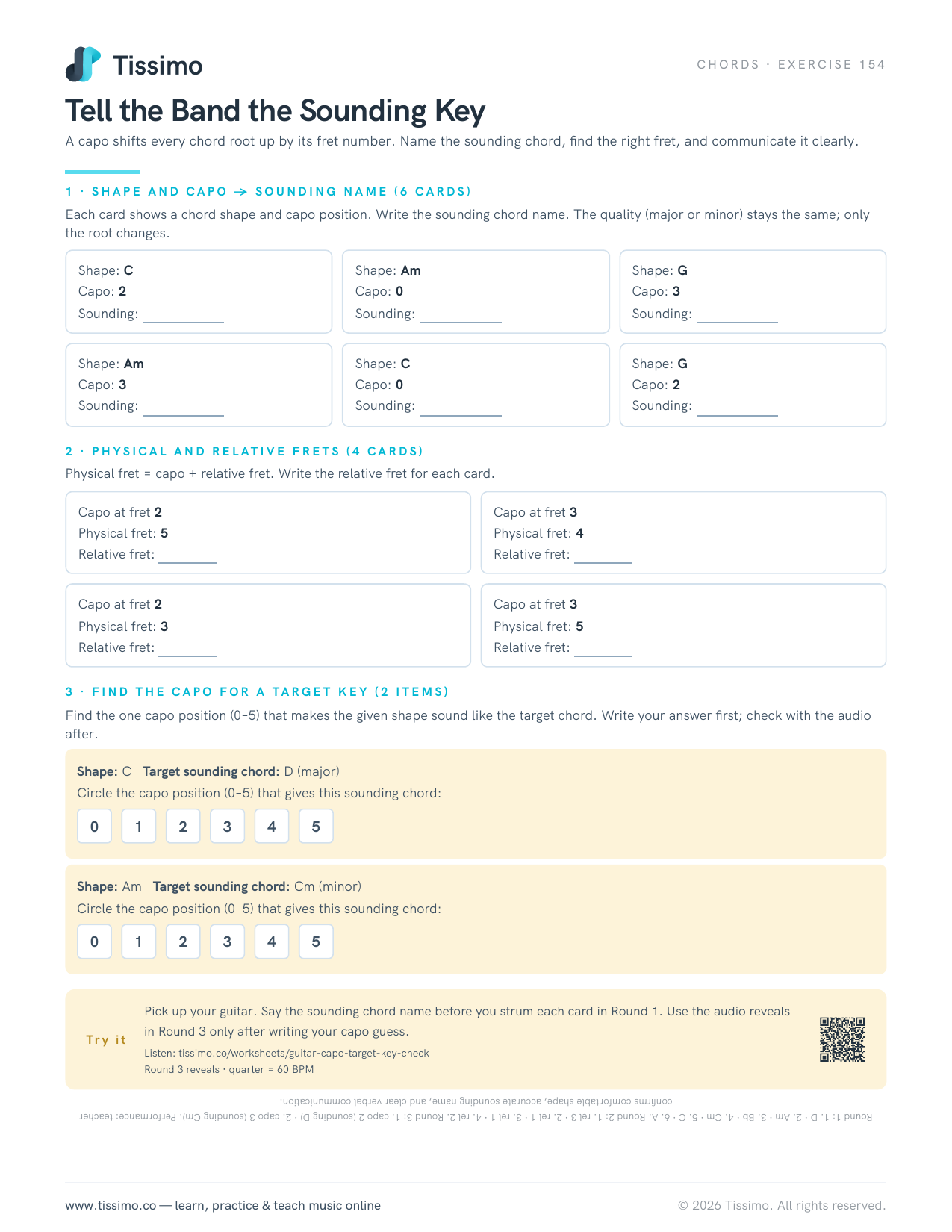
Chord sheets and tabs usually say which fret the capo goes on, for example "Capo 2". When you play with other musicians, give them the sounding key: "we're in A", not "we're in G". One Shape, Another Sound and Tell the Band the Sounding Key practice both directions.
Why guitarists use one
- To suit a singer. Moving the capo up a fret or two raises the key of a song without any new chords to learn.
- To keep open shapes in awkward keys. In keys such as E-flat or B-flat, most of the main chords need barre chords. With a capo you can play them with open shapes instead.
- For a brighter sound. A capo at or above the 5th fret gives a light, chiming tone.
A capo can only raise the pitch: to sound lower than the open strings you would have to tune the strings down. In a barre chord, your index finger does the job of a capo.
Putting it on
Place the capo just behind the fret, close to it but not on top of it, and straight across the neck. Use only as much pressure as it takes for every string to ring clearly: too little and the strings buzz, too much and they are pulled out of tune. Check your tuning again once the capo is on.
Capo or da capo?
The two words share the Italian capo, "head", and nothing else. A capo is a clamp. Da capo (D.C.) is a written instruction that sends you back to the beginning of a piece.
Common questions
What does Capo 2 mean?
Put the capo on the 2nd fret. Every chord shape then sounds two half steps (a whole step) higher: a G shape sounds A, a C shape sounds D and a D shape sounds E.
Does a capo change the key?
It changes the key you hear, not the way you finger the chords. The shapes keep their names; the sound moves up one half step for each fret.
Can a capo make a guitar sound lower?
No. A capo shortens the vibrating part of the strings, so it can only raise the pitch. To sound lower, tune the strings down.
Comments