Technique & Performance
Barre Chord
A barre chord is a guitar chord in which one finger, usually the index finger, presses several or all strings at one fret while the other fingers form a chord shape, so the whole shape can move up and down the neck.
In a barre chord, one finger lies flat across the strings like a bar and presses several or all of them at the same fret, while the other fingers make a chord shape above it. The barring finger is usually the index finger. It does the job of the nut, or of a capo: everything above it sounds higher, but the shape stays the same. That makes barre chords movable: one shape gives you a major chord on every fret.
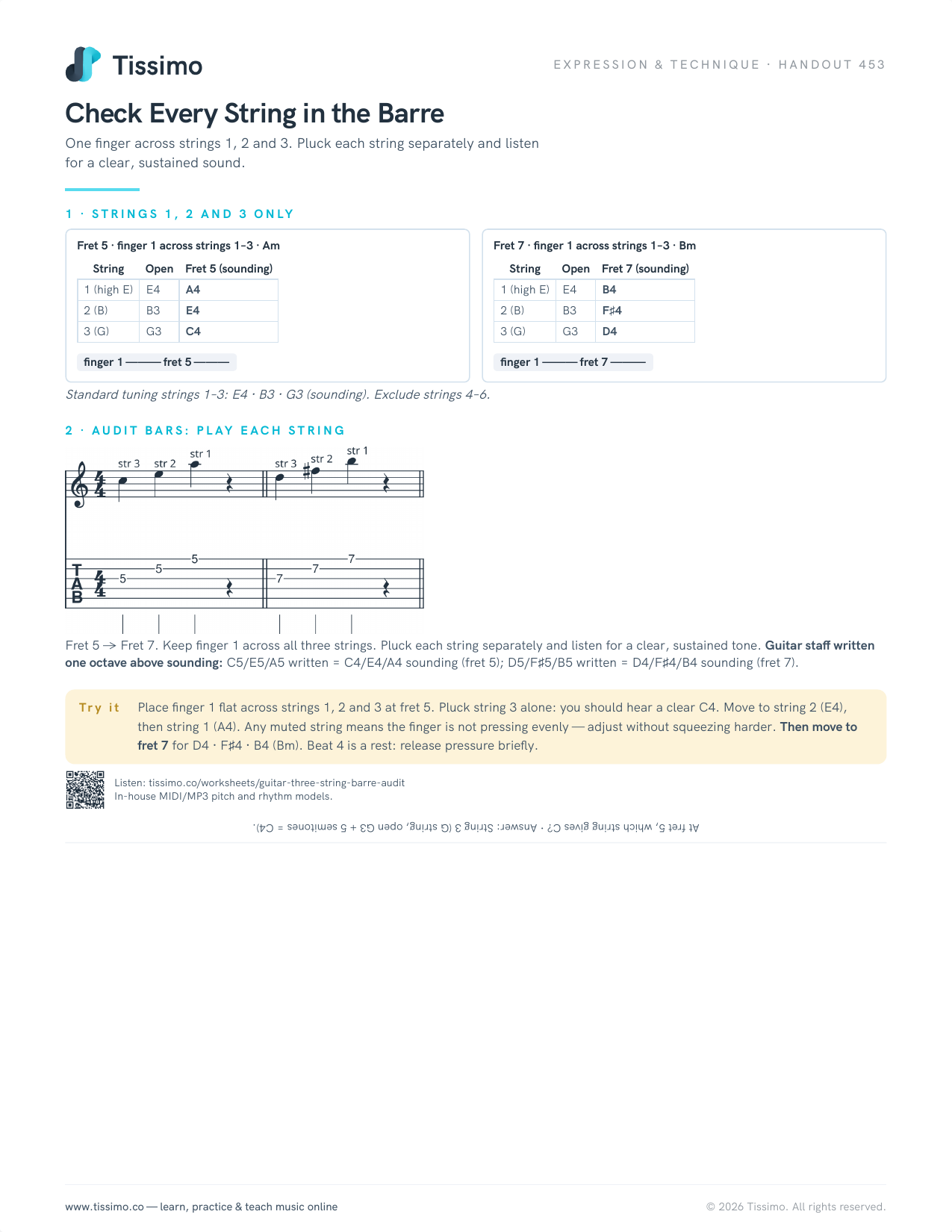
The word comes from the French barré, "barred", and many players spell it bar chord. A full barre covers all six strings; a partial barre covers only some of them, such as the top three. Check Every String in the Barre starts with that three-string barre.
The two shapes to learn first
Most guitarists begin with two shapes, named after the open chords they come from:
- E shape (root on the 6th string): the open E major chord moved up the neck, with the barre in place of the open strings. With the barre at fret 1 it is F major, at fret 3 G major, at fret 5 A major.
- A shape (root on the 5th string): the open A major chord moved up the same way. At fret 1 it is B-flat major, at fret 3 C major, at fret 5 D major.
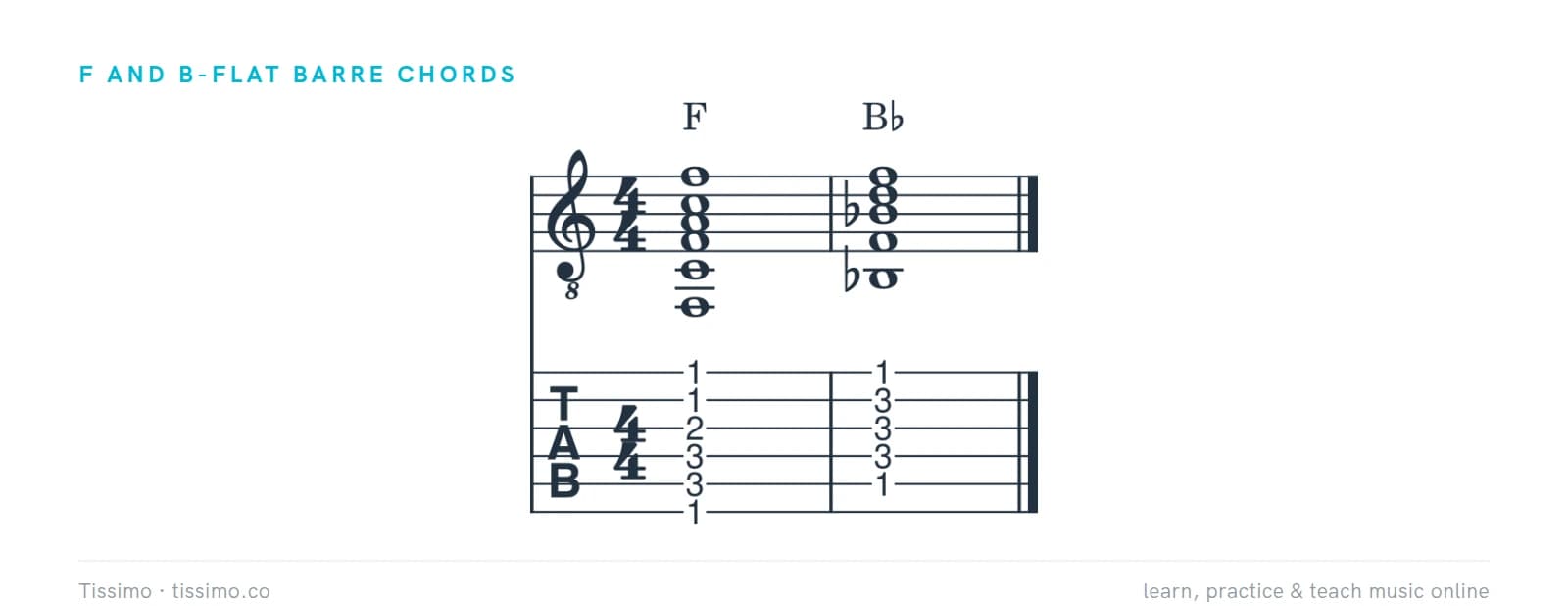
To name a barre chord, find the note under the barre on the root string. Minor barre chords come from the open E minor and A minor shapes in the same way.
How to play one
- Lay the finger straight across the strings, just behind the fret.
- Turn it slightly onto its side. The side of the finger is harder than the soft pad, so it presses more evenly with less effort.
- Add the other fingers, then pluck each string on its own and listen. A buzzing or dead string shows where the barre needs adjusting; moving the finger often helps more than squeezing harder.
- Rest when your hand gets tired. Barre chords take strength, and it builds gradually.
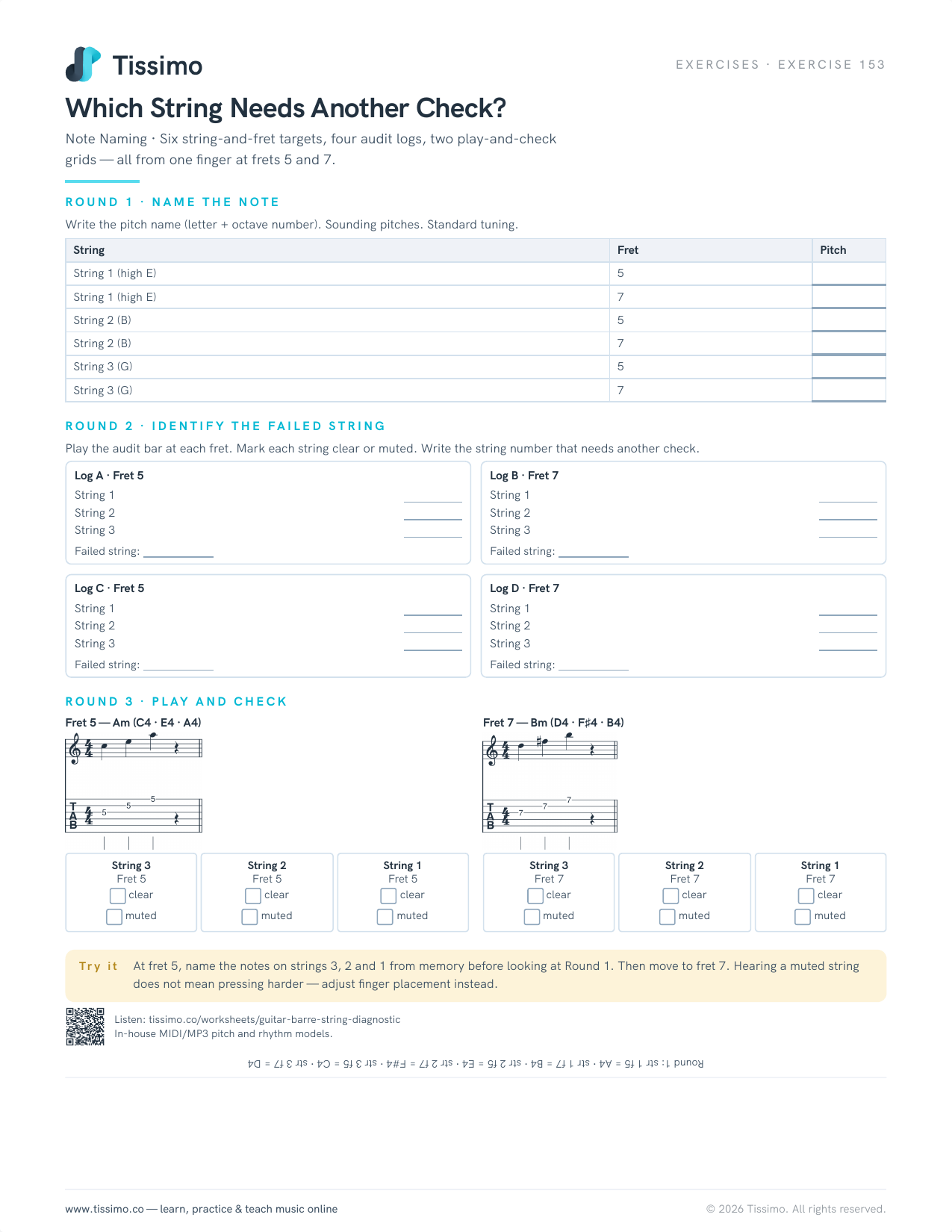
Which String Needs Another Check? turns that string-by-string check into a routine.
Barre markings in guitar music
Classical guitar music often marks a barre with a Roman numeral for the fret, sometimes with a C (for the Spanish cejilla or the Italian capotasto) or a B (for barré) in front, so CV means a barre at the 5th fret. A partial barre may be shown with a fraction such as ½ or a line through the letter. There is no single standard, so check the edition's own key.
Barre chord or power chord?
A power chord has only a root and a fifth, often with the octave on top, and no third, so it is neither major nor minor. A full barre chord is a complete chord, most often major or minor, on five or six strings. The two are related: the three lowest notes of an E-shape barre chord form a power chord.
Common questions
Is a bar chord the same as a barre chord?
Yes. They are two spellings of the same thing. Barre comes from the French barré, "barred", because one finger bars the strings.
Why are barre chords so hard?
One finger has to hold five or six strings down evenly while the other fingers make a shape. That takes strength and accuracy, which build gradually. Start with a partial barre on the top three strings and check each string separately.
Comments