Form & Structure
Cantata
Pronounced kan-TAH-tuh
A cantata is a work in several movements for voices and instruments, such as recitatives, arias and choruses. Bach's church cantatas, written for Lutheran Sunday services, are the best-known examples.
A cantata is a vocal work in several movements: recitatives, arias, duets and choruses, accompanied by instruments. The name is Italian for "sung," the opposite of a sonata, a piece that is played. Cantatas are usually shorter than an oratorio, and the word has meant different things in different centuries.
The Italian chamber cantata
In 17th-century Italy a cantata was often a secular piece for one solo voice and continuo (a bass line with chords, see basso continuo). Some cantatas were built from recitatives, others from a string of arias. The cantata da camera (chamber cantata) was secular and the cantata da chiesa (church cantata) sacred. Alessandro Scarlatti alone wrote several hundred cantatas for solo voice and continuo.
The German church cantata
In Lutheran Germany the cantata became part of the Sunday service. When Bach worked in Leipzig from 1723, his job included performing a cantata on almost every Sunday and feast day, with soloists, choir and orchestra. Its words matched the Bible readings of the day: they combined Bible quotations, new poetry and verses of a hymn.
A typical cantata from Bach's first Leipzig year runs:
- Opening chorus, usually polyphonic, with the orchestra introducing the themes
- Recitative
- Aria, most often a da capo aria
- Recitative (or arioso)
- Aria
- Chorale: a simple four-part setting of a hymn the congregation knew
Bach did not follow this plan strictly. His chorale cantatas are built entirely on one hymn. The orchestra rests on strings and continuo (cello, double bass and organ), with oboes, flutes, trumpets or horns giving each work its color. More than 200 of Bach's cantatas survive, sacred and secular together, and many more are lost.
Secular cantatas
Cantatas were also written for weddings, anniversaries, town and university ceremonies and other celebrations. Bach's Coffee Cantata is a comic scene that works like a little opera.
The word today
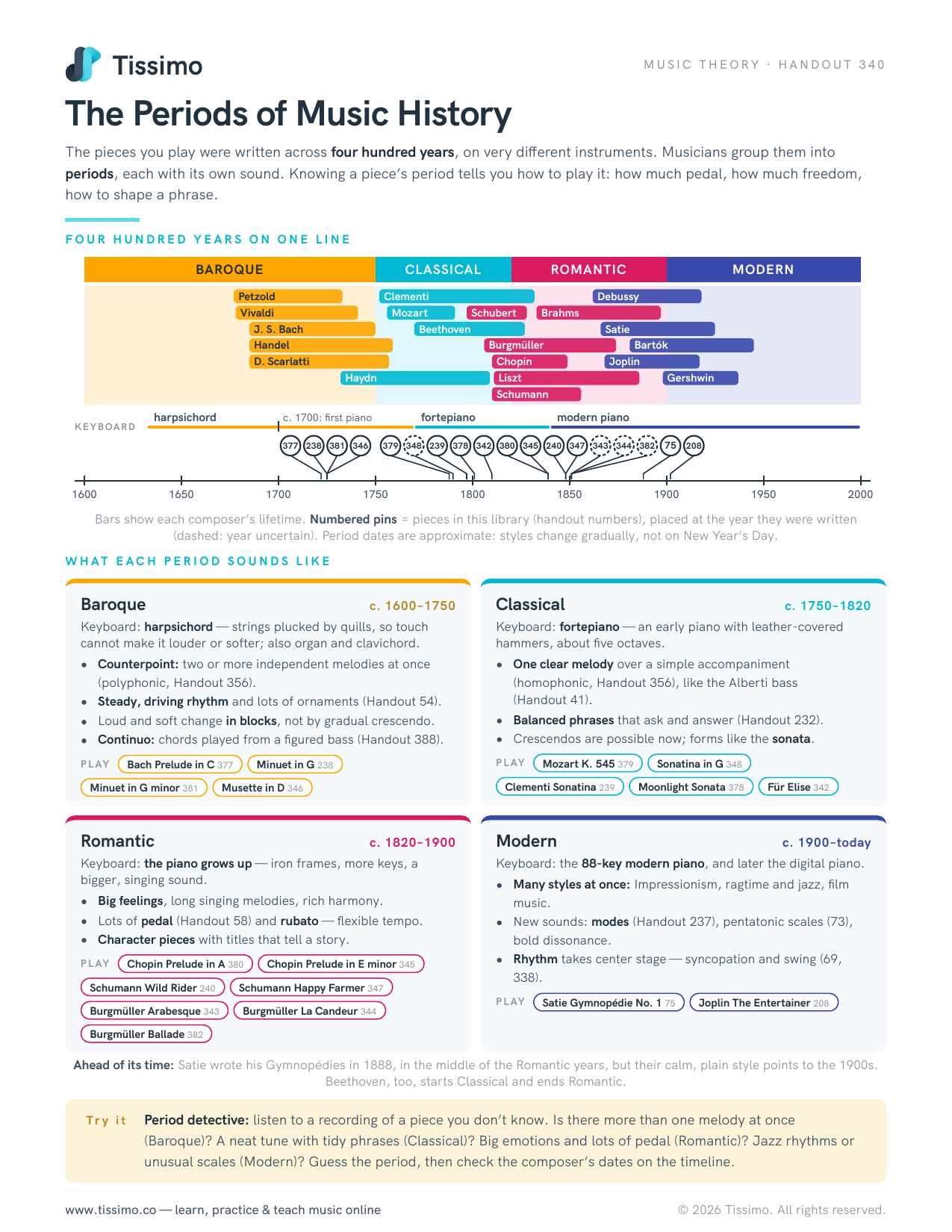
After Bach, a cantata was often a choral work on a sacred subject, in effect a short oratorio. In the 20th century the word loosened further, and composers use it for many works for voices and orchestra. To place the Baroque era among the other periods, see The Periods of Music History.
Common questions
What is the difference between a cantata and an oratorio?
Both are works for voices and instruments in several movements, performed without staging. An oratorio is usually longer and tells or reflects on a story at length. A cantata is usually shorter, and Bach's church cantatas were written to fit into a Sunday service. Some works could be called either.
How many cantatas did Bach write?
More than 200 survive, sacred and secular together, and many more are lost, so the number he wrote is not known exactly.
Comments