Instruments & Voices
Lute
The lute is a plucked string instrument with a deep, rounded back, a fretted neck and strings mostly in pairs called courses. A leading European instrument of the Renaissance and Baroque, it was read from tablature.
The lute is a plucked string instrument with a body shaped like half a pear: a deep, rounded back glued together from thin strips of wood and closed by a flat soundboard with a carved rose over the soundhole. Frets of gut are tied around the neck and can be moved, and the pegbox is bent back at an angle. Most of the strings come in pairs called courses, tuned in unison or an octave apart and played as one; the highest course, the chanterelle, is usually a single string.
From the oud to the courts of Europe
The European lute grew out of the Middle Eastern oud, which reached Europe through Spain, and it was played across Europe from about the 12th century until well into the 18th. Medieval players used a quill; by the late 15th century they plucked with the fingers, and in 1507 the first printed book of lute music appeared in Venice. Much of its finest music was written by lutenists such as Francesco da Milano, John Dowland and Silvius Leopold Weiss. The lute is a key sound of Renaissance and Baroque music (see The Periods of Music History); it faded after about 1700, except in German-speaking lands, and its revival began at the end of the 19th century.
Renaissance and Baroque lutes
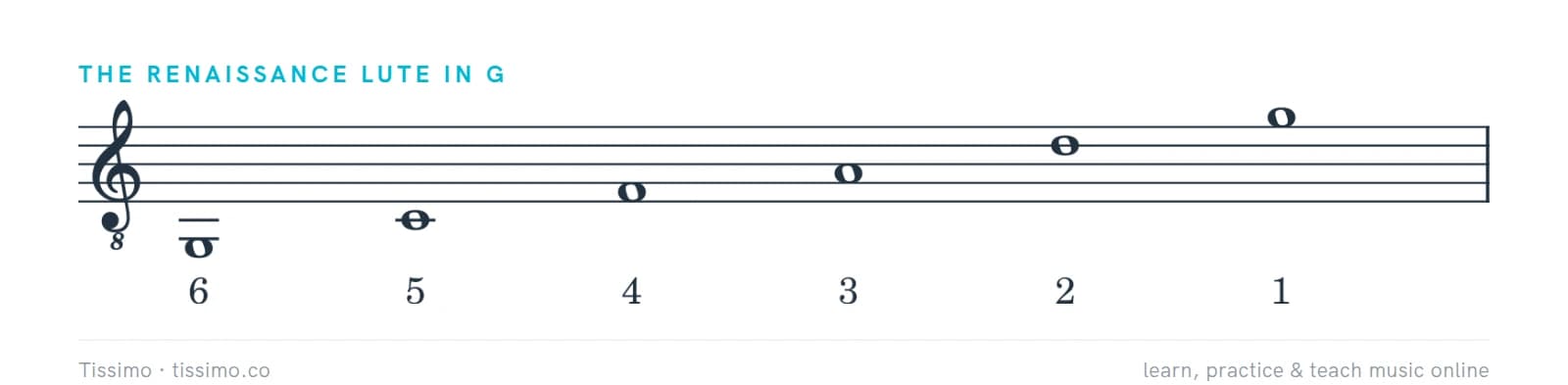
- The Renaissance lute has six or more courses. The top six are tuned fourth, fourth, major third, fourth, fourth: in the common G tuning, G2, C3, F3, A3, D4 and G4 from the lowest course to the highest. Lutes came in many sizes, so the real pitch varied; a tuning in A was also common. From about 1590 players added extra bass courses.
- The Baroque lute of France and northern Europe used a new D minor tuning, A, D, F, A, D, F for the fretted courses, with up to 13 courses in all; the low bass courses are played as open strings, and the longest run to a second pegbox.
- The archlute and theorbo are lutes with long neck extensions for low bass strings, much used in basso continuo.
Lute tablature
Lute music was written in tablature, which shows where to put the fingers rather than which pitch sounds. In French tablature, used in France and England, six lines stand for the courses with the highest at the top, and letters mark the frets: a for the open course, b for the first fret, c for the second, and so on. Italian tablature uses numbers instead and turns the staff upside down, with the highest course on the bottom line; German tablature is another system altogether. Rhythm signs above the staff give the durations, and each sign holds until a new one appears.
A common confusion
In the study of instruments, "lute" is also the name of a whole family: any instrument whose strings run along a neck over a body, which includes the Arabic oud, the Chinese pipa and the Japanese biwa. And a luthier makes any string instrument, not only lutes.
Common questions
What is the difference between a lute and a guitar?
The lute has a deep, rounded back, strings mostly in pairs (courses), frets of gut tied around the neck and a pegbox bent sharply back. The guitar has a flat back, single strings and fixed metal frets. Their tunings are close: the guitar with its third string lowered to F♯ has the Renaissance lute's intervals.
Is the lute related to the oud?
Yes. The European lute developed from the Middle Eastern oud, which came to Europe through Spain in the Middle Ages, and both have the deep, rounded back built from strips of wood.
Comments