Sound & Acoustics
Waveform
A waveform is the shape of a sound wave or audio signal drawn over time. Synthesizer waveforms such as sine, square, sawtooth and triangle each contain a different mix of harmonics, which gives each its own timbre.
A waveform is a picture of a vibration: a line that rises and falls as the air pressure, or the voltage or numbers of an audio signal, goes up and down over time. In a steady pitched sound the same shape repeats, and one repetition is one cycle. How often the cycle repeats is its frequency, which you hear as pitch. How tall it is, its amplitude, relates to loudness. Its shape relates to timbre, the color of the sound.
Shape and harmonics
A pitched sound can be described in two ways: as a shape, or as a list of harmonics, pure sine-wave components at whole-number multiples of the fundamental, each with its own strength. Which harmonics are present, how strong each one is and how they line up in time decide the shape. A synthesizer's waveform menu is really a menu of harmonic recipes.
The classic synth waveforms
- Sine: a single frequency with no higher harmonics. It sounds smooth and pure.
- Sawtooth: every harmonic, with harmonic n at 1/n of the fundamental's strength. It sounds bright and buzzy.
- Square: only the odd harmonics (1, 3, 5, 7...), also at 1/n. It is often described as hollow, a little like a clarinet.
- Triangle: odd harmonics only, like the square, but they fade much faster, at 1/n², so the 3rd harmonic has only a ninth of the fundamental's strength. It sounds softer, between a sine and a square.
- Pulse: a wave that sits at its high value for only part of each cycle; that share is its duty cycle. A square wave is the pulse with a 50% duty cycle. Other duty cycles have other recipes: at 25%, every 4th harmonic is missing.
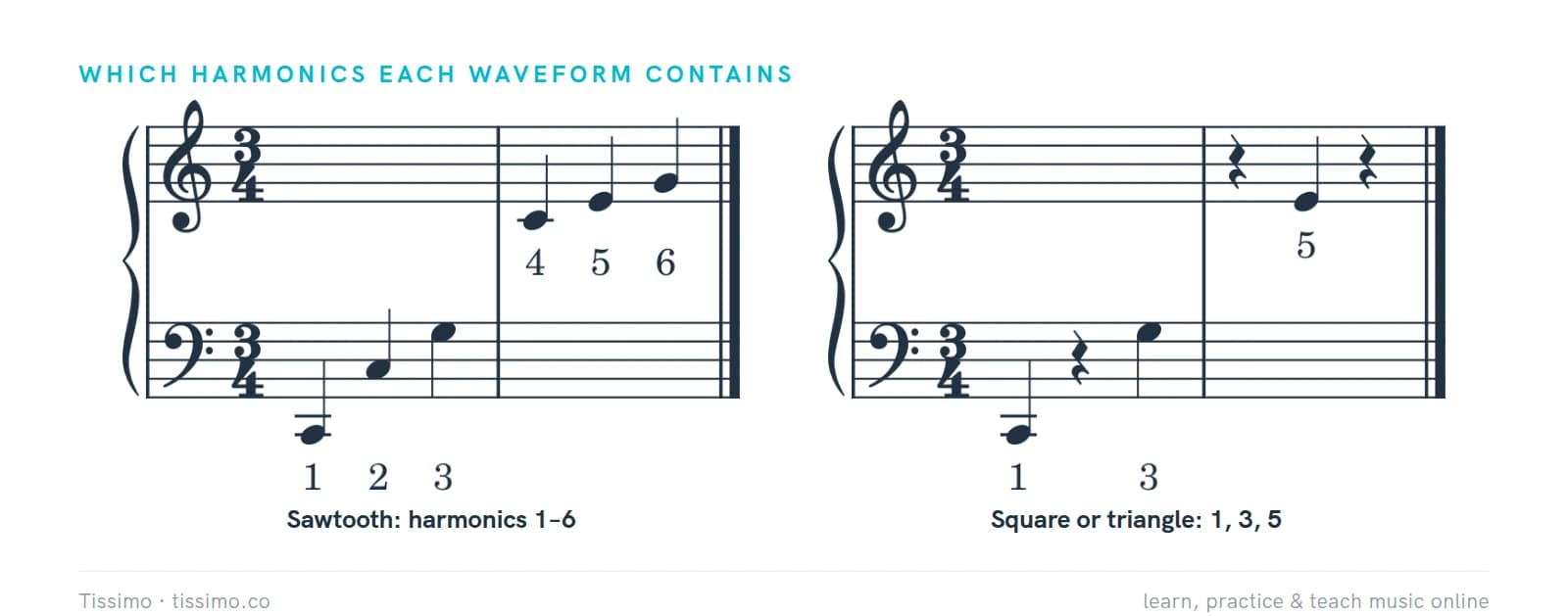
The figure writes the first six harmonics of a low C as the nearest piano notes, to show which of them each recipe contains.
Same note, different color
Changing the waveform changes the color, not the note. A sine, a square and a sawtooth at 220 Hz all sound as the A below middle C; only their brightness differs. On a synthesizer, the oscillator makes the waveform, and a filter can then take harmonics away, which changes the shape again.
Waveforms in a DAW
In a DAW or audio editor, "the waveform" is the drawing of a recording on its track. Zoomed out, it shows how the loudness rises and falls, so drum hits show as spikes and silences as flat lines. Zoomed in, you can see single cycles. Real voices and instruments rarely draw a neat textbook shape: their many harmonics keep changing, and the line is far more complicated.
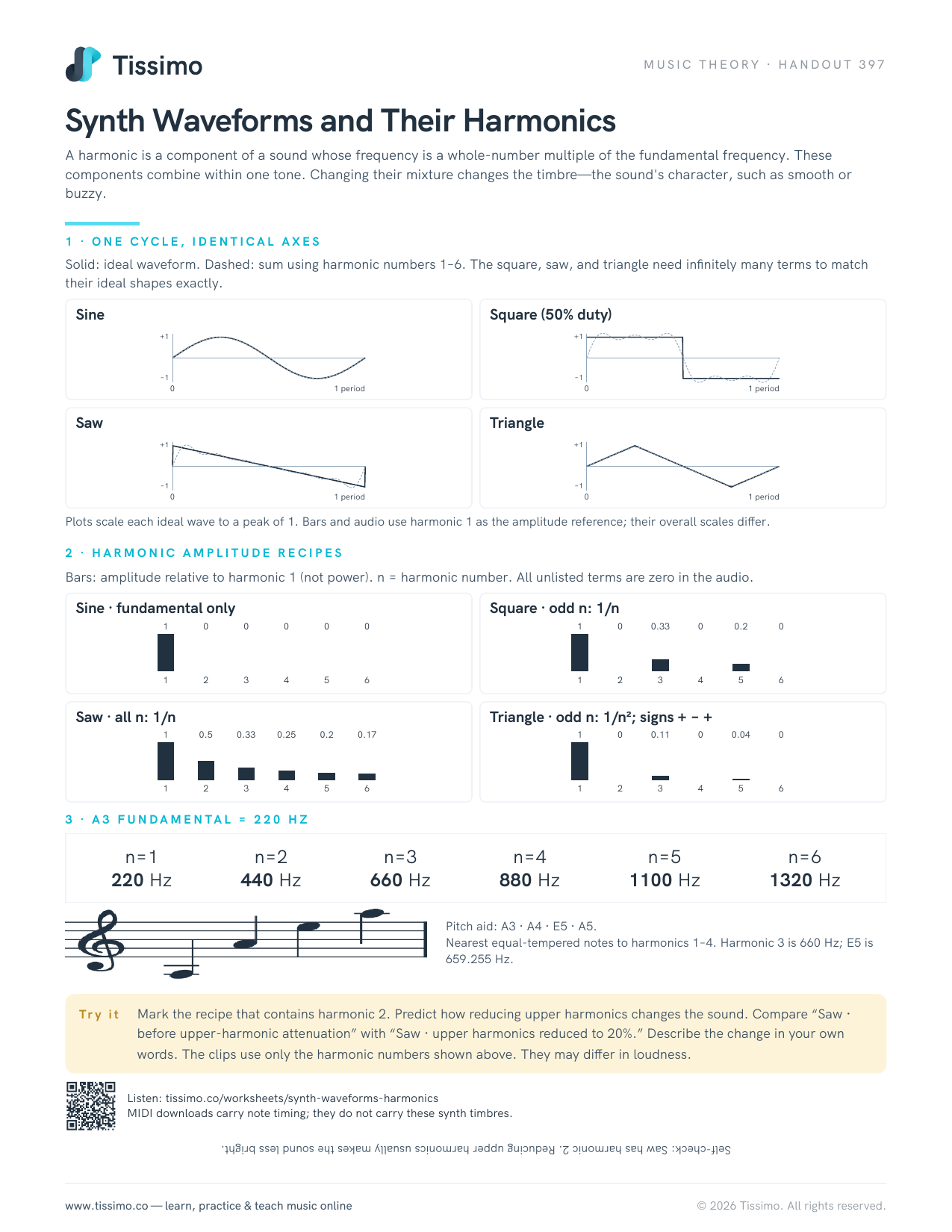
A picture is not the whole story. When a filter shifts the timing of a square wave's few remaining harmonics, the shape on screen changes visibly, yet in that simple case you will probably not hear the difference. Listen as well as look. Synth Waveforms and Their Harmonics draws the four classic shapes beside their recipes and lets you hear each one.
Common questions
What is the difference between a square wave and a sawtooth wave?
A sawtooth contains every harmonic of its fundamental, each weaker than the one before, so it sounds bright and buzzy. A square wave contains only the odd-numbered harmonics, which gives it a hollower sound. At the same frequency both play the same note.
Why does a sine wave sound so pure?
It contains just one frequency, with no higher harmonics to add color or buzz. Almost every natural sound is a mixture of many sine-wave components, which is why a sine on its own sounds plain and electronic.
Comments