Sound & Acoustics
Filter (Synth Filter)
A filter turns down part of a sound's frequency range. In a synthesizer, a low-pass, high-pass or band-pass filter with cutoff and resonance controls shapes the oscillator's tone, often moving while a note plays.
A filter lets some frequencies through and turns others down. On a synthesizer it usually comes straight after the oscillator: the oscillator supplies a waveform full of harmonics, and the filter takes some of them away. Building a sound by removing harmonics from a bright source is called subtractive synthesis, and the filter is its main tool.
The main types
- Low-pass: keeps the frequencies below the cutoff and turns down those above it, so the sound gets darker as the cutoff falls. The resonant low-pass filter is the classic synth filter, the one most associated with the sound of subtractive synthesis.
- High-pass: the opposite: it turns down the lows, thinning a sound out.
- Band-pass: keeps a band around the cutoff and turns down both ends.
- Notch (band-reject): removes a band and keeps both ends.
Cutoff, slope and resonance
- Cutoff (often labeled frequency) sets where the filter acts. It is not a brick wall: at the cutoff of a simple filter the level is already about 3 dB down, and beyond it keeps falling gradually.
- Slope says how fast it falls, in decibels per octave. The simplest filter falls by 6 dB per octave, which acts more like a tone control. Synth filters are often 12 dB per octave (called 2-pole) or 24 dB per octave (4-pole), which remove the upper harmonics more decisively.
- Resonance boosts a band around the cutoff, so the harmonics there stand out; the width of that peak is described by its Q. As in acoustic resonance, the circuit responds most strongly near one frequency. Turned up far enough, a resonant filter can begin to oscillate at its cutoff frequency and produce a tone of its own.
A filter that moves
The filter comes alive when its cutoff moves while you play:
- An envelope can open the filter at the start of each note and close it as the note fades: a bright start that turns dark, like a pluck.
- An LFO can sweep it up and down for a repeating wobble.
- Key tracking moves the cutoff with the note you play, so high notes keep a brightness similar to low ones.
- A knob or automation can sweep it slowly over many bars, a familiar build-up in dance music before the drop.
Try it: hold one sawtooth note and lower the cutoff slowly. The sound darkens while the pitch stays the same. Raise the resonance a little and sweep again, and the boosted band travels through the harmonics: the classic filter sweep. Hear a sawtooth with its upper harmonics turned down in Synth Waveforms and Their Harmonics, and draw the ADSR shape that a filter envelope follows in Draw an ADSR Envelope (the sheet plots it for loudness).
Filter or EQ?
An EQ uses the same shapes for a different job. In mixing, a filter is usually set to fix or fit a sound, often with no resonant peak. In a synthesizer it is part of the instrument, resonant and moving. This entry covers the synth filter; the EQ entry covers high-pass and low-pass filters as mixing tools.
Common questions
What does a low-pass filter do?
It lets the frequencies below its cutoff pass and turns down those above it. On a synthesizer, lowering the cutoff removes upper harmonics, so the sound becomes darker and softer while the note stays the same.
What is filter resonance?
A boost of the frequencies around the cutoff. A little resonance makes the filter's movement easier to hear; a lot gives a sharp, ringing peak, and on many filters very high settings make the filter produce a tone of its own at the cutoff frequency.
Is a synth filter the same as EQ?
They use the same filter shapes. EQ is a mixing tool, usually set to correct or balance a sound. A synth filter is part of the instrument's sound design, usually with resonance and a cutoff that moves as you play.
Practice it: free worksheets
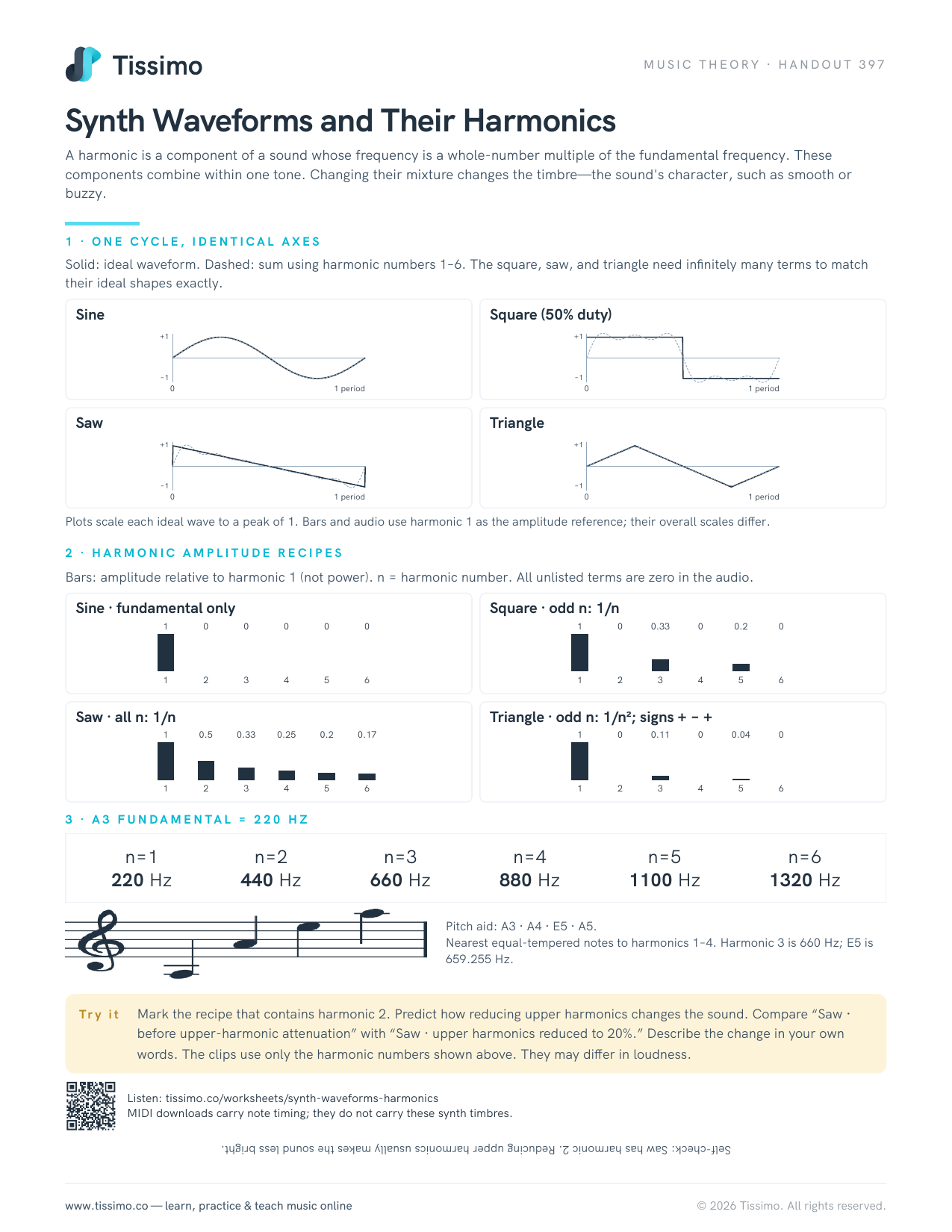 Synth Waveforms and Their HarmonicsA harmonic is a component of a sound whose frequency is a whole-number multiple of the fundamental frequency. These components combine within one tone. Changing their mixture changes the timbre—the sound's character, such as smooth or buzzy.
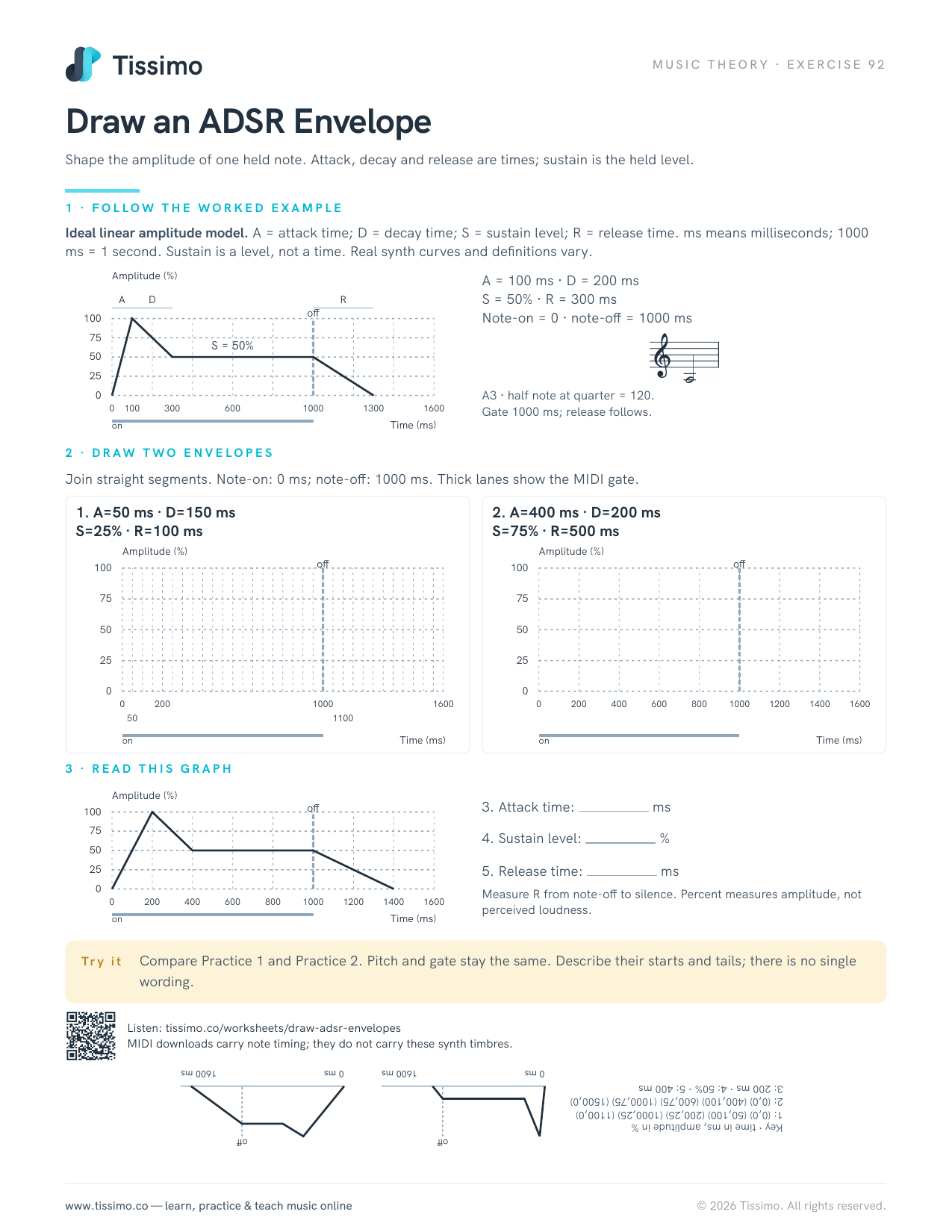 Draw an ADSR EnvelopeShape the amplitude of one held note. Attack, decay and release are times; sustain is the held level.
Comments