Scales, Keys & Modes
Minor Scale
A minor scale is a seven-note scale with a minor third between its first and third notes, which gives it a darker sound than major. It comes in three forms: natural, harmonic and melodic minor.
A minor scale is a seven-note scale whose third note is a minor third (three half steps) above the tonic. Compared with the major scale on the same note, that third is a half step lower, and it is the note that makes the scale sound minor. Hear the two colors side by side in Major & minor.
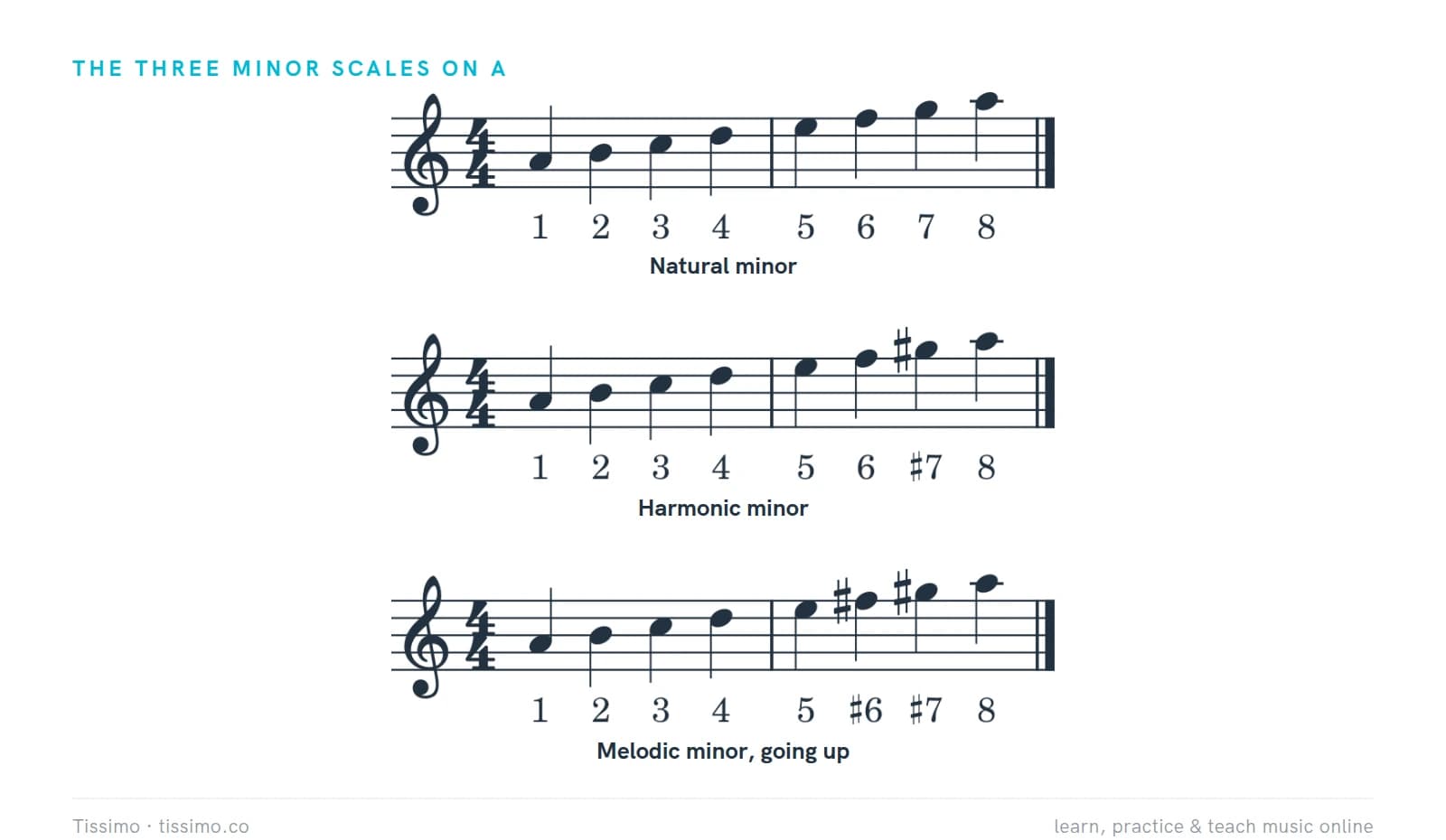
Theory books teach three forms of the minor scale. All three share their first five notes, 1 2 3 4 5 (A B C D E in A minor), and differ only in the 6th and 7th degrees.
The three forms
- Natural minor: the 6th and 7th degrees as the key signature gives them. In A minor: A B C D E F G A, with the step pattern W–H–W–W–H–W–W.
- Harmonic minor: the 7th degree raised a half step: A B C D E F G♯ A. G♯ becomes a leading tone, a half step below the tonic, and the chord on the 5th degree becomes major (E major in A minor).
- Melodic minor: going up, both the 6th and 7th are raised: A B C D E F♯ G♯ A. Coming down, they return to their natural-minor form. Jazz musicians usually keep the rising form in both directions.
Why three?
They are three versions of one key, and a piece in A minor usually mixes them. Natural minor supplies the basic notes and the key signature. Composers raise the 7th when the harmony moves to the dominant, to get a strong pull back to the tonic, and raise the 6th as well when a melody climbs smoothly up to the tonic, to avoid the wide gap between F and G♯.
How a minor key looks on the page
A minor key shares its key signature with its relative major, the major key three half steps higher. A minor and C major have no sharps or flats; D minor and F major have one flat, B♭. The raised notes of harmonic and melodic minor are not in the key signature, so they appear as accidentals. In D minor, harmonic minor needs C♯, and melodic minor going up needs B♮ and C♯.
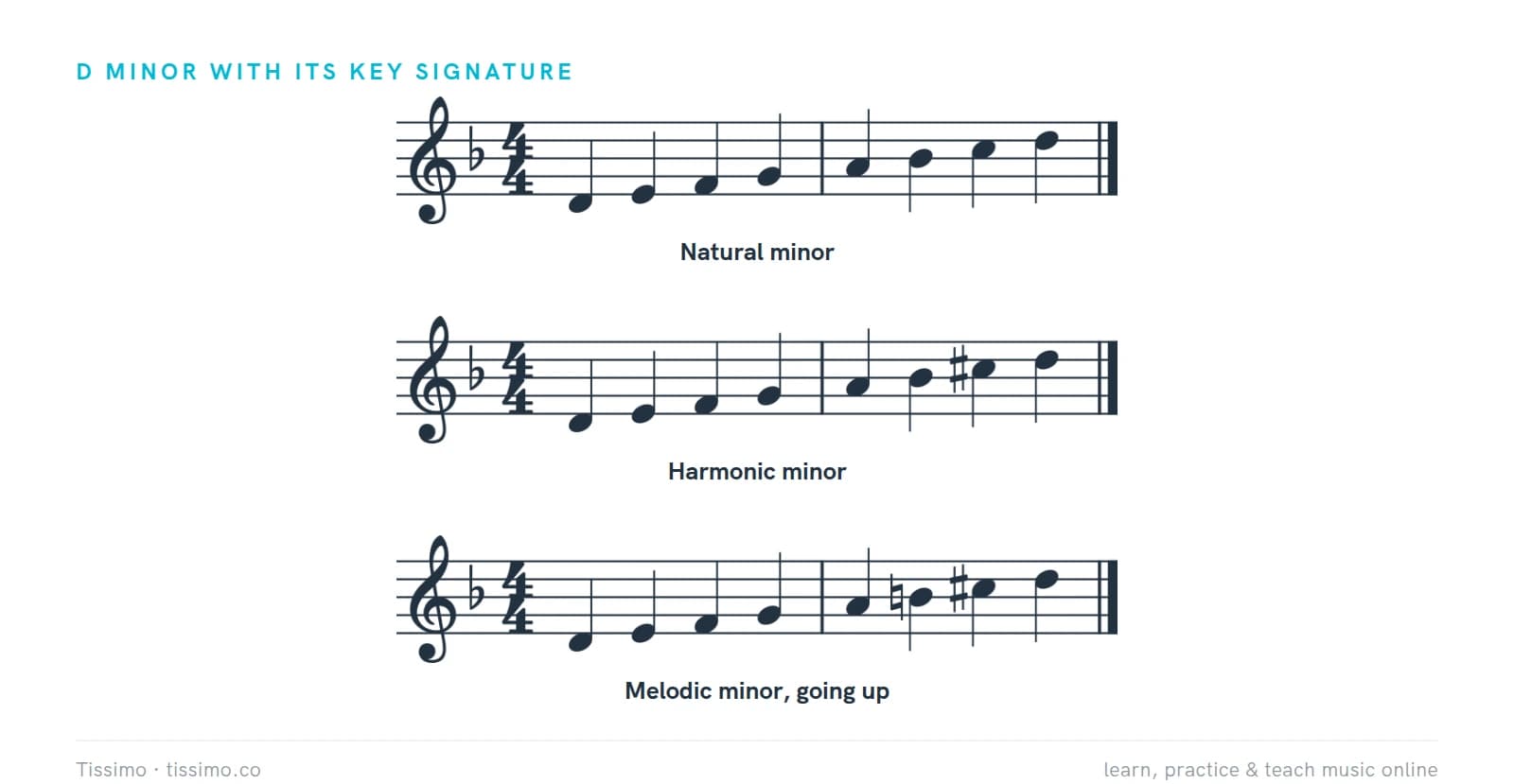
An accidental on the 7th degree is often the first clue that a piece is in a minor key rather than its relative major.
Relative and parallel minor
Two different minor keys sit close to every major key. The relative minor has the same notes and key signature but a different tonic: A minor for C major. The parallel minor has the same tonic but different notes: C minor for C major, with the 3rd, 6th and 7th lowered to E♭, A♭ and B♭ (see parallel key). The natural minor scale is also the same scale as the Aeolian mode.
Compare the forms side by side in The three minors, test yourself with Identify the minor scales, and sort relative from parallel keys in Relative or parallel?. The minor-key pages of Scales in Every Key give fingerings for all 12 minor scales.
Common questions
How many minor scales are there?
Each of the 12 notes can be the tonic of a minor scale, and each minor scale has three forms: natural, harmonic and melodic. Counting spellings, there are 15 minor keys, because three of them can be written two ways: G♯ or A♭ minor, D♯ or E♭ minor, and A♯ or B♭ minor.
What is the difference between a major and a minor scale?
The 3rd degree. A major scale has a major third above the tonic (C to E), a minor scale a minor third (C to E♭). In natural minor the 6th and 7th degrees are lowered as well: C natural minor is C D E♭ F G A♭ B♭ C.
Practice it: free worksheets
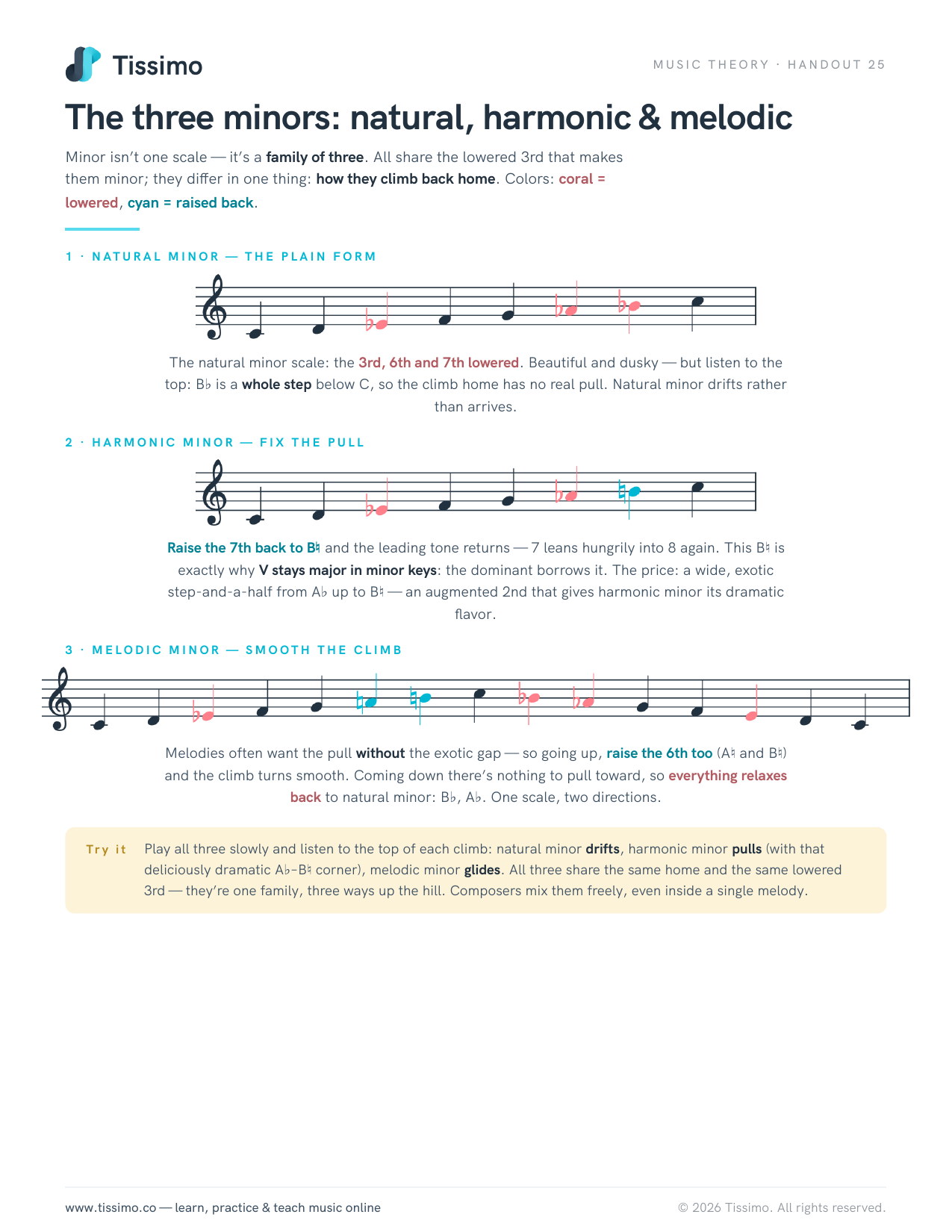 The three minors: natural, harmonic & melodicMinor isn’t one scale — it’s a family of three. All share the lowered 3rd that makes them minor; they differ in one thing: how they climb back home. Colors: coral = lowered, cyan = raised back.
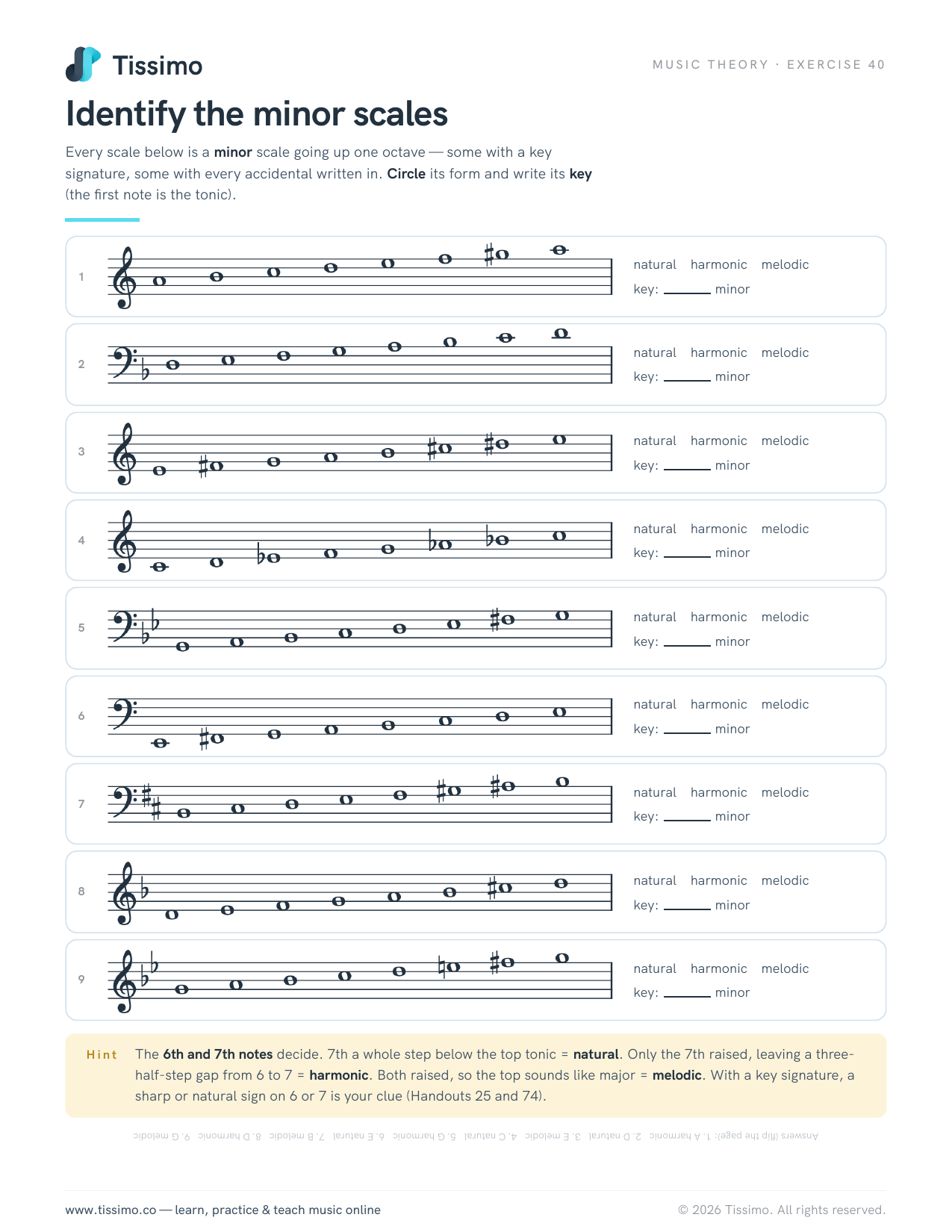 Identify the minor scalesEvery scale below is a minor scale going up one octave — some with a key signature, some with every accidental written in. Circle its form and write its key (the first note is the tonic).
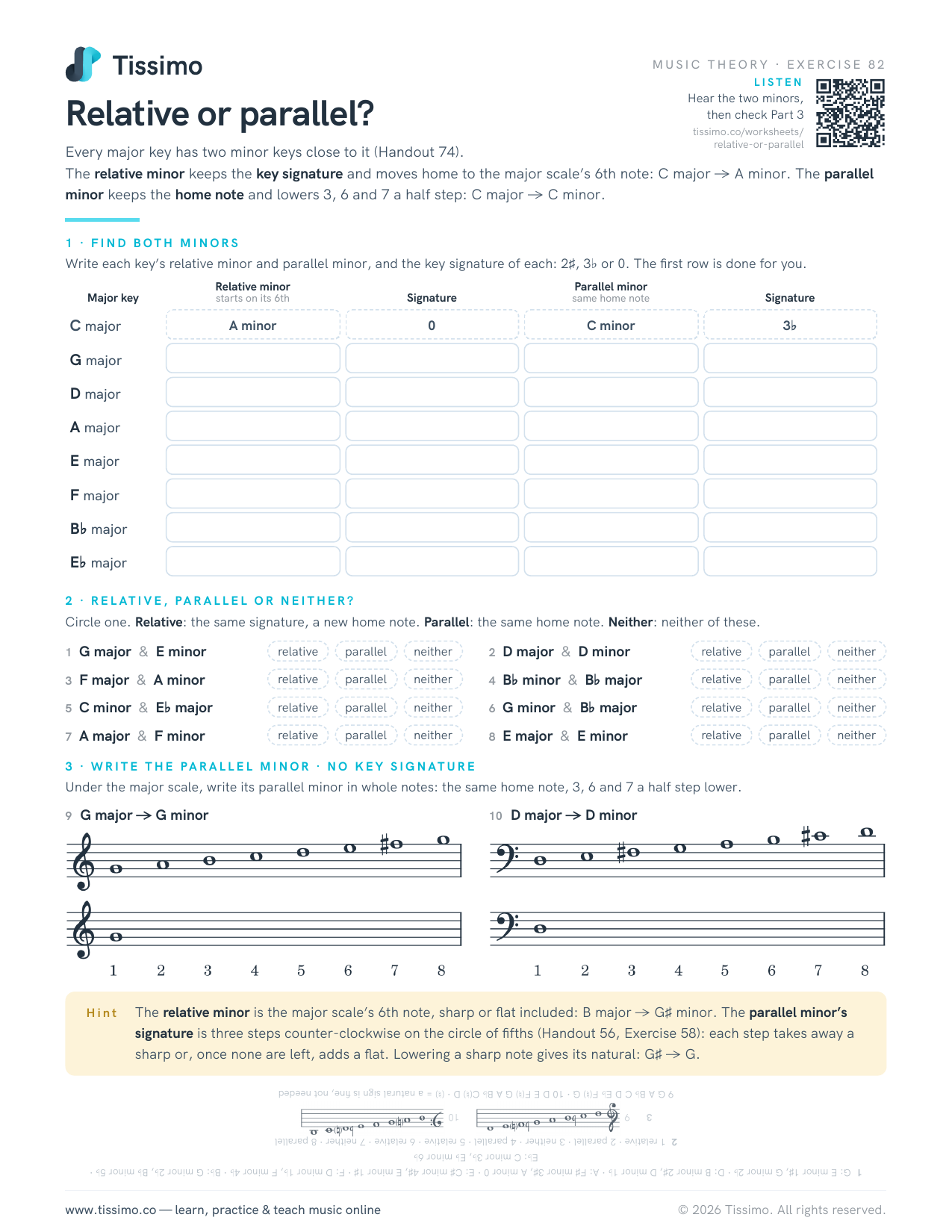 Relative or parallel?Every major key has two minor keys close to it (Handout 74). The relative minor keeps the key signature and moves home to the major scale’s 6th note: C major → A minor. The parallel minor keeps the home note and lowers 3, 6 and 7 a half step: C major → C minor.
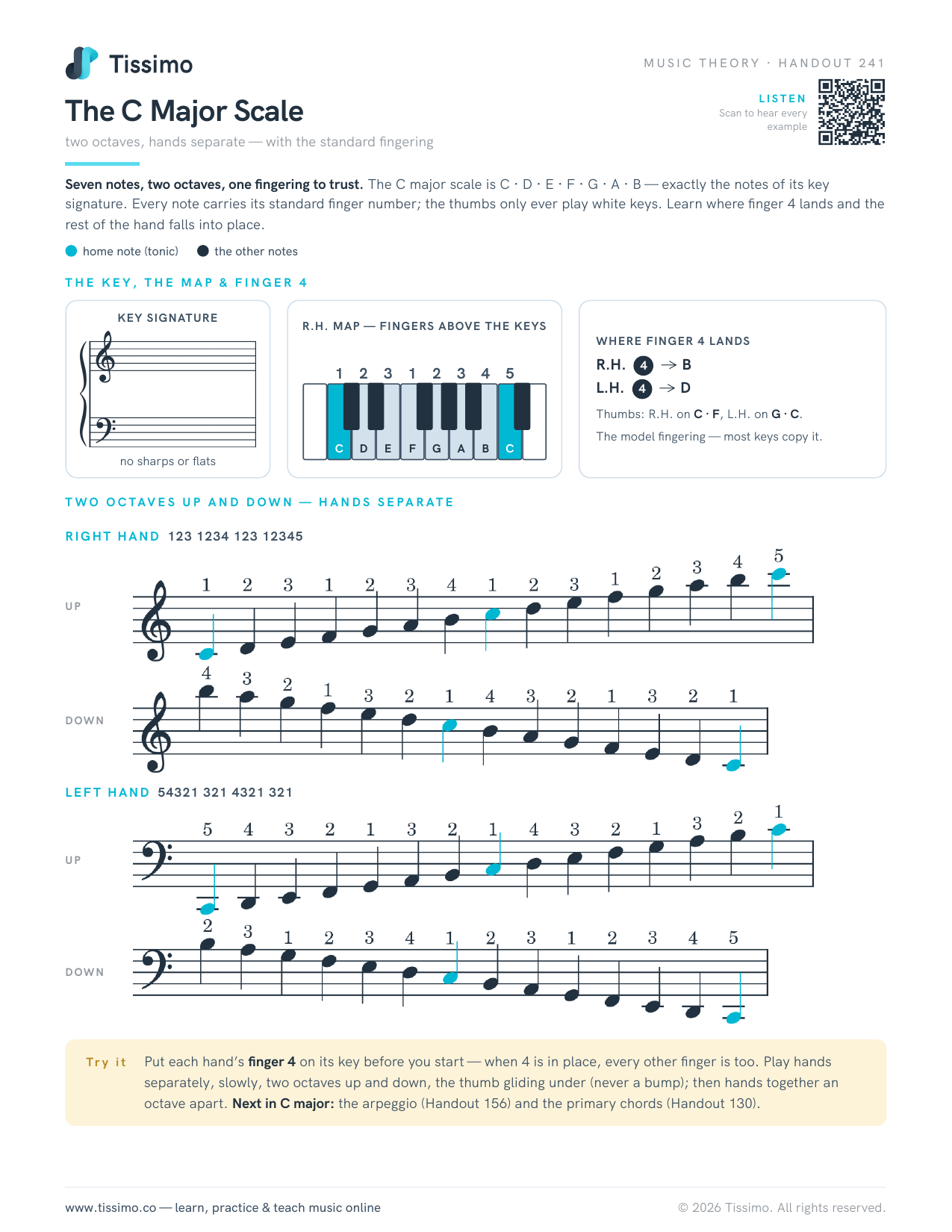 Scales in Every KeyTwo octaves up and down with the standard fingering on every note, in all 24 keys.
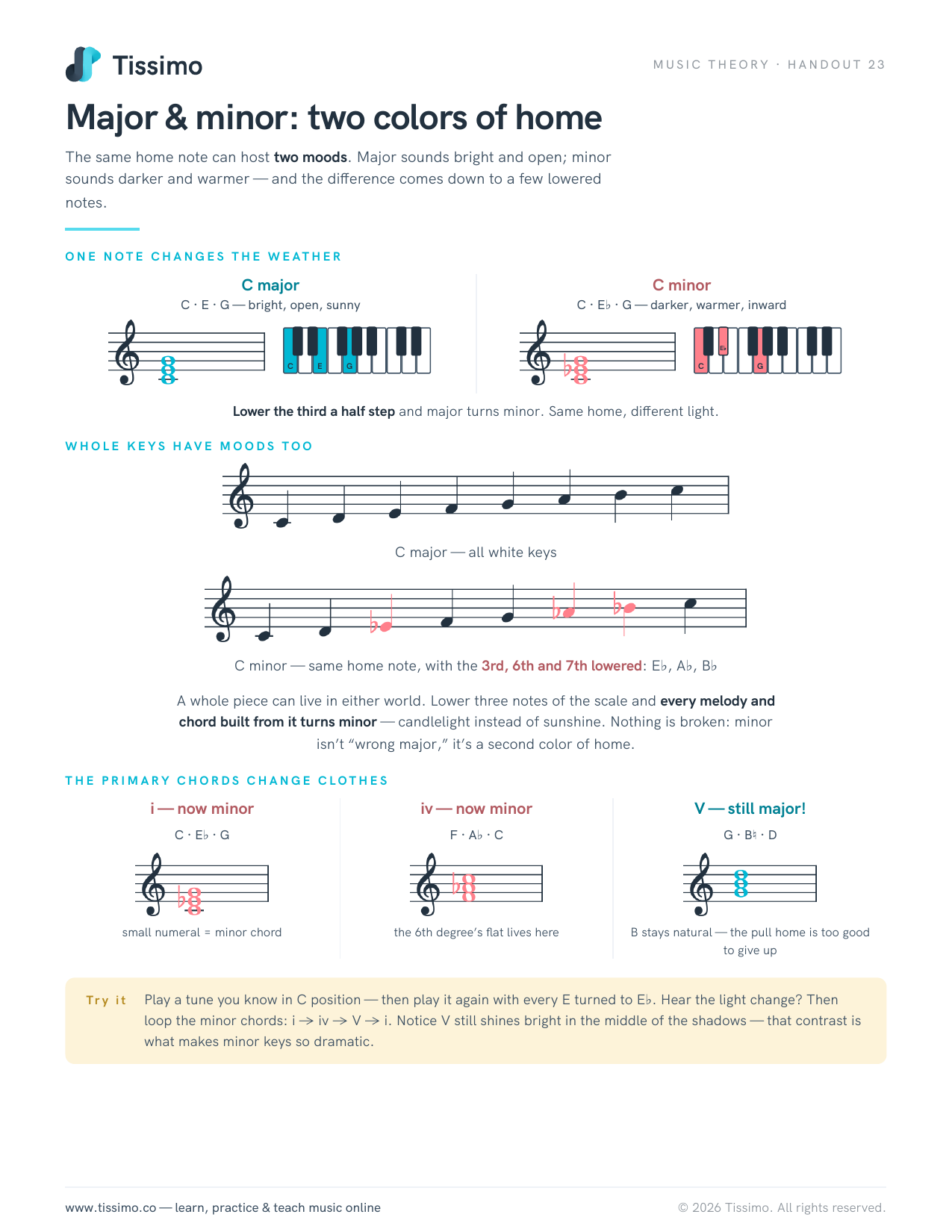 Major & minor: two colors of homeThe same home note can host two moods. Major sounds bright and open; minor sounds darker and warmer — and the difference comes down to a few lowered notes.
Comments