Chords & Harmony
I–V–vi–IV Progression
The I–V–vi–IV progression is a four-chord loop built on the 1st, 5th, 6th and 4th degrees of a major key, such as C–G–Am–F in C major. It is one of the most common progressions in pop music.
The I–V–vi–IV progression uses four chords of a major key in a fixed order: the tonic (I), the dominant (V), the submediant (vi, a minor chord) and the subdominant (IV). In C major that is C – G – Am – F; in G major it is G – D – Em – C. Three of them are the primary chords, and vi is the relative minor of I, so the loop is easy to play in any key, and it repeats over and over through a verse or a chorus. The pop music and chord progression entries show it in C major.
Many names, one loop
Open Music Theory calls it the singer/songwriter progression, because it became especially common with singer-songwriters of the mid-1990s, although it is much older and is heard in many styles. Many musicians call it the axis progression, after the comedy group Axis of Awesome, whose video demonstrates it with snippets of many songs. Players often just say "one, five, six, four".
Rotations
Because it loops, the progression can start on any of its four chords. Two starting points are especially common:
- I–V–vi–IV, starting on the major tonic.
- vi–IV–I–V, the same cycle starting on the minor chord: Am – F – C – G in C major.
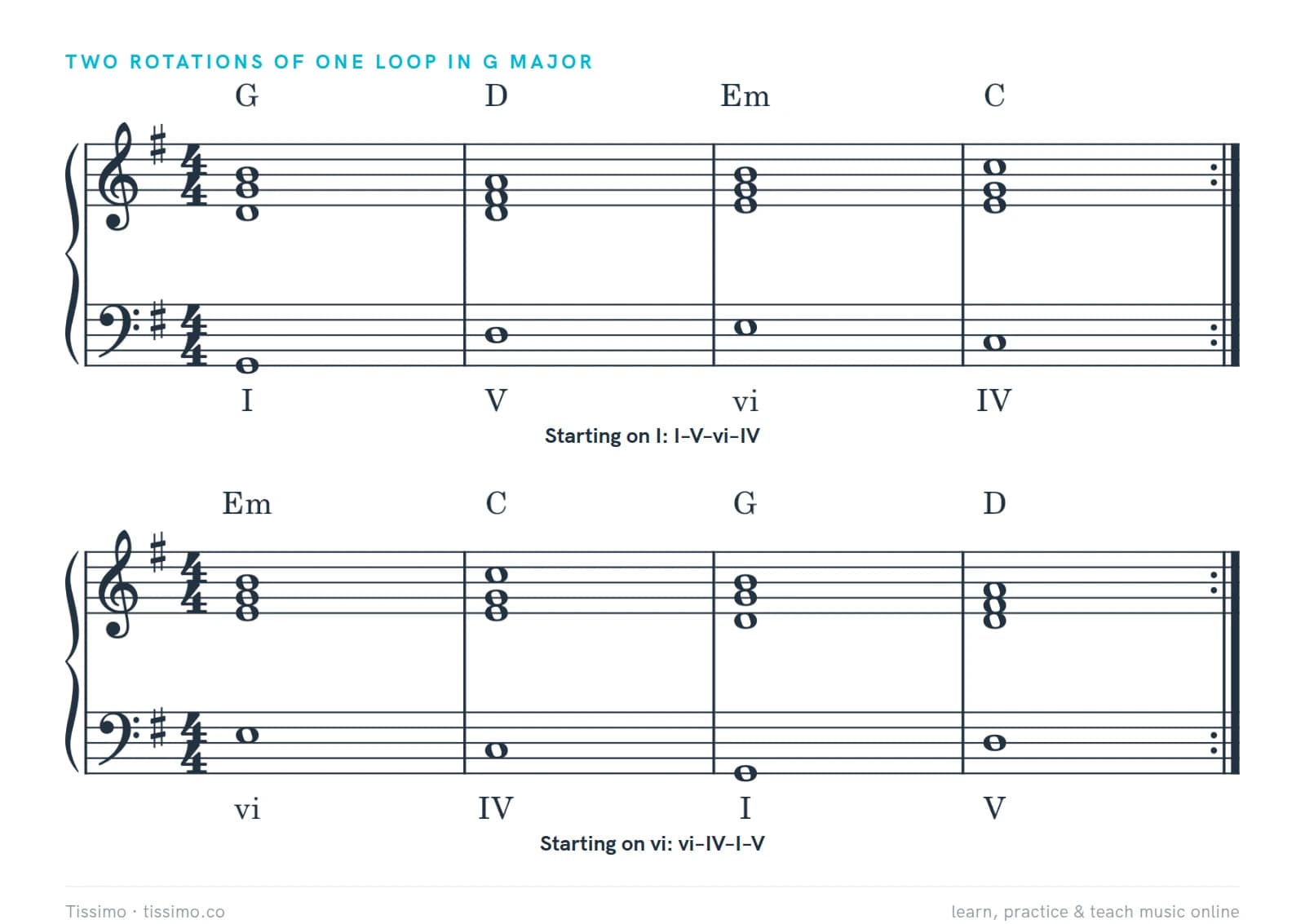
Starting on vi changes the mood. The loop can now sound as if it is in the relative minor, as i–VI–III–VII (Em – C – G – D in E minor). Open Music Theory points out that the progression has no V–I authentic cadence: the only moves into a tonic are IV to I or the step from VII to i. So your ear decides which chord is home from the melody, the bass and where the loop begins and ends. A third rotation, IV–I–V–vi, ends each cycle with V moving to vi, a little deceptive cadence.
Not the fifties progression
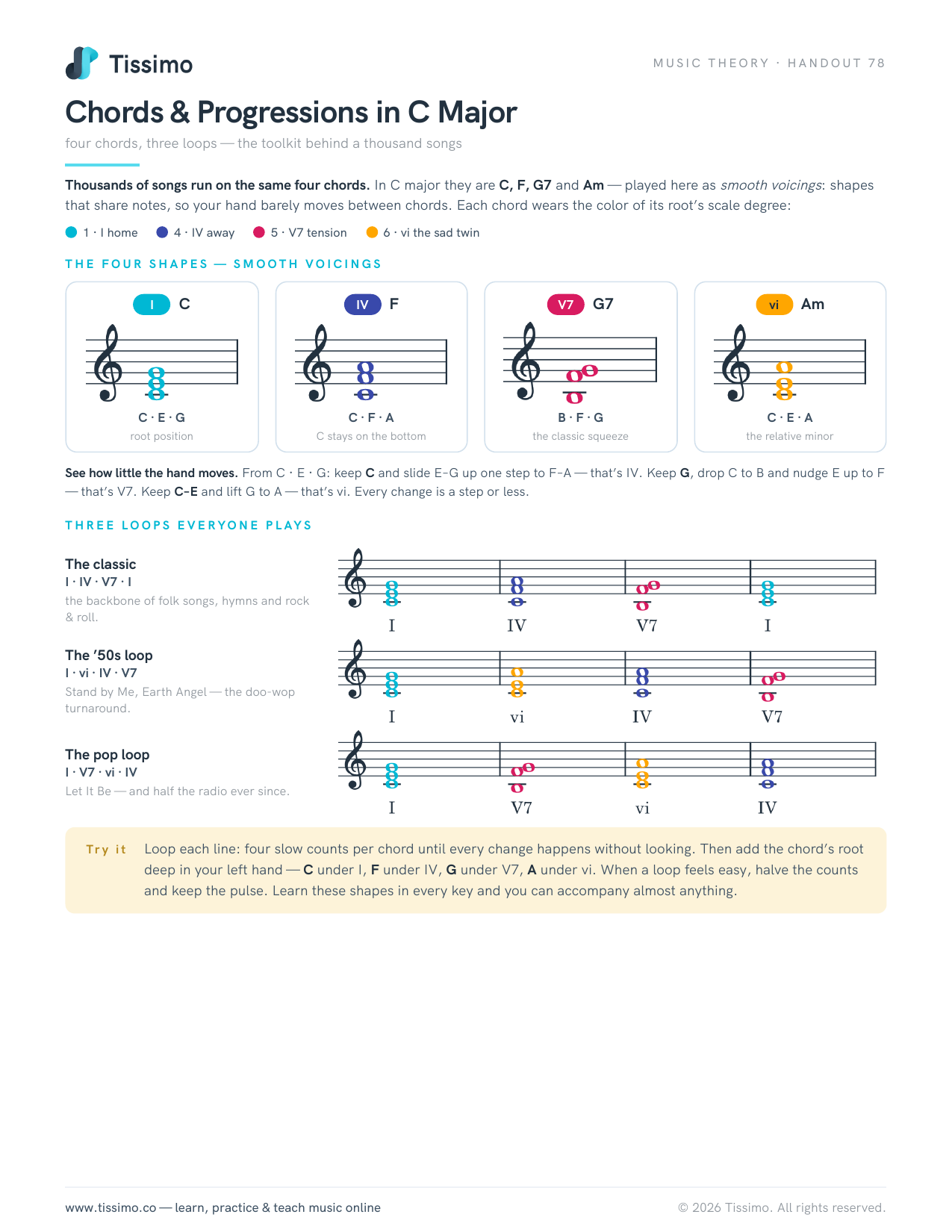
The doo-wop or "fifties" progression, I–vi–IV–V, uses the same four chords in a different order. The order matters: the fifties loop ends on V and pulls back to I with a strong authentic motion, while I–V–vi–IV keeps circling.
Playing it
At the keyboard, keep the right hand close: from G (D G B), move to D (D F♯ A), then Em (E G B) and C (E G C), so no note moves more than a step. Play the roots in the left hand. Then start the loop on vi and listen for the change in mood. Chords & Progressions in Every Key gives you this loop, the "pop loop" (with V7 in place of V), in every major key.
Common questions
Is I–V–vi–IV the same as the fifties progression?
No. They use the same four chords, but the fifties (doo-wop) progression runs I–vi–IV–V: C – Am – F – G in C major. Its last chord, V, leads back to I with an authentic cadence; I–V–vi–IV has no V–I move.
Why does vi–IV–I–V sound sad?
Starting on the minor chord lets the ear hear it as home, so the loop can sound like a minor key: i–VI–III–VII in the relative minor. The chords are the same; only the starting point has changed.
Comments