Chords & Harmony
Turnaround
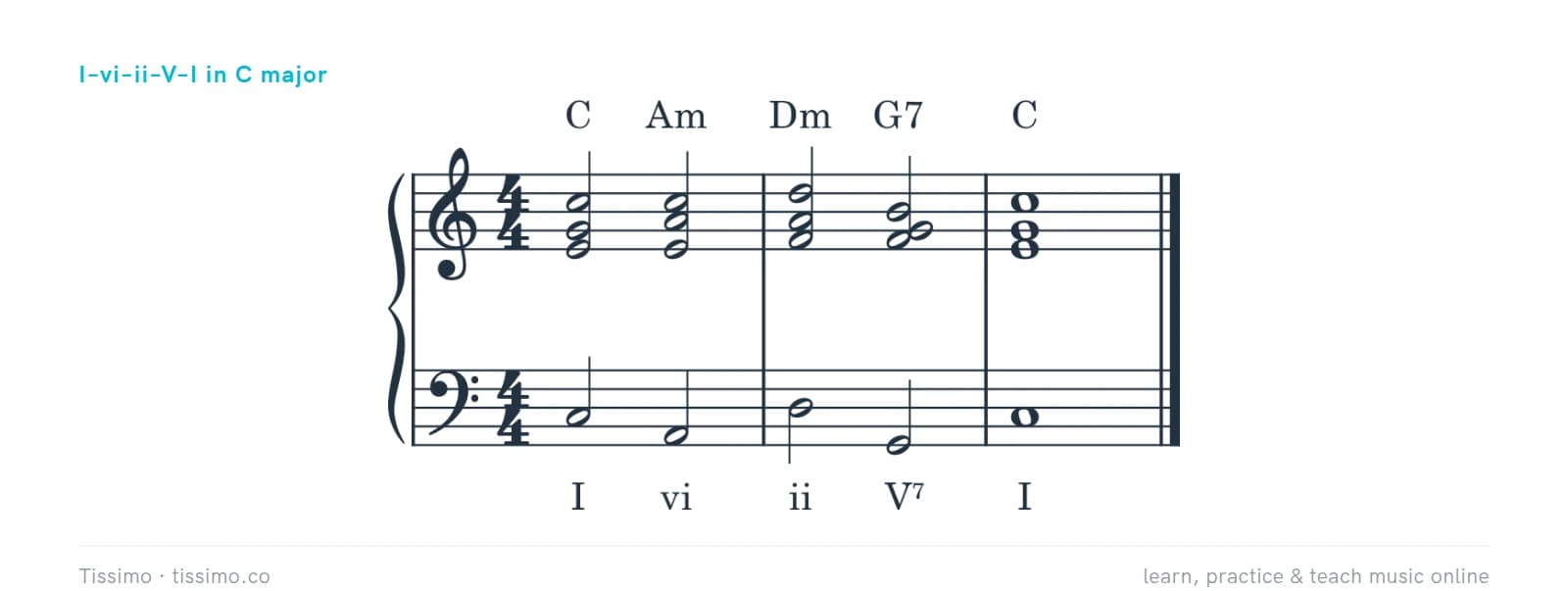
A turnaround is a short chord progression at the end of a section that leads the music back to its beginning so it can repeat. A classic turnaround is I–vi–ii–V, such as C–Am–Dm–G7 in C major.
A turnaround is the short chord pattern at the end of a section, just before the band "turns around" to play the section again. Its job is to lead the ear back to the first chord, so the repeat feels inevitable instead of abrupt. It is usually short, often just two bars, and the chords tend to change faster there than in the rest of the tune. Jazz musicians also call it a turnback (or turn back).
The classic turnaround: I–vi–ii–V
In C major, the classic turnaround is C – Am – Dm – G7, two chords per bar, leading back to C. After the first move, each root falls a fifth: A to D, D to G, G to C. That chain around the circle of fifths ends with the ii–V–I, so the return to C sounds as strong as a cadence.
Jazz musicians also loop the same pattern to make up an introduction on the spot.
Variations
The classic pattern has many relatives. Each keeps the goal, a V chord that leads back to I, and changes the road to it:
- I–VI7–ii–V7: the vi becomes a dominant seventh (A7 in C), a secondary dominant that points to Dm.
- iii–vi–ii–V: the first chord is Em instead of C, so the roots fall by fifths all the way (E–A–D–G).
- With a tritone substitution: D♭7 replaces G7 and slides down a half step to C (see tritone substitution).
In the blues
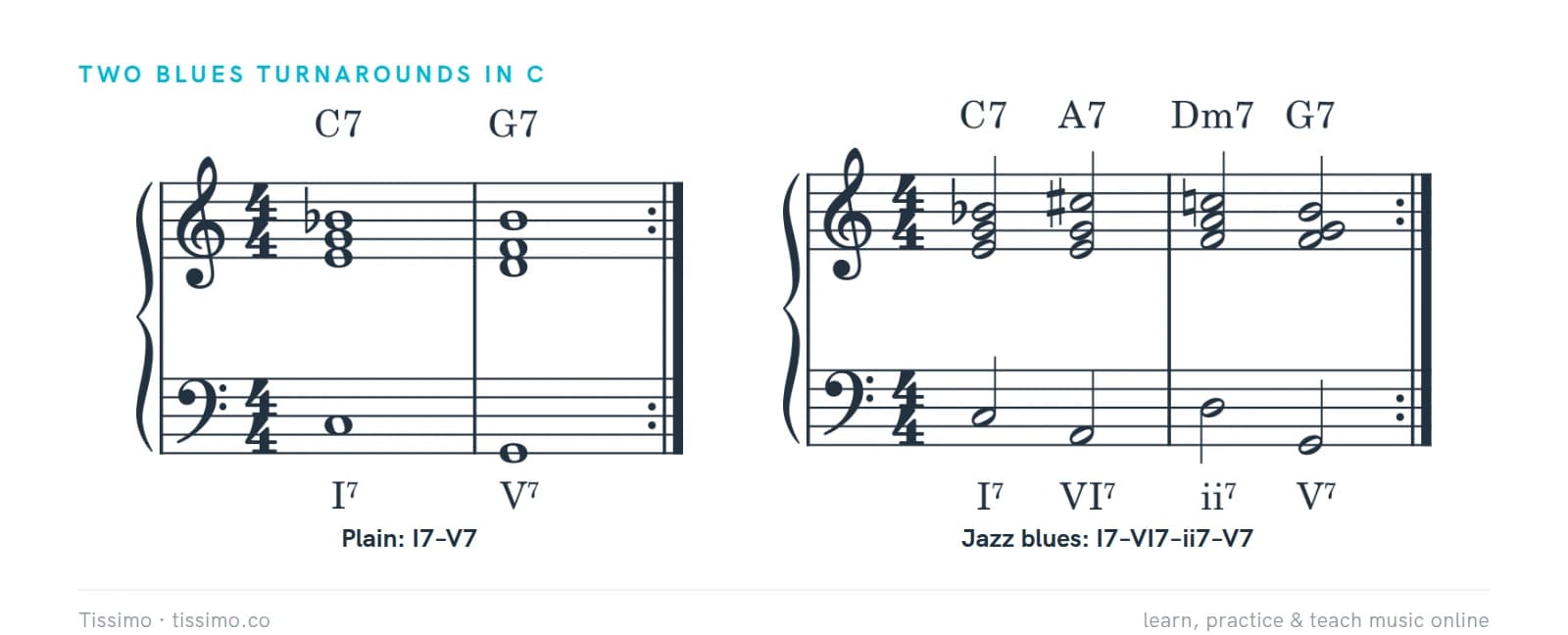
In the twelve-bar blues, the turnaround is the last two bars, 11 and 12, which lead back to bar 1. The plainest version stays on the I chord in bar 11 and moves to V in bar 12 (C7 to G7 in C). Jazz blues players fill the same two bars with I–VI7–ii–V7. On the final chorus the band usually skips the turnaround and ends on I.
A progression or a turnaround?
"Turnaround" names a job, not a fixed list of chords. Looped through a whole song, I–vi–ii–V is simply a chord progression; together with I–vi–IV–V, which has IV (F) in place of ii (Dm), it is the "50s doo-wop" loop heard in many rock ballads of the 1950s and early 1960s. The same chords become a turnaround when they sit at the end of a section and lead back to its start. The ii version gives the jazzier lead-in, because its roots fall by fifths (D to G to C), the strongest root motion in tonal harmony.
Practice the ii–V that ends the classic turnaround with The ii–V–I in Every Key, the A7 of I–VI7–ii–V with Secondary dominants, and the blues ending with The 12-Bar Blues. Chords & Progressions in Every Key drills common loops in all keys.
Common questions
What is a turnaround in music?
A short chord progression, usually at the end of a section, that leads back to the beginning so the section can repeat. In C major the classic one is C–Am–Dm–G7.
Where is the turnaround in a 12-bar blues?
In the last two bars, 11 and 12. The plain version is I in bar 11 and V in bar 12; jazz blues players often use I–VI7–ii–V7 there instead.
Practice it: free worksheets
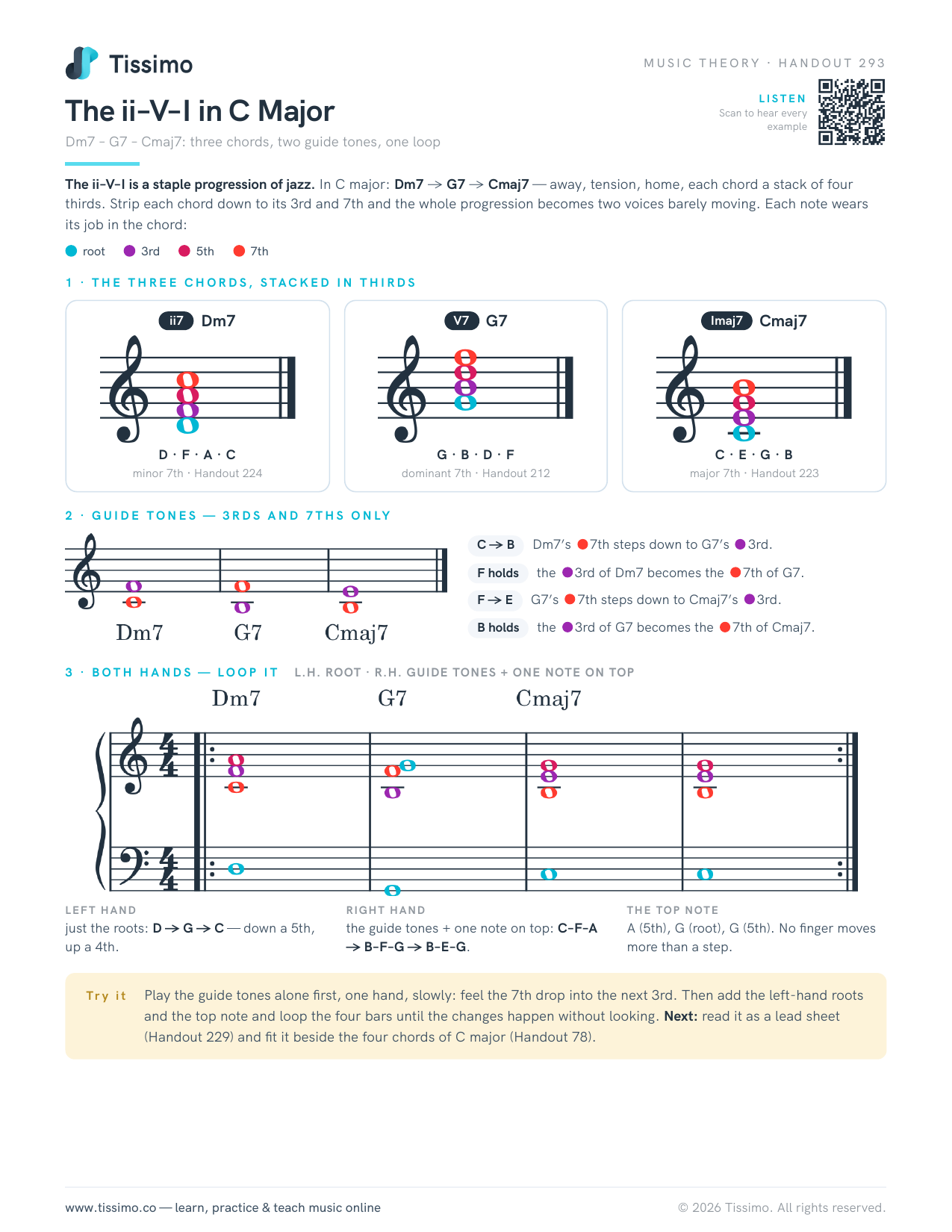 The ii–V–I in Every KeyThe most-played progression in jazz: three chords, two guide tones, one loop, in all 24 keys.
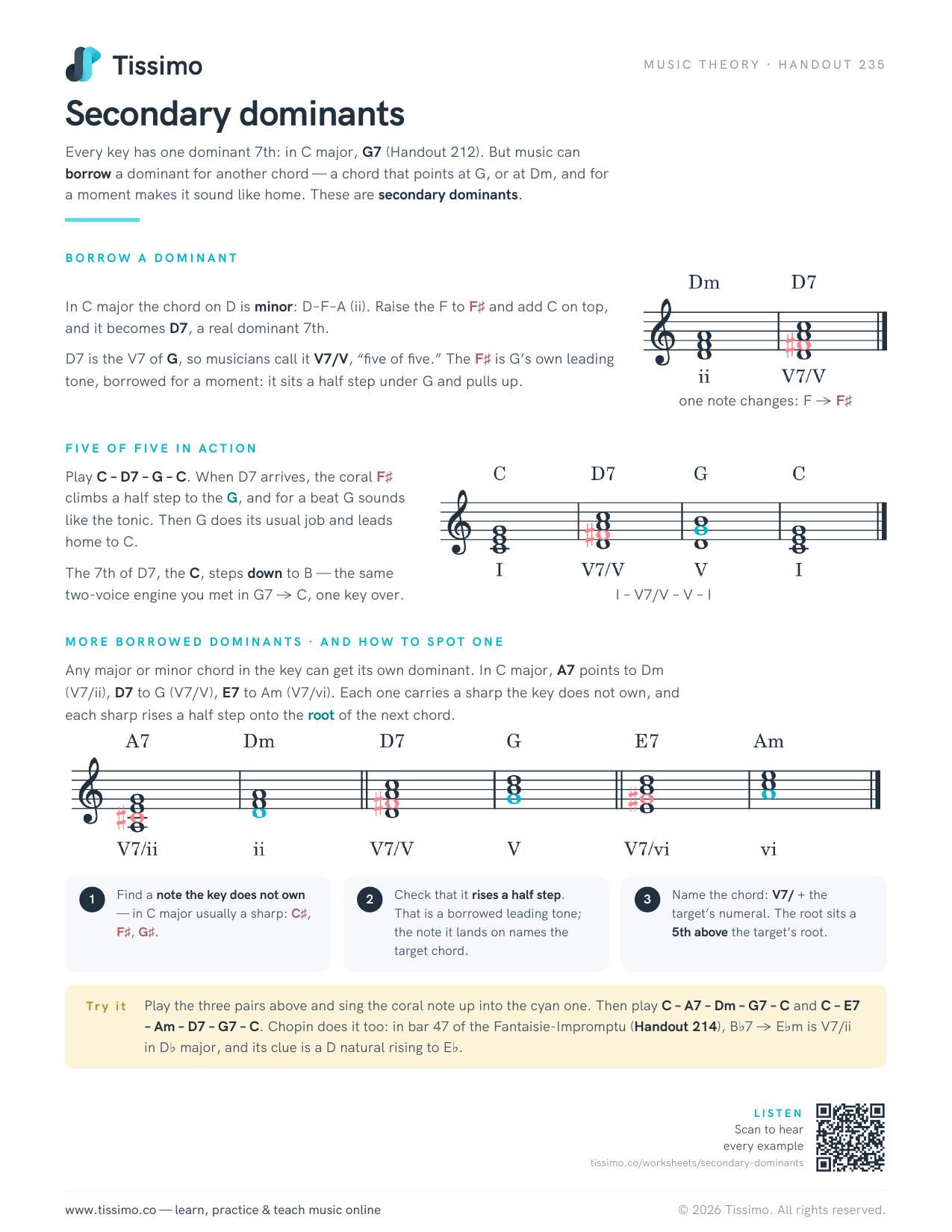 Secondary dominantsEvery key has one dominant 7th: in C major, G7 (Handout 212). But music can borrow a dominant for another chord — a chord that points at G, or at Dm, and for a moment makes it sound like home. These are secondary dominants. (Borrowing a chord from the parallel minor is different: Handout 384.)
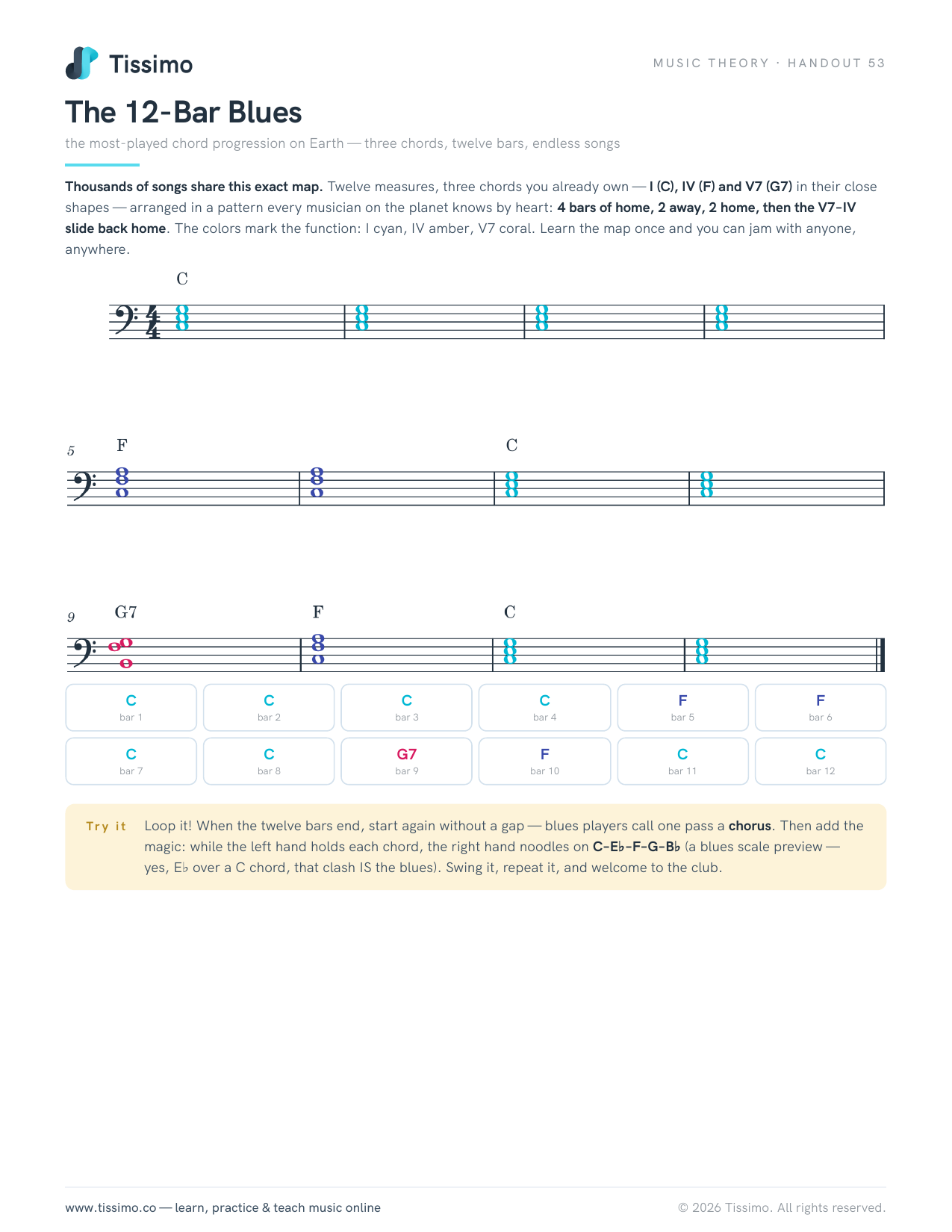 The 12-Bar Bluesone of the best-known chord progressions — three chords, twelve bars, endless songs
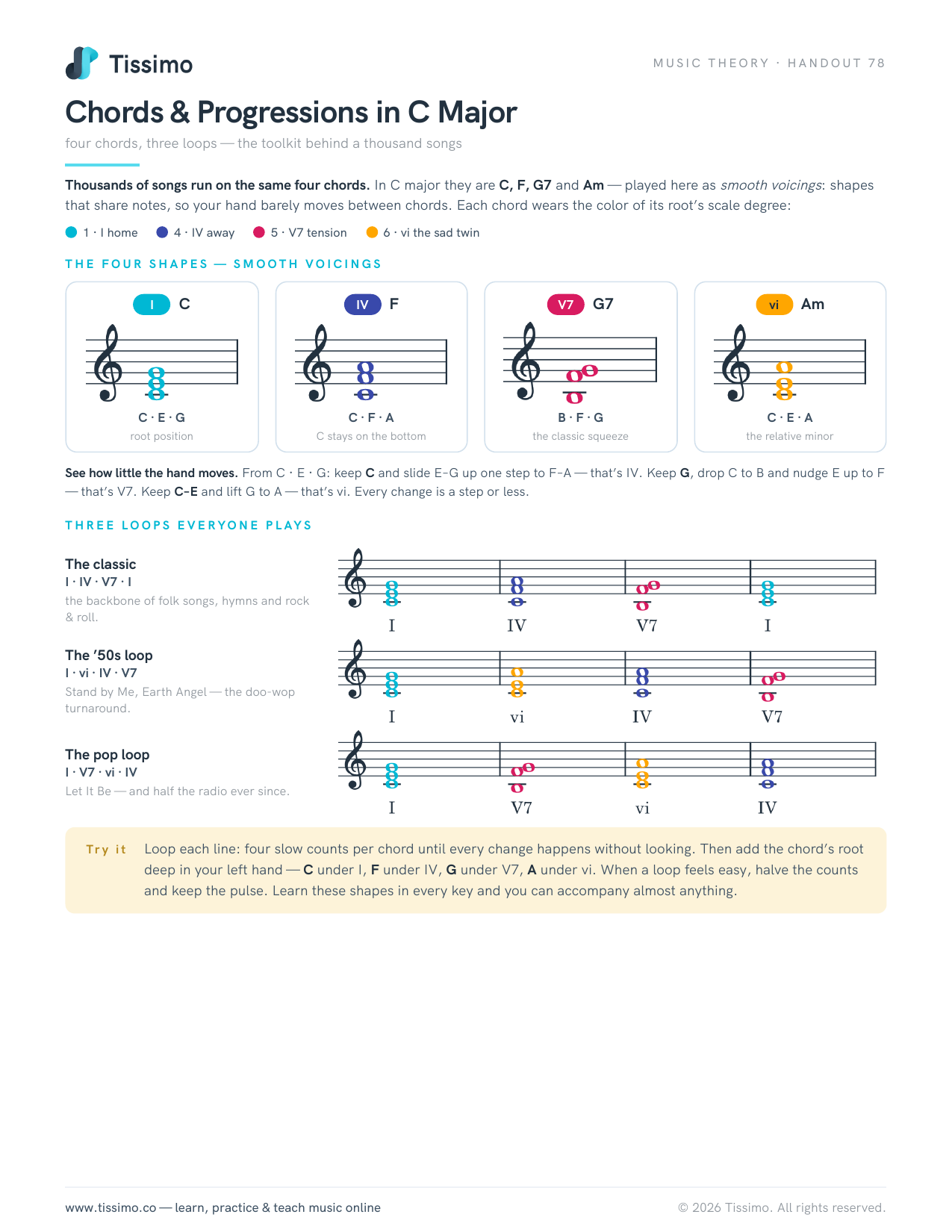 Chords & Progressions in Every KeyFour chords, three loops — the toolkit behind a thousand songs, in all 24 keys.
Comments