Scales, Keys & Modes
Closely Related Keys
Closely related keys are the keys whose key signatures differ from the home key's by no more than one sharp or flat. Every major and minor key has five of them, and music modulates to them most often.
When a piece modulates, it most often moves to a key that is close to home. Closely related keys are the keys whose key signatures differ from the home key's by no more than one sharp or flat. Every major and every minor key has five of them: its relative major or minor, plus the major and minor keys with one sharp more and with one sharp fewer (or one flat fewer and one flat more).
Because their signatures are so alike, these keys share most of their notes with the home key. That is why a move between them sounds smooth: often a single new accidental is enough to point the music to its new tonic.
The closely related keys of C major and A minor
C major has no sharps or flats, so its closely related keys are:
- A minor: the same key signature (the relative minor).
- G major and E minor: one sharp.
- F major and D minor: one flat.
A minor shares the key signature of C major, so it belongs to the same family. Its closely related keys are C major, G major, E minor, F major and D minor.
A shortcut: the chords of the key
There is a second way to find them. Take the other major and minor triads that belong to the home key, leaving out its own tonic chord: each one is the tonic chord of a closely related key. In C major these are Dm (ii), Em (iii), F (IV), G (V) and Am (vi). The diminished triad on B (vii°) cannot be the tonic of a key, so it is left out. In a minor key, use the chords of the natural minor scale: in A minor, C, Dm, Em, F and G.
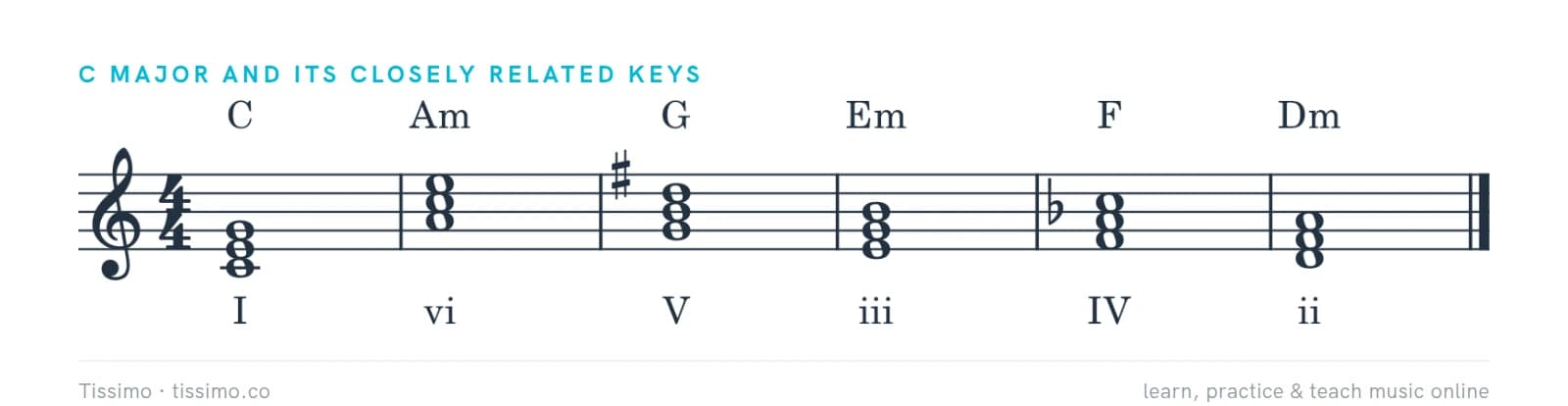
Where music goes
In the Baroque and Classical eras, a piece in a major key most often moved to its dominant key, and a piece in a minor key to its relative major: both are closely related keys. Romantic composers also explored more remote keys, which theory books call distantly related or "foreign".
Parallel keys are not closely related
C major and C minor share a tonic, but C minor has three flats, so it is three steps away. Parallel keys are in fact distantly related. Telling a relative key from a parallel key is the point of Relative or parallel?.
Common questions
What are the closely related keys of G major?
E minor (the relative minor, one sharp), D major and B minor (two sharps), and C major and A minor (no sharps). Their tonic chords are vi, V, iii, IV and ii in G major.
Is the parallel minor a closely related key?
No. C minor has three more flats than C major, so it is distantly related, even though it has the same tonic. The relative minor, A minor, is the closely related one.
Practice it: free worksheets
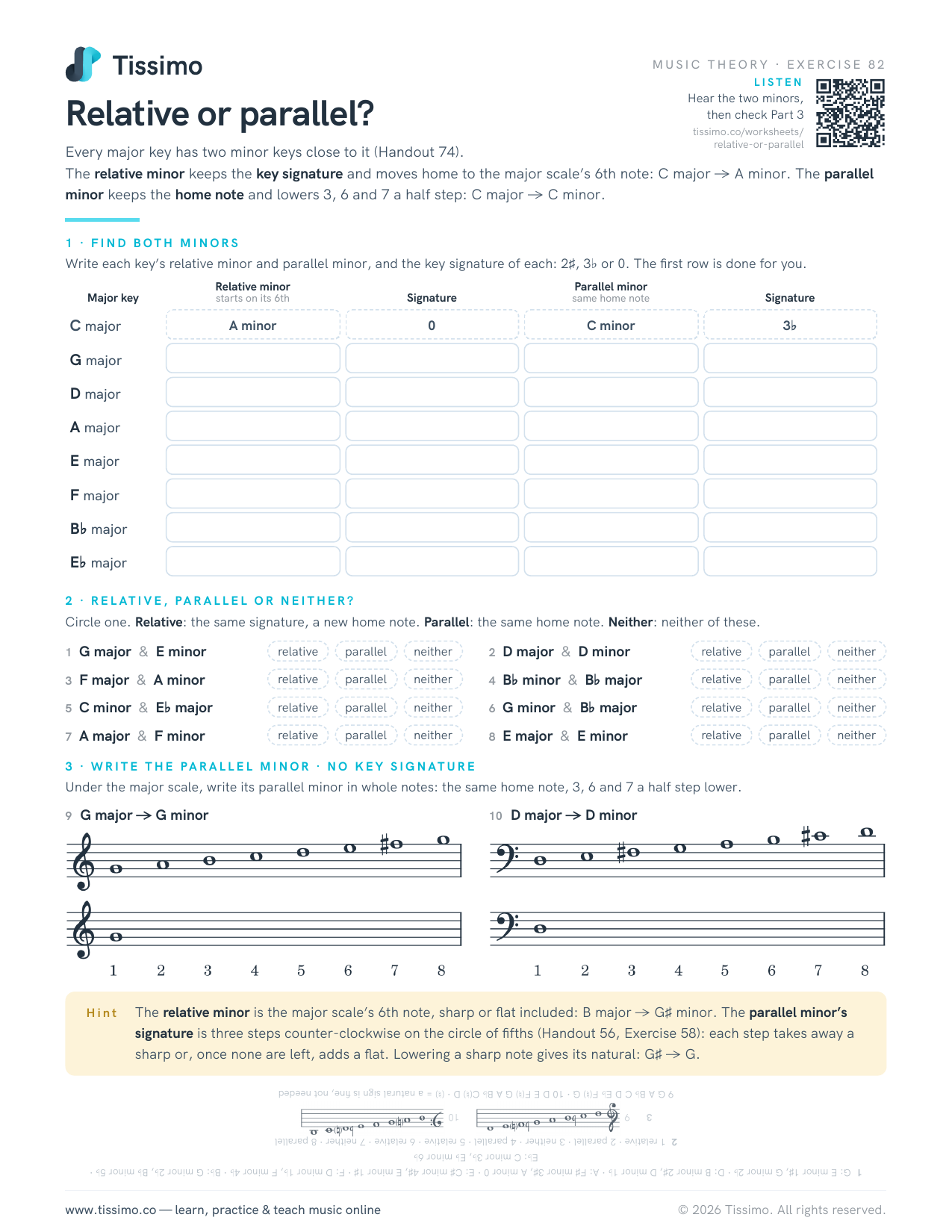 Relative or parallel?Every major key has two minor keys close to it (Handout 74). The relative minor keeps the key signature and moves home to the major scale’s 6th note: C major → A minor. The parallel minor keeps the home note and lowers 3, 6 and 7 a half step: C major → C minor.
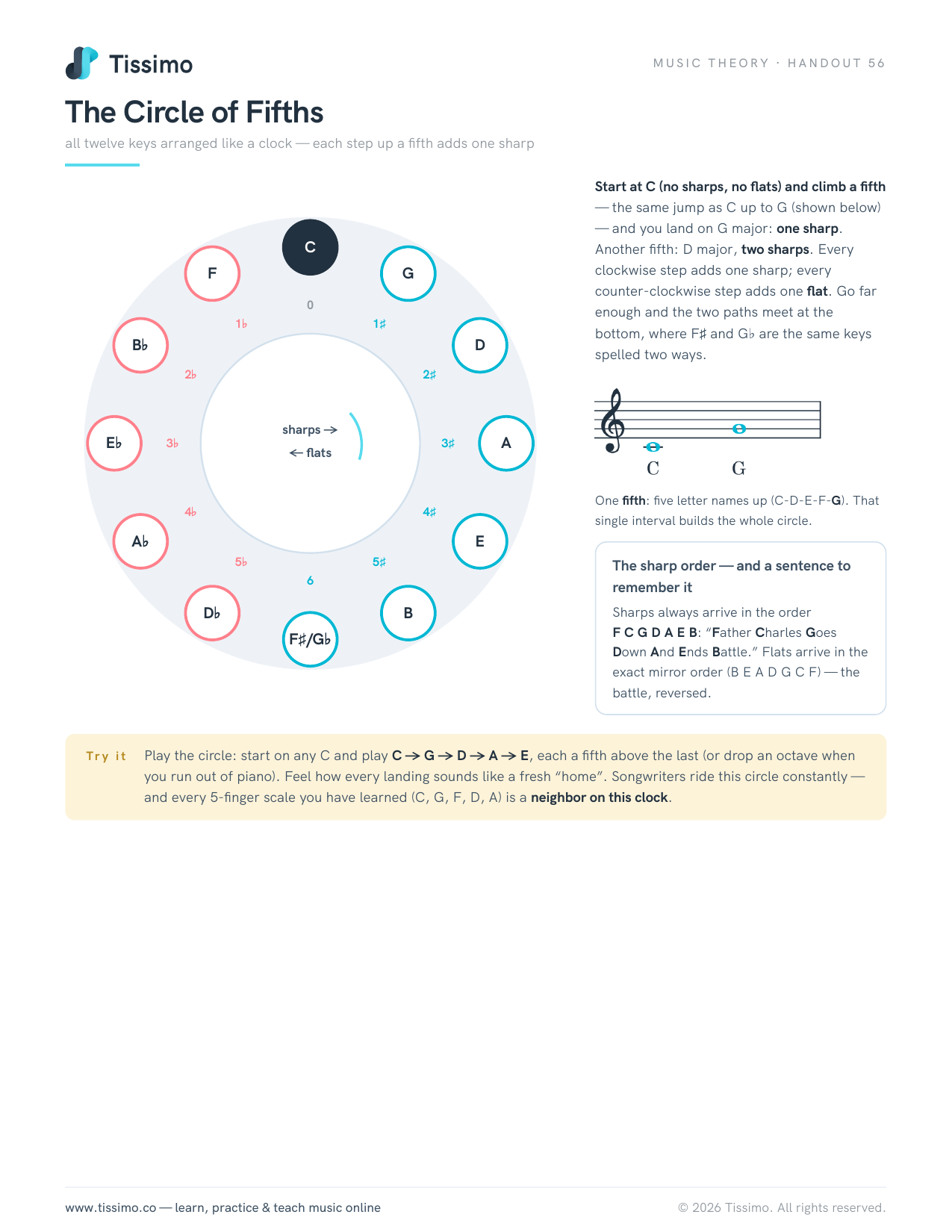 The Circle of Fifthsall twelve keys arranged like a clock — each step up a fifth adds one sharp
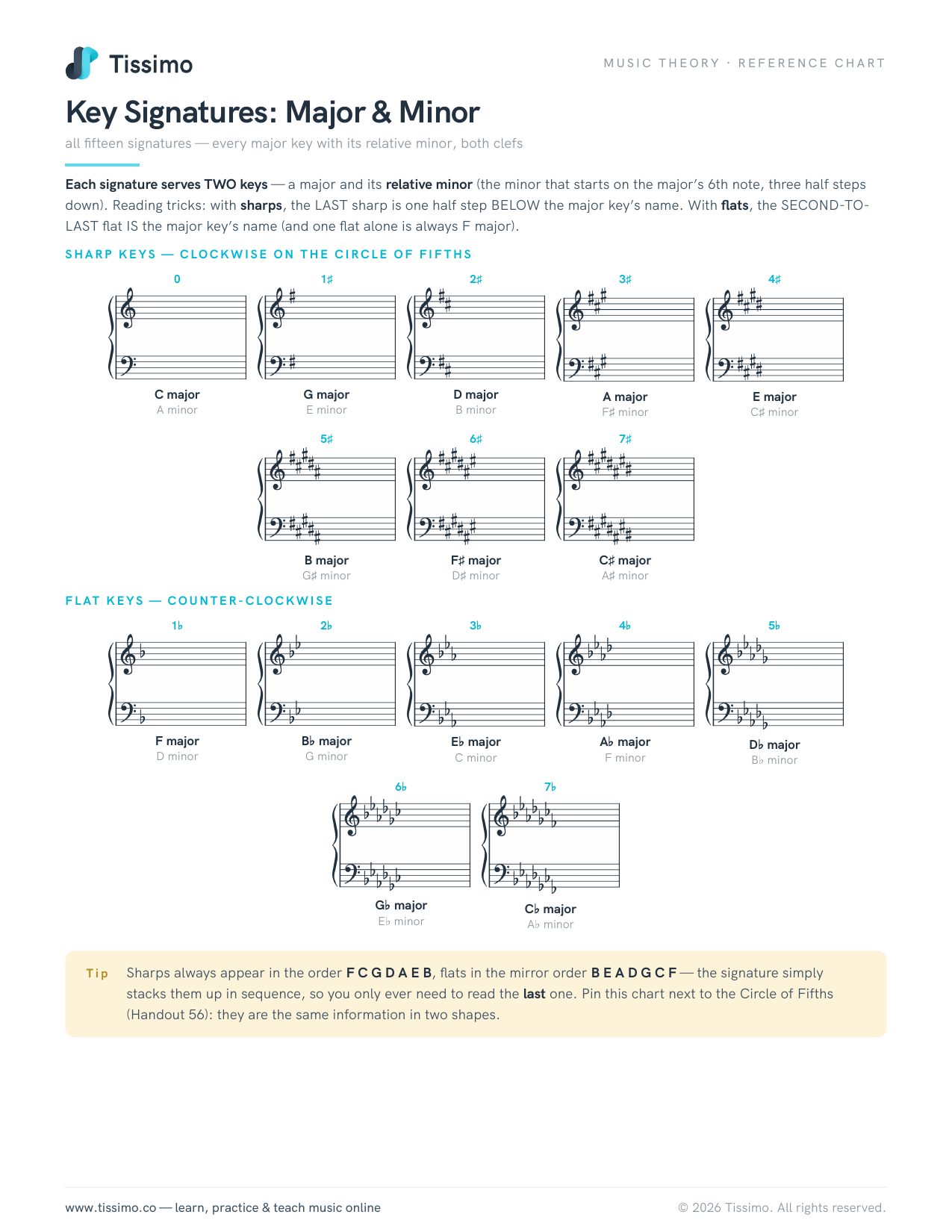 Key Signatures: Major & Minorall fifteen signatures — every major key with its relative minor, both clefs
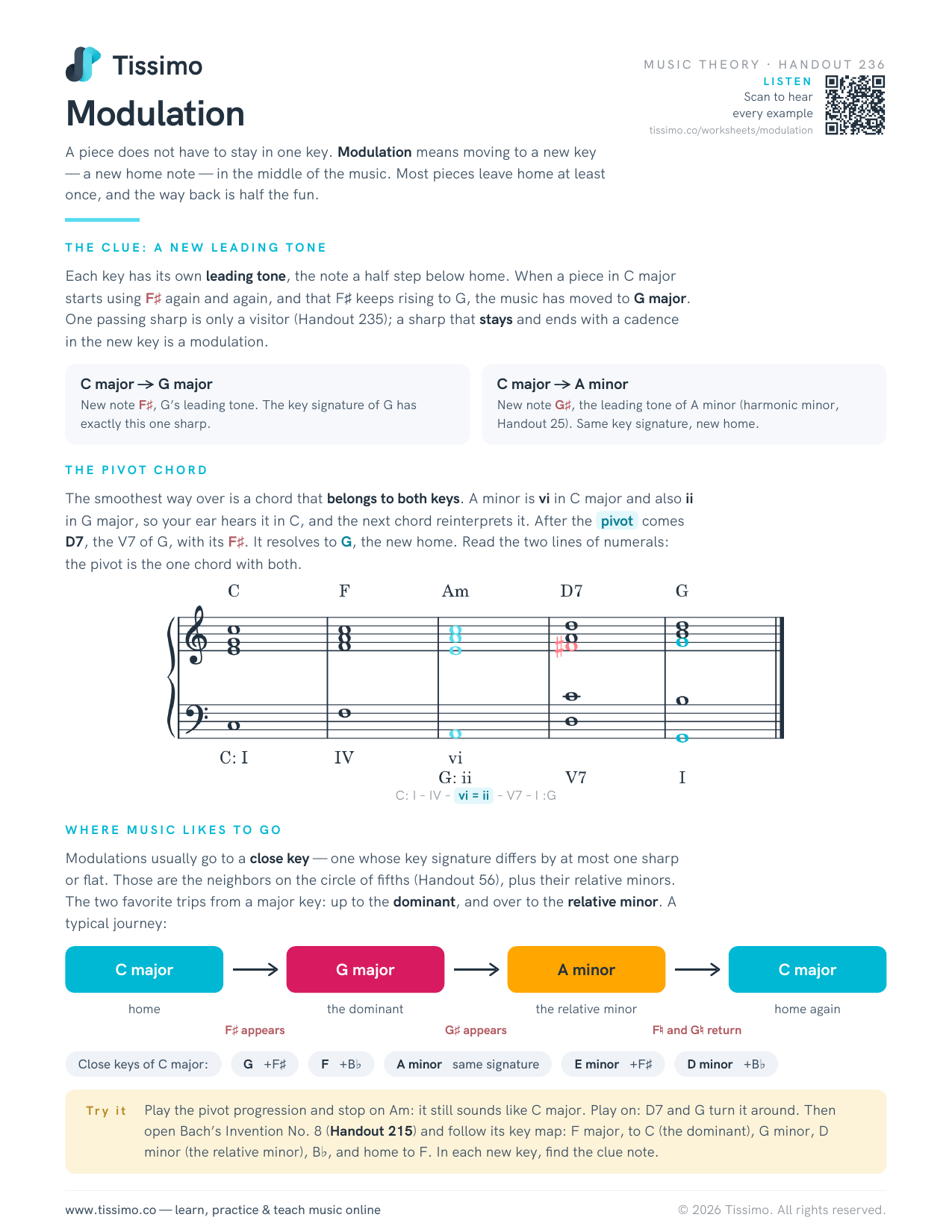 ModulationA piece does not have to stay in one key. Modulation means moving to a new key — a new home note — in the middle of the music. Most pieces leave home at least once, and the way back is half the fun.
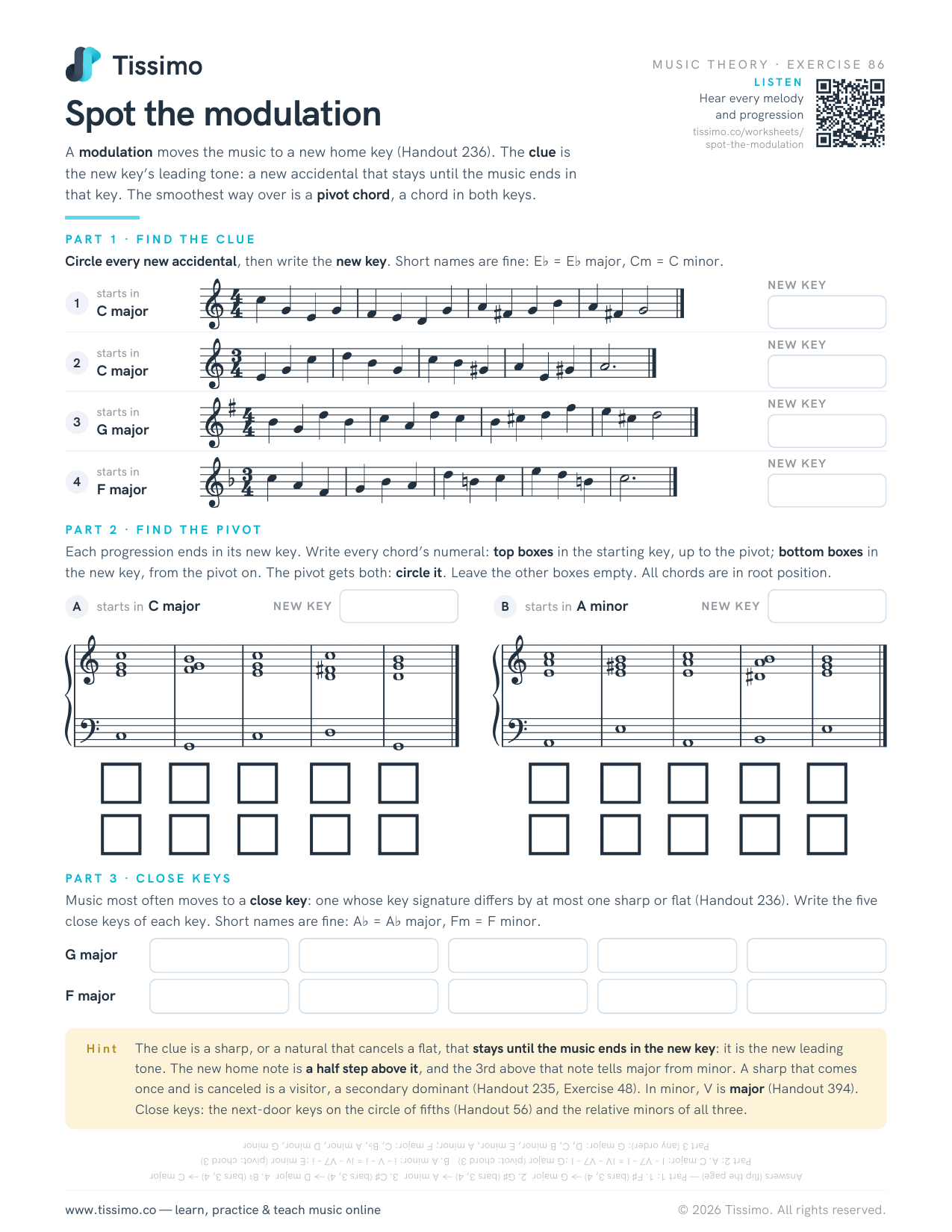 Spot the modulationA modulation moves the music to a new home key (Handout 236). The clue is the new key’s leading tone: a new accidental that stays until the music ends in that key. The smoothest way over is a pivot chord, a chord in both keys.
Comments