Sound & Acoustics
Subtractive Synthesis
Subtractive synthesis builds a sound by starting from a waveform rich in harmonics, or from noise, and filtering part of it away. It is the oscillator, filter and amplifier design of the classic analog synthesizers.
Subtractive synthesis works like carving: you start with more sound than you need and take some of it away. An oscillator supplies a bright waveform such as a sawtooth or a square wave, full of harmonics, and a filter removes or turns down part of that spectrum. What is left, shaped over time, is the finished tone. The name describes exactly that step: harmonics are subtracted.
The signal path
Most subtractive synthesizers follow the same chain:
- Source. One or more oscillators, often with a noise generator for breathy or percussive sounds. Two oscillators slightly detuned against each other give a thicker tone.
- Filter. Usually a resonant low-pass filter. Lowering its cutoff darkens the sound; raising its resonance emphasizes the harmonics near the cutoff.
- Amplifier. It sets the loudness, normally under the control of an envelope, so a note can start sharply or swell in, and stop at once or fade slowly.
- Modulation. Envelopes and LFOs move the other controls while the note plays: the filter's cutoff, the oscillator's pitch, the amplifier's level.
On older hardware these stages are labeled VCO, VCF and VCA: voltage-controlled oscillator, filter and amplifier.
Making a sound with it
The movement matters as much as the starting waveform: a tone that never changes tends to sound static. Try this. Choose a sawtooth, set the filter's cutoff fairly low and give the filter its own envelope with no attack, a medium decay and a low sustain, and turn up the amount by which that envelope opens the filter. Each note now starts bright and darkens as the cutoff falls, a simple plucked sound. Lengthen the attack of both envelopes and the same patch becomes a slow pad that swells into brightness.
See the raw waveform recipes, and a sawtooth with its upper harmonics turned down, in Synth Waveforms and Their Harmonics, and sketch the envelope shapes in Draw an ADSR Envelope.
Where it comes from
Subtractive synthesis is the method of the classic analog synthesizers. Bob Moog's modular designs of the 1960s worked this way, and so, for the most part, did the synthesizers of the next two decades. It is still the usual starting point for learning synthesis, because each control does one job you can hear.
Subtractive is not the same as analog
"Analog" names a technology; "subtractive" names a method. Digital and software instruments use subtractive synthesis all the time, and analog circuits can do other kinds of synthesis, such as FM. The real contrast is with additive synthesis, which builds a tone up from separate sine waves instead of carving it out of a rich one. Many instruments mix methods: a wavetable oscillator, for example, can feed a filter in exactly the subtractive way.
Common questions
Why is it called subtractive synthesis?
Because the sound is made by taking harmonics away. The oscillator produces a waveform with many harmonics, and the filter removes or weakens some of them to leave the tone you want.
Is subtractive synthesis the same as analog synthesis?
No. Subtractive is a method and analog is a technology. Most classic analog synths are subtractive, but software and digital synths use the same oscillator, filter and amplifier design, and analog circuits can also do other methods such as FM.
Practice it: free worksheets
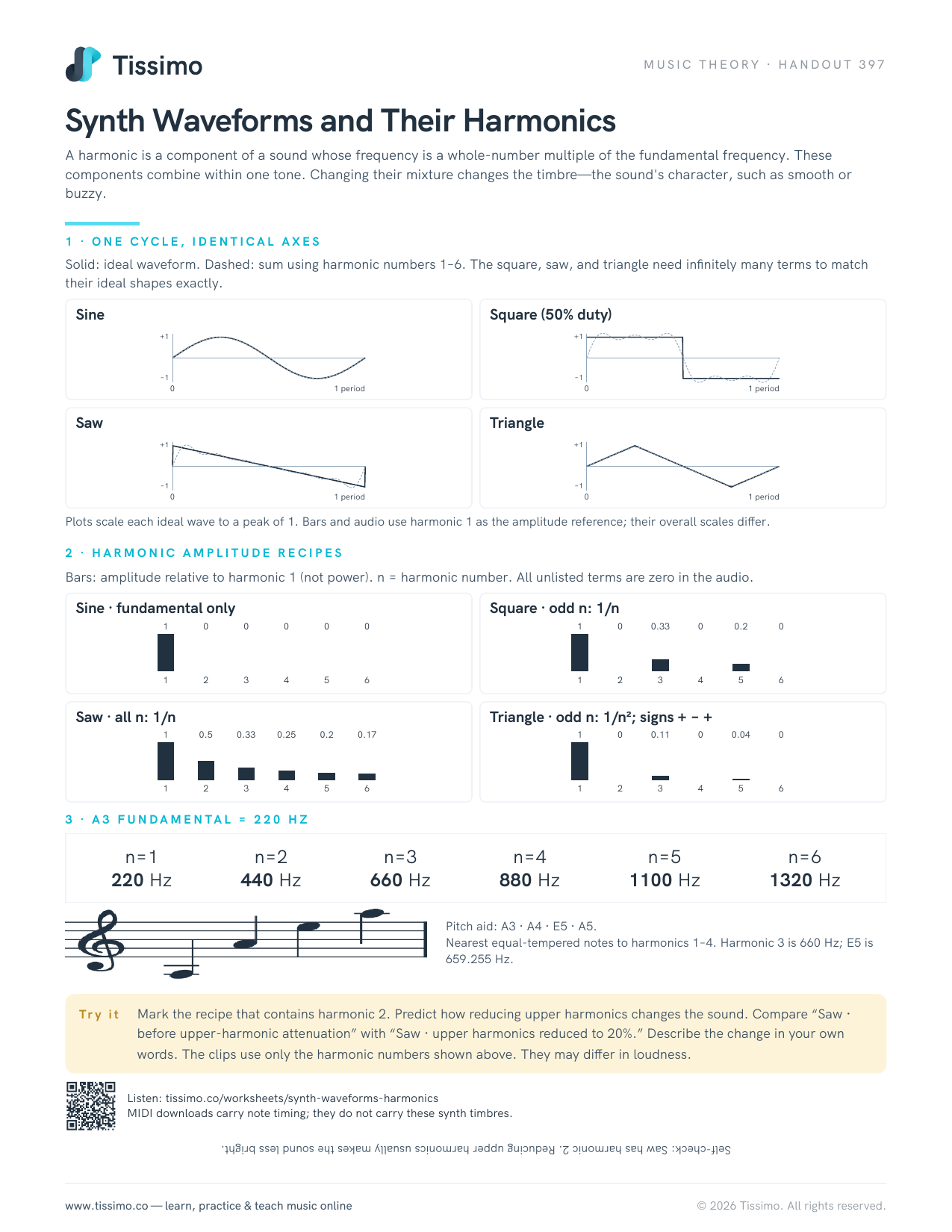 Synth Waveforms and Their HarmonicsA harmonic is a component of a sound whose frequency is a whole-number multiple of the fundamental frequency. These components combine within one tone. Changing their mixture changes the timbre—the sound's character, such as smooth or buzzy.
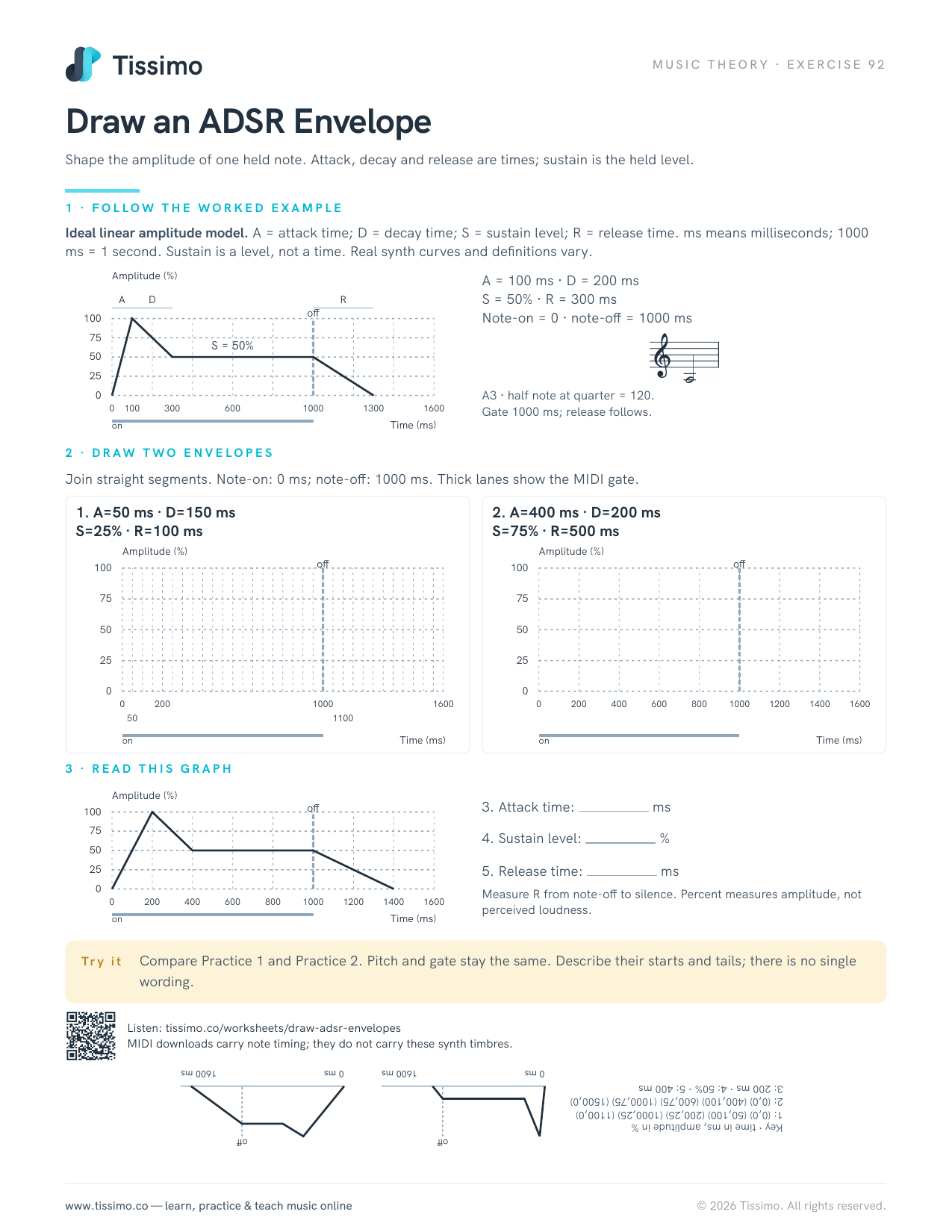 Draw an ADSR EnvelopeShape the amplitude of one held note. Attack, decay and release are times; sustain is the held level.
Comments