Sound & Acoustics
Additive Synthesis
Additive synthesis builds a sound by adding together sine waves, each with its own frequency and level, usually at harmonics of one fundamental. Changing each level over time shapes the timbre.
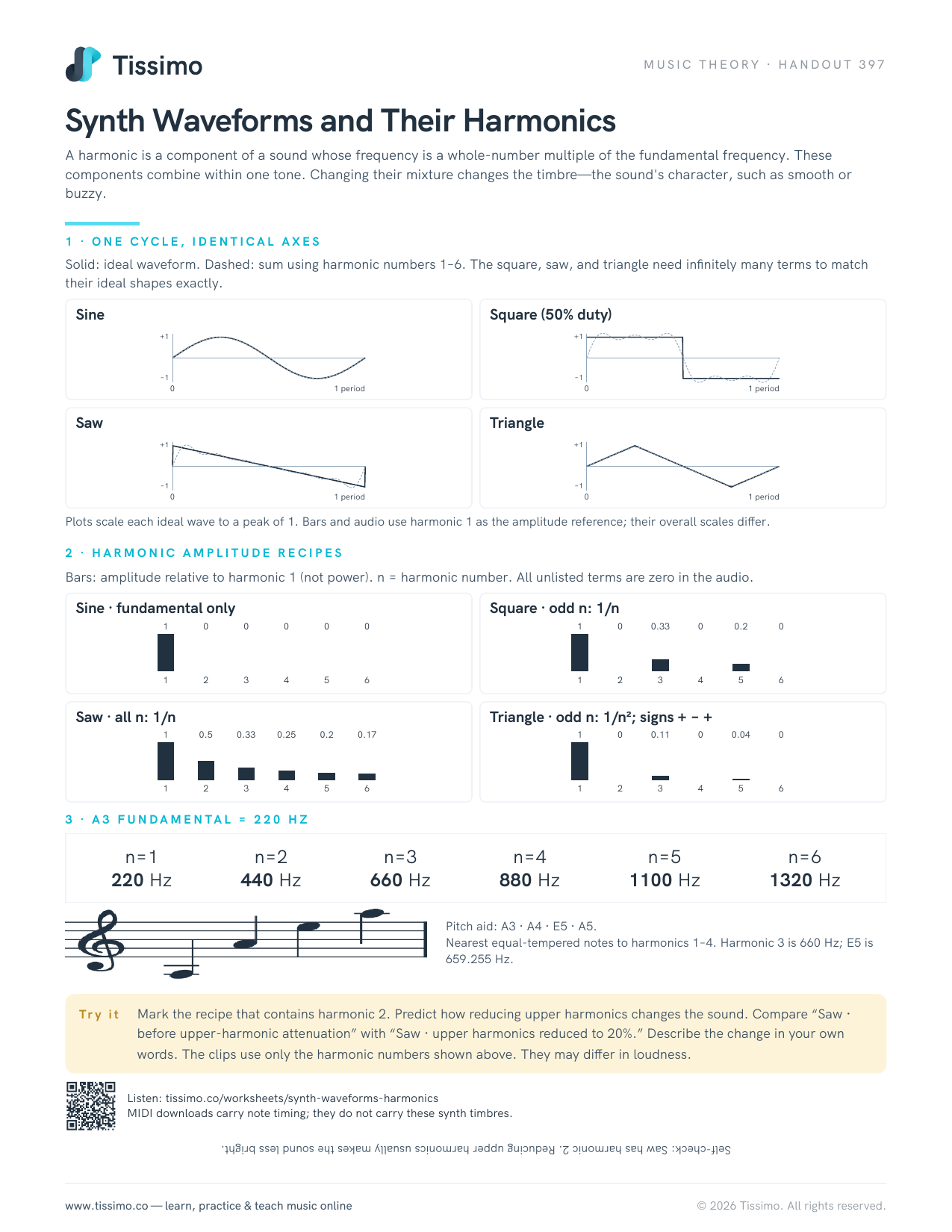
A steady pitched tone can be described as a stack of sine waves: a fundamental plus overtones, each with its own strength. Additive synthesis builds a sound from that description. Instead of starting from a ready-made waveform, you set the frequency and level of each sine wave and add them together. Give harmonic n a level of 1/n and the sum comes close to a sawtooth; keep only the odd harmonics, at the same 1/n levels, and it comes close to a square wave.
Harmonics that move
A recipe that never changes tends to sound static and organ-like. The strength of additive synthesis is that each harmonic can have its own envelope. To imitate a plucked string, let the upper harmonics fade faster than the lower ones: the note starts bright and darkens as it dies away. Let one middle harmonic swell and fade inside a note and you get a change of color that one oscillator and one filter cannot easily make.
The price is control. A convincing natural sound may need dozens of harmonics, each with its own envelope and often a slight movement of pitch, plus a little filtered noise for breath or bow. That is why full-scale additive synthesizers are digital: in software an oscillator is only a calculation.
Additive ideas on keyboards
- Drawbar organ. On a tonewheel organ such as the Hammond, each drawbar adds a nearly pure sine tone at one pitch, named in organ feet: 16′, 5 1/3′, 8′, 4′, 2 2/3′, 2′, 1 3/5′, 1 1/3′ and 1′. Counting 16′ as harmonic 1, these are harmonics 1, 3, 2, 4, 6, 8, 10, 12 and 16, so the recipe has gaps. The organ takes these tones from one shared set of wheels tuned close to equal temperament, so only the octave drawbars are exact: 5 1/3′, 2 2/3′ and 1 1/3′ sit about 2 cents flat of the true harmonics and 1 3/5′ about 14 cents sharp.
- Pipe organ. Besides stops at octave pitches (8′, 4′, 2′), many organs have mutation stops such as the 2 2/3′, which sounds an octave and a fifth above the key: the third harmonic of the 8′ pitch. Each pipe has a complex tone of its own, so the organ is additive only in a broad sense.
Additive or subtractive?
The two methods come at the same goal from opposite ends. Subtractive synthesis starts from a bright waveform and filters harmonics away; additive synthesis starts from silence and adds each harmonic you want. The sine-wave form is also called Fourier synthesis, after the mathematician Joseph Fourier, whose analysis splits a sound into sine waves. "Additive" is the broader word, because the parts you add need not be sine waves.
Build the classic waveforms from their harmonic recipes, and hear each one, in Synth Waveforms and Their Harmonics.
Common questions
What is the difference between additive and subtractive synthesis?
Additive synthesis builds a tone up by adding sine waves at chosen frequencies and levels. Subtractive synthesis starts from a waveform that already has many harmonics and removes some with a filter.
Is a Hammond organ an additive synthesizer?
In principle, yes. Each drawbar mixes in a nearly sine-shaped tone at one harmonic-related pitch, so a registration is a recipe of harmonics. It offers only nine pitches, though, and the drawbar mix does not change during a note the way the harmonics of a full additive synthesizer can.
Comments