Sound & Acoustics
Wavetable Synthesis
Wavetable synthesis plays a tone from a stored set of single-cycle waveforms, called a wavetable, and can move through the set while a note sounds, so the timbre changes without a filter.
One waveform gives one fixed color. A wavetable is a whole series of short waveforms, each a single cycle long and usually only a little different from its neighbors. A wavetable oscillator repeats one of them at the pitch you play. Move to another place in the table and the timbre changes, because the oscillator now repeats a different shape with a different mix of harmonics. Sweep through the table while a note sounds and the tone evolves.
How it is played
The control that chooses the place in the table is often labeled position. Left alone, it gives a steady color. Moving it is what makes the method worth using:
- An envelope can sweep the position at the start of each note, so the attack has one color and the sustain another.
- An LFO can move it back and forth for a constant shimmer or growl.
- A knob, the mod wheel or automation can move it by hand or over many bars.
The oscillator is usually followed by a filter and an amplifier, as in subtractive synthesis. A table can even hold the plain sine, sawtooth, square and pulse shapes, so a wavetable synth can do the work of a basic subtractive synth as well.
Where it comes from
The PPG Wave synthesizers, invented by Wolfgang Palm, made the method well known. Their tables were factory-made families of related waveforms, and an envelope or LFO moved through them; PPG's Waveterm computer later let users build their own. Some software instruments now let you load a short audio file as a wavetable and draw the table on screen as a stack of shapes.
How it differs from its neighbors
- From a filter sweep. A filter can only reshape harmonics that are already there: it turns some down and, with resonance, emphasizes a few. Moving through a wavetable can bring in harmonics the first shape did not have.
- From additive synthesis. Additive synthesis sets the level of each harmonic separately. A wavetable stores finished shapes, a quicker route to a changing spectrum.
- From sampling. A wavetable holds single cycles that loop at any pitch; a sampler plays a whole recording. Confusingly, computer sound cards of the 1990s that played back short recordings of instruments were sold as "wavetable" cards, so you will still meet the word used for plain sample playback.
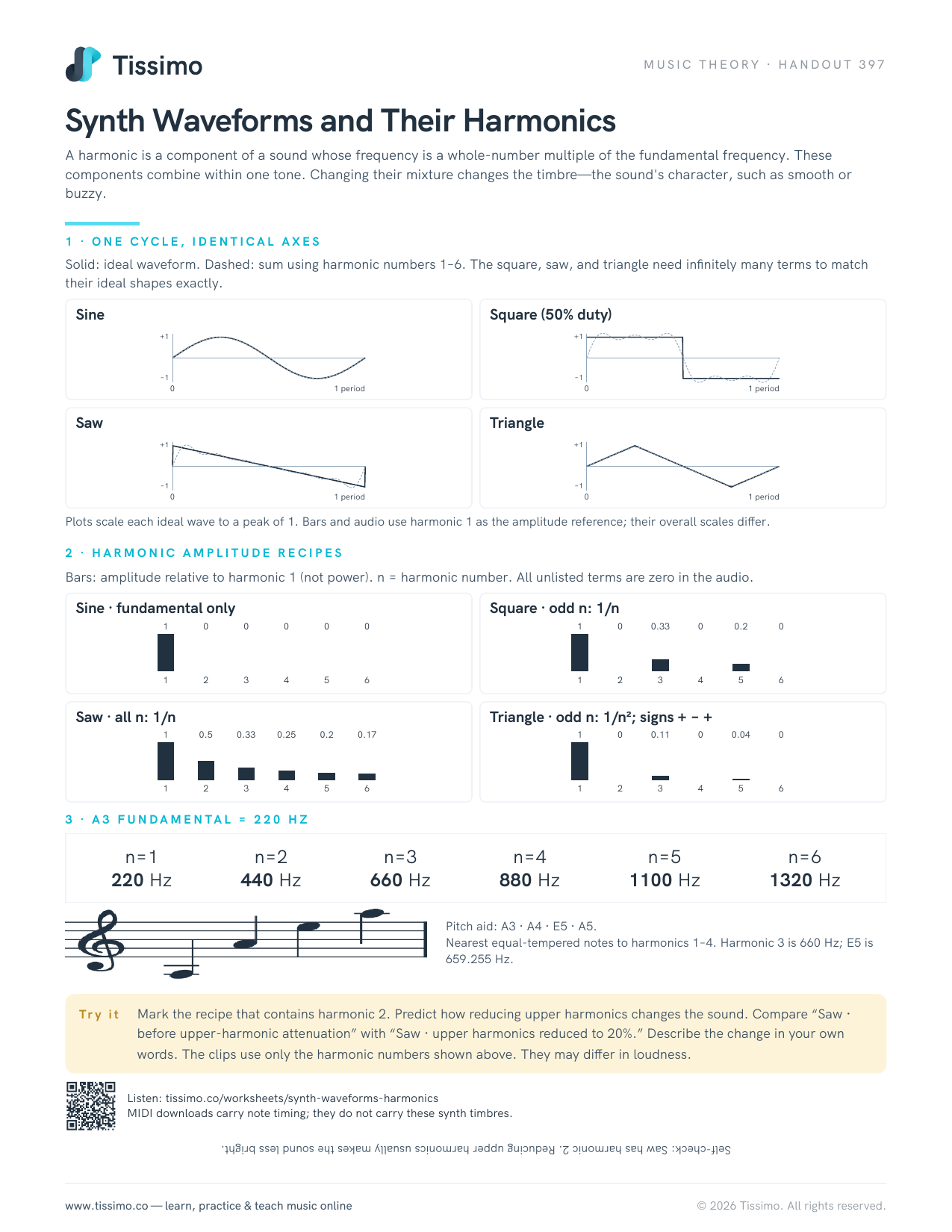
The classic single-cycle shapes that many tables start from are drawn and played in Synth Waveforms and Their Harmonics.
Common questions
What is a wavetable?
A stored series of single-cycle waveforms, each a little different from the next. A wavetable oscillator repeats one of them as a steady tone, and moving its position through the series changes the timbre.
Is wavetable synthesis the same as sampling?
No. A wavetable is a set of one-cycle shapes that the oscillator loops and moves between; a sampler plays back a complete recording. The word "wavetable" was also used loosely for 1990s sound cards that played samples, which is a different technique.
Comments