Notation & Symbols
Nashville Number System
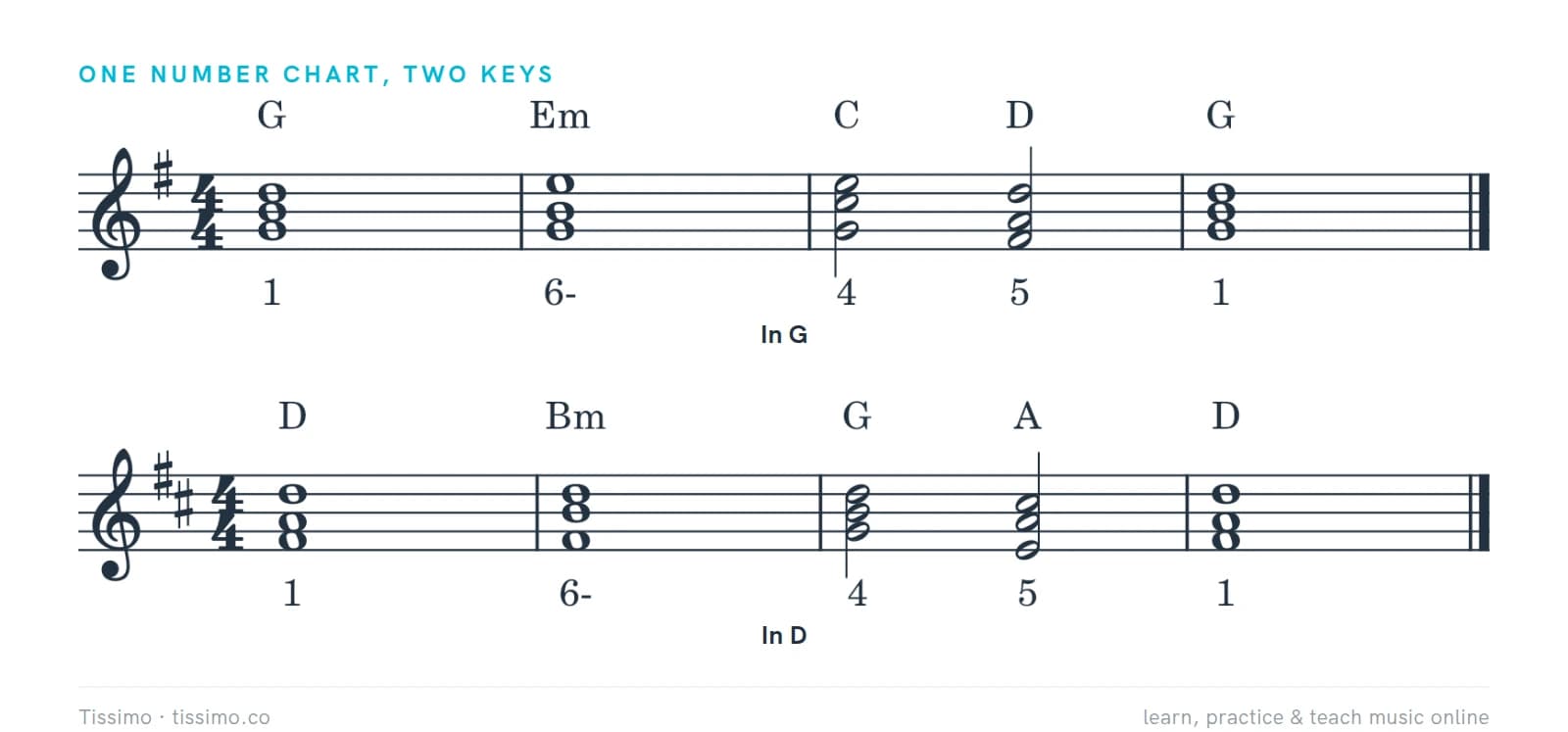
The Nashville Number System writes a song's chords as numbers for the degrees of the key's scale: in G, 1 is G, 4 is C and 5 is D. The same number chart works in any key.
The Nashville Number System is a way of writing a chord chart with numbers instead of chord letters. Each number is a scale degree of the song's key: 1 is the chord built on the first note of the scale, 4 the chord on the fourth note, and so on. Because the numbers describe the chords' places in the key rather than their letter names, one chart fits every key.
Reading the numbers
Count up the major scale of the key. In G major the degrees are G (1), A (2), B (3), C (4), D (5), E (6) and F♯ (7). So in G:
- A plain number is a major chord: 1 is G, 4 is C, 5 is D.
- A dash after the number marks a minor chord: 2- is A minor, 3- is B minor, 6- is E minor. Some players write m instead (6m).
- A small circle marks a diminished chord: 7° is F♯ diminished.
- Other chord types take the same suffixes as chord symbols: in G, 5⁷ is D7.
- A slash adds a bass note, as in a slash chord: 1/3 is the 1 chord with the third degree in the bass, G/B in G.
So the seven chords of a major key are written 1, 2-, 3-, 4, 5, 6-, 7°. Write the dash and the circle every time: a plain number is read as a major chord.
Bars and rhythm
Each number normally lasts one bar. When two or more numbers share a bar, the chart shows it, usually by underlining them; this is called a split bar. With no other marks, an underlined pair in 4/4 gets two beats each. Charts also borrow signs for rhythm and feel, such as a diamond around a number for a chord struck once and left to ring, and they show the song's sections, such as verse and chorus.
Why musicians use it
A number chart works in any key. If the singer wants the song a step lower, the band plays the same chart from a new 1, with no rewriting: in D, the chart above gives D, B minor, G, A, D. That makes it quick to learn a song, to change key on the spot and to talk about a progression ("one, six minor, four, five").
Where it came from
By the usual account, Neal Matthews Jr. of the Jordanaires, a vocal group that sang on many Nashville recording sessions, began writing vocal parts with numbers in the 1950s (around 1957, by Chas Williams's account), drawing on the shape-note notation used by gospel quartets. In the early 1960s, session musician Charlie McCoy applied the numbers to chords and the rhythm section, and the idea spread among Nashville's studio players. Williams's own guide to the system, The Nashville Number System, dates from 1988. The system became the standard chart language of Nashville studios, and it is widely used in country music, including bluegrass and old-time jams.
Numbers and Roman numerals
The idea is the same as Roman numerals, which also name chords by scale degree. The use differs. Roman numerals are mainly a tool for analyzing harmony, and they show quality with capital and small letters (ii, IV). A Nashville chart is written to be played from, with Arabic numbers, a dash for minor and the bars of the song.
Practice finding the numbers in every key with The chords of a key and Chords & Progressions in Every Key, then compare them with Roman numeral analysis.
Common questions
What does a dash mean in a Nashville number chart?
A minor chord. In G, 6- is E minor and 2- is A minor. A plain number is a major chord, so write the dash every time you mean minor.
Is the Nashville Number System the same as Roman numeral analysis?
Both name chords by scale degree, but Nashville charts use Arabic numbers, mark minor with a dash and are written to play from. Roman numerals show quality with capital and small letters and are mainly used to analyze harmony.
Practice it: free worksheets
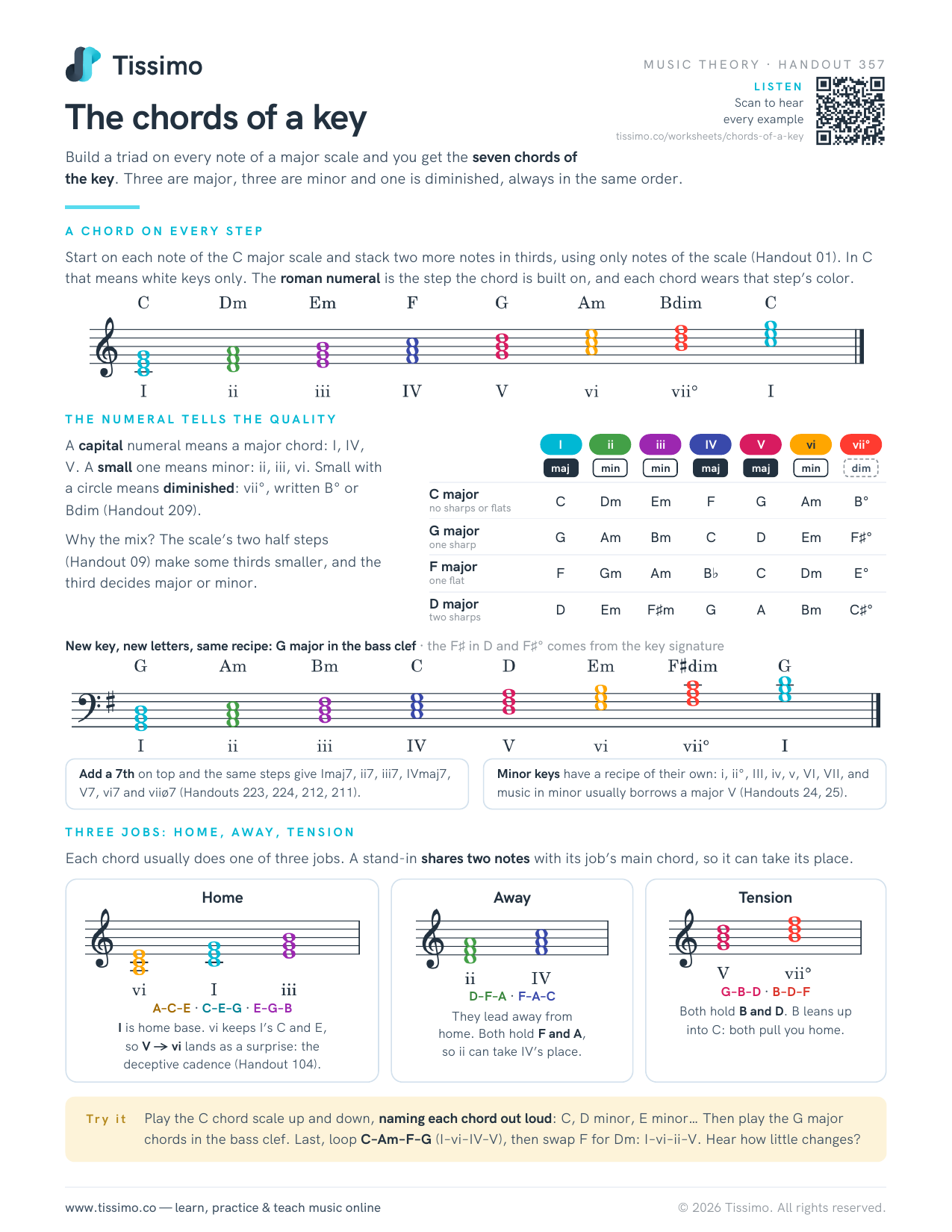 The chords of a keyBuild a triad on every note of a major scale and you get the seven chords of the key. Three are major, three are minor and one is diminished, always in the same order.
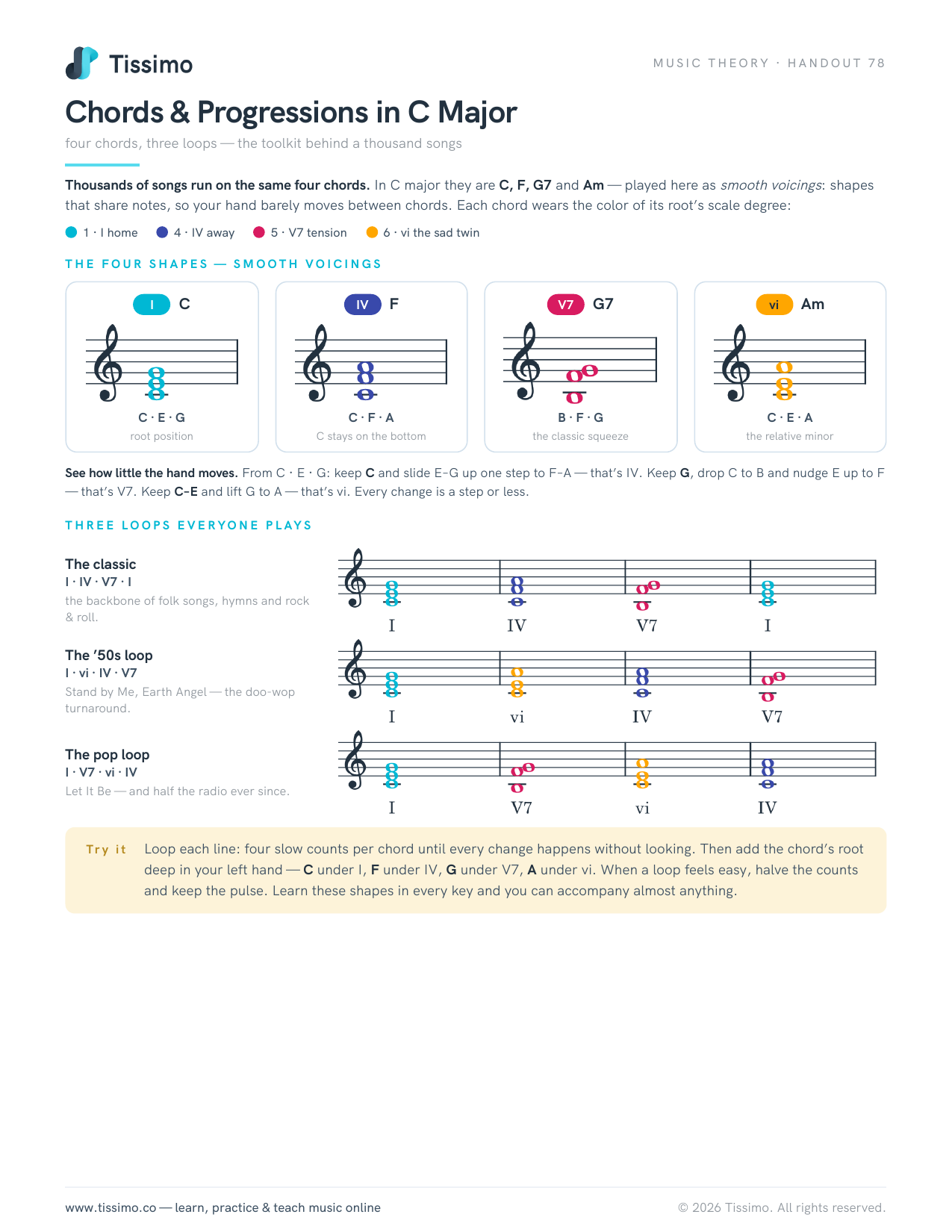 Chords & Progressions in Every KeyFour chords, three loops — the toolkit behind a thousand songs, in all 24 keys.
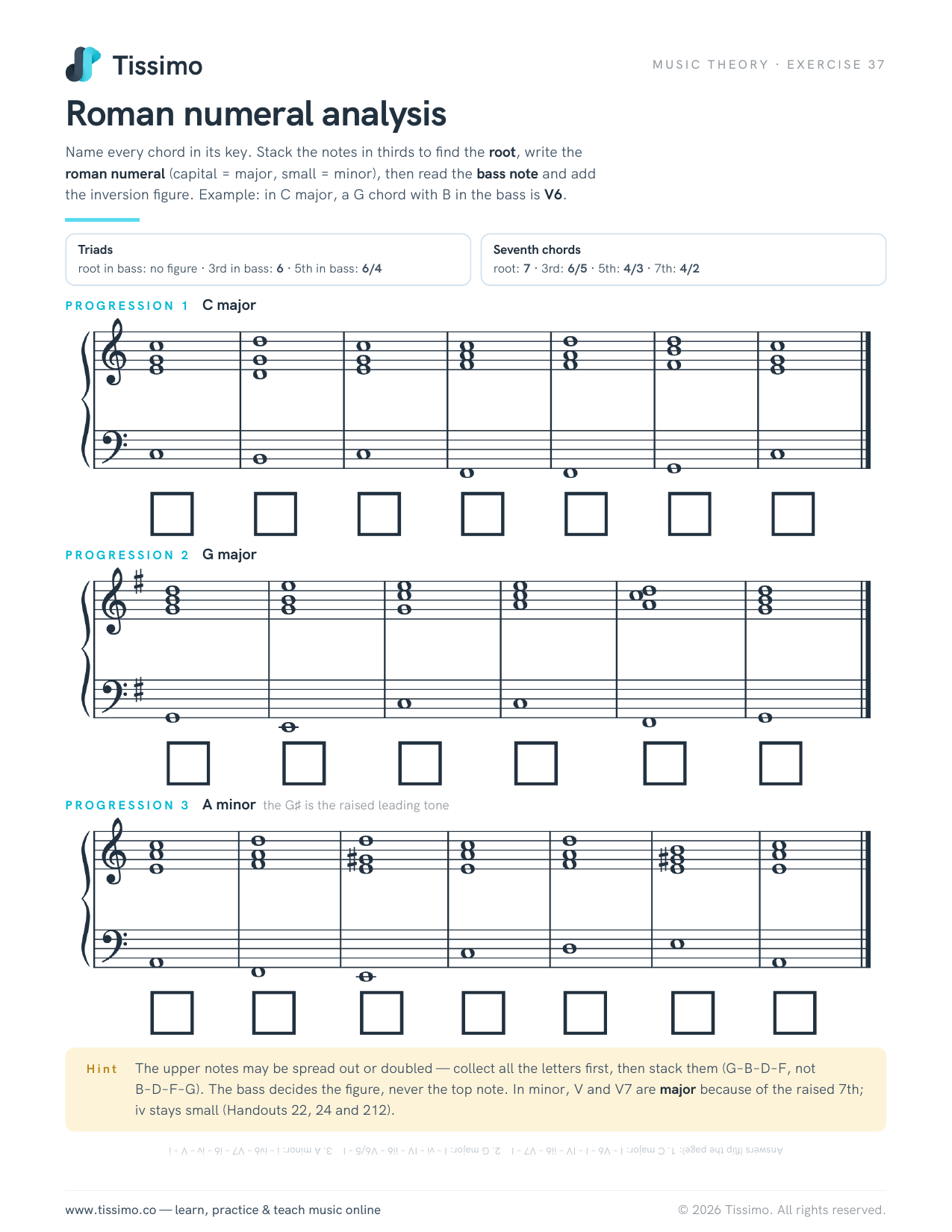 Roman numeral analysisName every chord in its key. Stack the notes in thirds to find the root, write the roman numeral (capital = major, small = minor), then read the bass note and add the inversion figure. Example: in C major, a G chord with B in the bass is V6.
Comments