Technique & Performance
Mute (Con Sordino)
Pronounced kon sor-DEE-nohWritten as con sord.
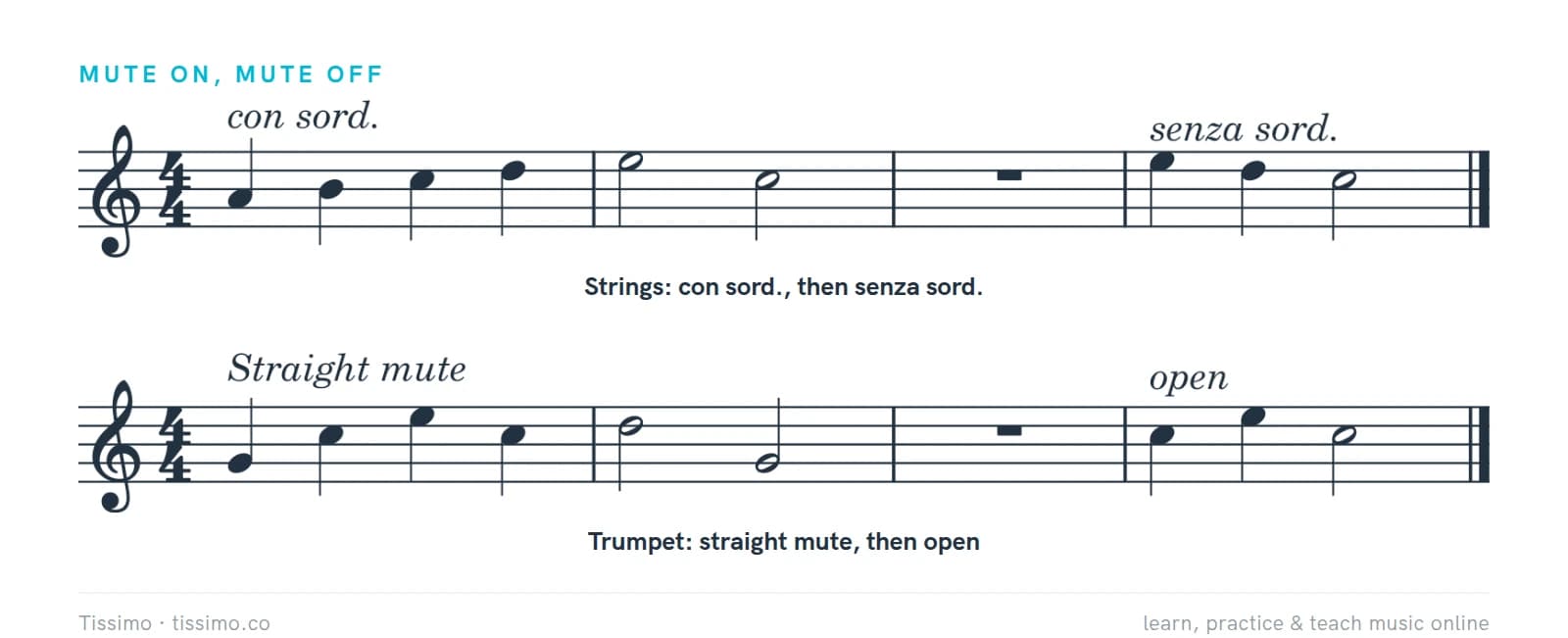
A mute is a device that softens and colors an instrument's sound, such as a clip on a violin's bridge or a cone in a trumpet's bell. Con sordino (con sord.) means play with the mute; senza sordino means take it off.
A mute changes an instrument's tone color, and usually makes it quieter too. String and brass players use mutes most. The instruction to put one on is the Italian con sordino, "with the mute", usually shortened to con sord. (the plural, con sordini, is also used, especially for a whole section). The instruction to take it off is senza sordino or senza sord. (see senza). French scores use the word sourdine, German ones Dämpfer (mit Dämpfer, "with mute").
Mutes on string instruments
A string mute sits on the bridge, the wooden piece that carries the strings, and damps its vibrations, so the violin or cello sounds softer and less brilliant. Some mutes are separate clips, often with prongs that fit over the bridge between the strings. Others stay on the strings between the bridge and the tailpiece, and slide up against the bridge when the music says con sord.
Mutes on brass instruments
Brass players put a mute in the bell. It filters the sound, cutting the low overtones more than the high ones, so the timbre becomes thinner, brighter, buzzier or softer, depending on the mute. The most common trumpet and trombone mutes are:
- Straight mute: bright, focused and slightly metallic; the usual mute when a classical brass part says con sord.
- Cup mute: softer and warmer, with a cup that covers the bell.
- Harmon mute: the buzzy jazz sound. Covering and uncovering its stem with the hand makes a "wah-wah".
- Plunger mute: held over the bell and moved between closed (+) and open (o) for a talking, vocal sound.
Brass parts often name the mute (straight mute, cup mute) and cancel it with open or senza sord. Mutes are not only for quiet music: composers also ask for them in loud passages, for their color.
Woodwinds are rarely muted. Trumpet players also use practice mutes, which make the instrument much quieter for practicing at home.
Leave time to change
Putting on or taking off a mute takes a moment, so parts usually leave rests before and after a muted passage. When you see con sord. after a rest, use the rest to get the mute ready. Brass players notice when an arranger leaves too little time, and a hurried change can make an audible clatter.
Sordino on the piano
On the piano the word is a trap. For Beethoven, the piano's "mutes" were its dampers, so his senza sordino at the start of the "Moonlight" Sonata means play without the dampers, that is, with the sustain pedal down. It does not mean "without the soft pedal". Some later composers wrote con sord. for the soft pedal. When a piano score uses the word, check the edition's notes.
Common questions
What does con sordino mean?
Play with the mute. It is Italian for "with the mute" and is usually written con sord. Senza sordino (senza sord.) means take the mute off again; brass parts often say open instead.
What does a mute do on a trumpet?
It changes the tone color and usually makes the sound quieter. A straight mute sounds bright and focused, a cup mute softer and warmer, and a Harmon mute buzzy; a plunger can make a vocal "wah".
What does senza sordino mean in piano music?
In Beethoven's piano music it means without the dampers, that is, with the sustain pedal down, as at the start of the "Moonlight" Sonata. Some later piano scores use con sord. for the soft pedal instead, so check the composer and the edition. On string and brass instruments the same words mean take the mute off.
Comments