Instruments & Voices
Hi-Hat
A hi-hat is a pair of cymbals on a stand that a drummer opens and closes with a foot pedal. Struck with sticks or clapped shut with the foot, it keeps time in rock, pop, jazz and blues.
A hi-hat is two cymbals mounted face to face on a metal stand. The bottom cymbal stays still. The top one sits on a rod linked to a foot pedal: press the pedal and the top cymbal comes down onto the bottom one. The hi-hat is part of the standard drum kit, where it is usually worked by the left foot while the right foot plays the bass drum.
Closed, open and foot
One instrument gives several sounds, depending on the pedal:
- Closed: the pedal is held down and the cymbals press together. Struck with a stick, they give a short, crisp "tick". The harder you press, the tighter the sound.
- Open: the foot eases off the pedal, so the cymbals part or only just touch. Struck with a stick, they give a longer, sizzling sound. Closing them a moment later with the foot cuts the sizzle short.
- Foot (pedal) hi-hat: you close the cymbals with the foot alone, no stick, for a soft "chick".
How the hi-hat is written
In the most common drum-kit layout, the hi-hat played with sticks is an x notehead in the space just above the staff. A small + above a note means closed and an o means open. Many drum charts print the mark only where the sound changes, and it holds until the next mark.
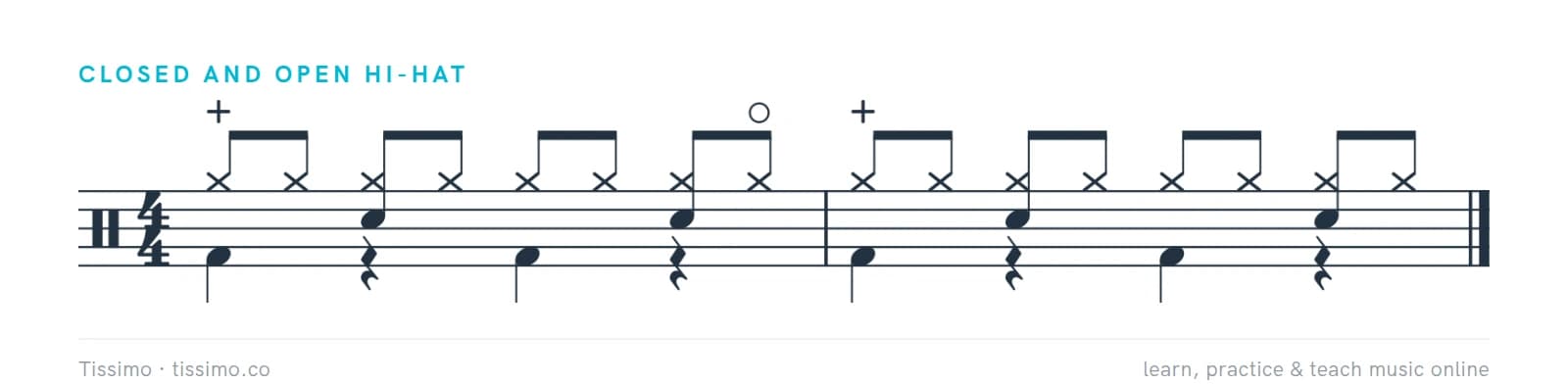
The hi-hat played with the foot is an x notehead in the space below the staff, usually with stems down, because it belongs to the feet's voice with the bass drum. Layouts vary between publishers, so check the key at the start of a drum book.

How drummers use it
In much rock and pop, one hand keeps a steady subdivision of eighth notes on the closed hi-hat while the other plays the backbeat on the snare, as in the basic rock beat shown under drum kit. One open note, closed again on the next beat, adds a burst of sizzle inside the groove. In jazz, the ride cymbal usually carries the time and the foot closes the hi-hat on beats 2 and 4, under the swing feel.
Practice the foot alone first: a steady "chick" on 2 and 4 against a metronome, then add the hands. Map closed-hat, kick and snare parts on a step grid in Drum Patterns: Sixteen Steps, Four Beats.
A common confusion
"Hi-hat" can mean the whole setup (stand, pedal and both cymbals) or just the two cymbals; drummers use it both ways. In notation, don't mix it up with the ride cymbal: both use x noteheads, but the ride sits on the top line and the hi-hat in the space above it.
Common questions
What do + and o mean over hi-hat notes?
+ means closed: keep the pedal down so the cymbals stay together. o means open: let the pedal up so they ring. Many charts print the mark only when the sound changes, so it applies to the following notes until the next mark.
Where is the hi-hat written in drum music?
In the most common layout, the hi-hat played with sticks is an x notehead in the space above the staff, and the hi-hat played with the foot is an x notehead in the space below it, with stems down. Check the key in your drum book, because layouts vary.
Comments