Instruments & Voices
Cymbal
A cymbal is a thin, round metal plate that rings with a bright, shimmering crash when struck. Drum kits use crash, ride and hi-hat cymbals; orchestras and bands use clashed pairs and suspended cymbals.
A cymbal is a round, slightly domed plate of metal, most often a bronze or brass alloy. It is held or hung at the raised center (the bell or dome), so the wide edge is free to vibrate. A struck cymbal produces a dense mix of unrelated overtones, which is why it sounds like a bright wash of noise rather than a note. Larger cymbals generally sound lower; at the same size, a thicker, heavier cymbal sounds higher.
Cymbals in the drum kit
- The hi-hat is a pair of cymbals on a stand, opened and closed with a foot pedal.
- The ride cymbal keeps steady patterns, especially in jazz. Played on its broad surface with the tip of the stick it gives a clear, controlled sound; struck on the raised bell it gives a focused, bell-like ping.
- The crash cymbal is for accents, often at the start of a new section. Struck on the edge it bursts into a loud, spreading crash.
- Smaller splash cymbals give a quick, thin accent, and China cymbals a harsher, trashier sound.
Cymbals in the orchestra and band
A pair of cymbals (Italian piatti), often called clash or crash cymbals, is held by straps through the bells and struck together with a glancing blow. The player can let them ring or damp them against the chest. A suspended cymbal hangs on a stand and is struck with sticks or soft mallets; a roll with two soft mallets swells from a whisper to a roar, a favorite effect at a climax.
How cymbals are written
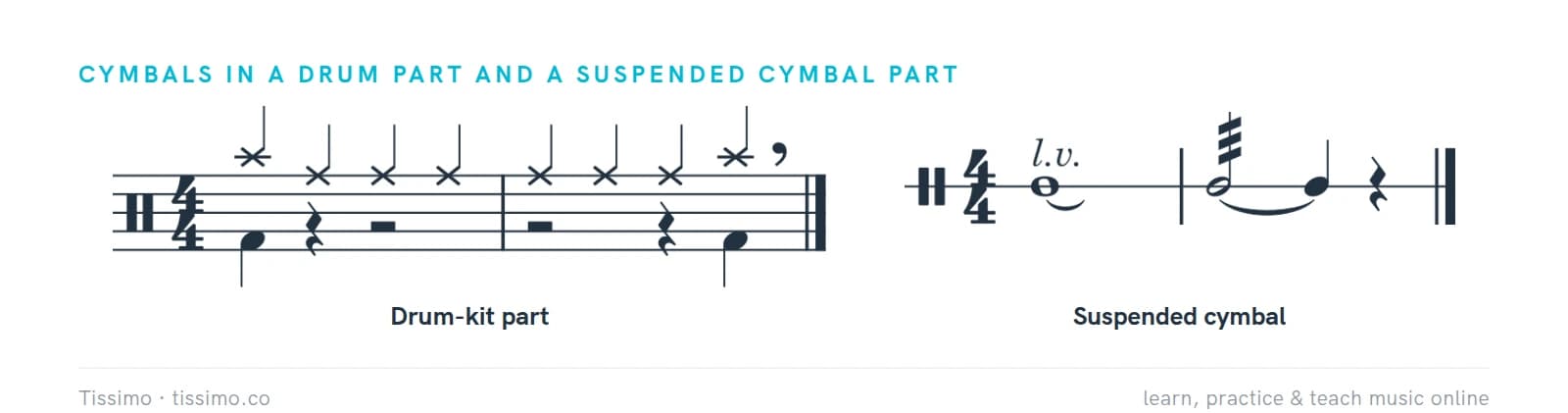
In a drum-kit part, cymbals use x noteheads on a five-line staff with a percussion clef: in the most common layout the ride is on the top line and the crash on a ledger line above. Orchestral cymbal parts usually sit on a single line.
How long a cymbal rings is part of the notation. In drum-kit music a cymbal normally rings unless told otherwise; in orchestral parts, a short note without a tie is usually damped at the end of its value. A tie that leads to nothing, often with l.v. (laissez vibrer, "let vibrate"), says to let the sound die away by itself. A choke is the opposite: the player grabs the edge right after striking, and the crash is cut off. Choke marks vary between publishers. Drum charts often use a small apostrophe-like comma after the note, and other parts write a plus sign, a staccato dot or simply the word "choke". Check the key at the start of the part.
A common confusion
"Crash cymbal" means two things. To a drummer it is one suspended kit cymbal for accents; in an orchestra or band, "crash cymbals" can mean the hand-held pair. And an x notehead does not always mean a cymbal: it can also ask for an unusual stroke, such as a stick on the rim of a drum.
Common questions
What is the difference between a crash and a ride cymbal?
A crash is for accents: struck on the edge, it explodes into a loud, spreading sound that fades fairly quickly. A ride is usually larger and heavier and is played with the tip of the stick for steady patterns, giving a clearer ping with less wash. In drum notation the ride is usually on the top line and the crash on a ledger line above the staff.
What does l.v. mean on a cymbal note?
It stands for French laissez vibrer, "let vibrate": let the cymbal ring until it dies away instead of damping it at the end of the written note. It is often shown with a tie that leads to nothing.
What does it mean to choke a cymbal?
To strike it and then grab its edge with your hand straight away, so the crash stops short. The mark varies: an apostrophe-like comma after the note, a plus sign, a staccato dot or the word choke.
Comments