Technique & Performance
Drum Fill (Fill)
A drum fill is a short break from the main groove in which the drummer plays a different pattern, often around the toms, to mark the end of a phrase and lead the band into the next section.
Most of the time a drummer repeats a groove: the same bass drum, snare and hi-hat pattern, bar after bar. A fill breaks that pattern for a moment. It fills the end of a phrase, typically the last bar or part of a bar before a new section such as a chorus, and tells the band and the listeners that something is about to change.
How long is a fill?
A fill can be very short, a beat or less, or it can last a whole bar or more. In rock drumming three lengths come up again and again: the last beat of the bar, the last half of the bar (beats 3 and 4) and the whole bar. The longer the fill, the bigger the break in the groove.
Landing the fill
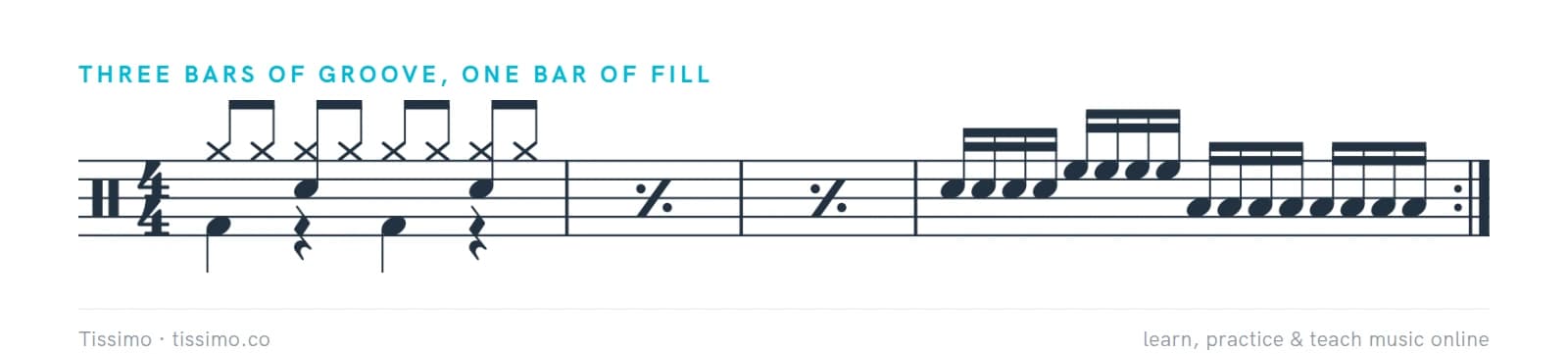
The most important note of a fill is the one after it. A fill has to end exactly in time, so that the groove can start again on the next downbeat. Many fills land with a crash cymbal on beat 1 of the new section, often together with the bass drum. In the example the repeat sign takes the fill straight back to the groove, so play beat 1 of bar 1 firmly when you come back to it.
To practice, play the groove for three bars and a fill in the fourth, then go straight back to the groove, as if you were inside a song. Count through the fill and keep the tempo steady. Start with simple fills in even eighth or sixteenth notes, for example one beat on the snare and one beat on each tom. The rudiments give you the stickings, and Drum Patterns: Sixteen Steps, Four Beats helps you feel where each sixteenth note falls in the bar.
Fill or solo?
A fill is a transition, not a solo. It is tempting to pack every fill with notes, but its job is to carry the music into the next section, and a short, clear fill often does that best. Other players use the word too: a short guitar or piano phrase in the gap between two sung lines is also called a fill.
Common questions
Where do drum fills go in a song?
Usually at the end of a phrase, often in the last bar before a new section, such as a verse going into a chorus. The fill leads the band into the first beat of the new section.
How do you end a drum fill?
Land exactly on beat 1 of the next bar, often with a crash cymbal and the bass drum together, and go straight back into the groove.
Comments