Instruments & Voices
Bass Drum (Kick Drum)
The bass drum is the largest and lowest drum of a band or orchestra. In a drum kit it stands on its side and is played with a foot pedal, so it is called the kick drum; in an orchestra it is struck with a soft mallet.
The bass drum gives music its low thud. It is a wide cylinder with a head stretched over each side and, unlike the snare drum, no snares. Its pitch is low but indefinite: you hear a deep boom, not a note you could name. It comes in two main forms, one played with the foot and one played with a mallet.
The kick drum in a drum kit
In a drum kit, the bass drum stands on its side on the floor. A foot pedal swings a beater against the head, usually with the right foot, which is why drummers call it the kick drum or just the kick. Kit bass drums are smaller than orchestral ones and are often damped with a cloth to give the short, punchy sound that most popular music favors.
The kick is the foundation of a groove. In a basic rock beat it plays on beats 1 and 3 while the snare drum plays the backbeat on 2 and 4, and much dance music puts it on every beat. It also works closely with the bass guitar: the bassist often lines up notes with the kick so the two sound like one low, solid part. In a recording, producers often use sidechain compression so that the bass or a pad dips slightly at each kick.
The orchestral bass drum
The concert bass drum (Italian gran cassa) is much larger, up to about a meter across. It usually hangs in a frame that lets the player tilt it to any angle. The player strikes it with a heavy beater with a thick felt head, a little off the center of the head, and stops the ringing with a hand or forearm. A roll uses two smaller, lighter mallets. European military bands, and then orchestras, took up the bass drum in the 18th century from Turkish military (Janissary) music, along with cymbals and the triangle.
How bass drum music is written
In a drum-kit part on a five-line staff with a percussion clef, the bass drum sits in the bottom space, usually with stems down because it is played by a foot. Orchestral parts usually put it on a single line. Because the drum rings for several seconds, the note value matters: a player normally damps the drum at the end of the written value, unless a tie to nothing or the words laissez vibrer ("let vibrate", l.v.) ask for the sound to ring.
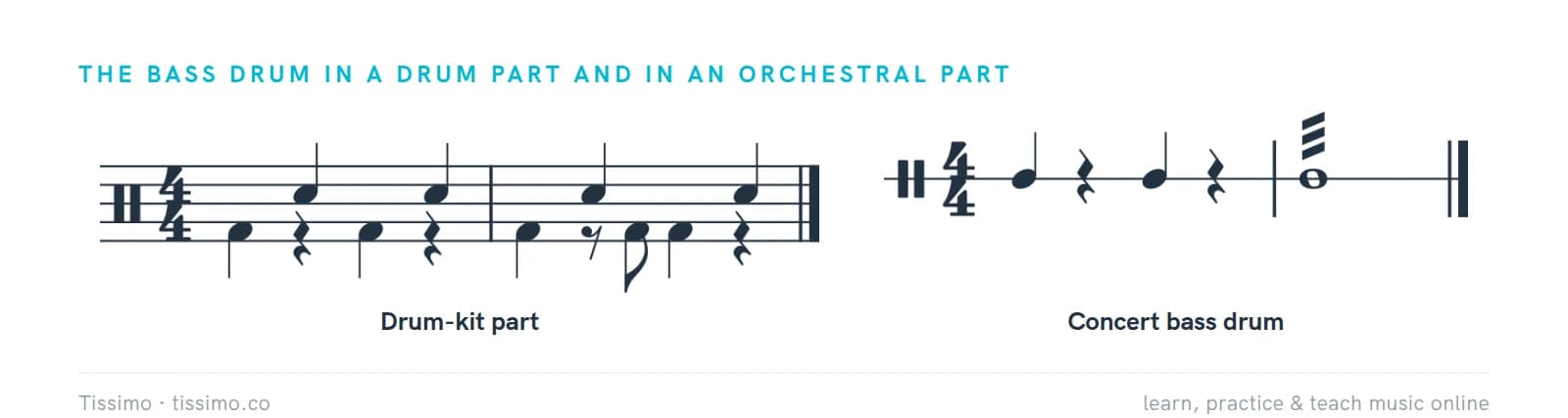
A common confusion
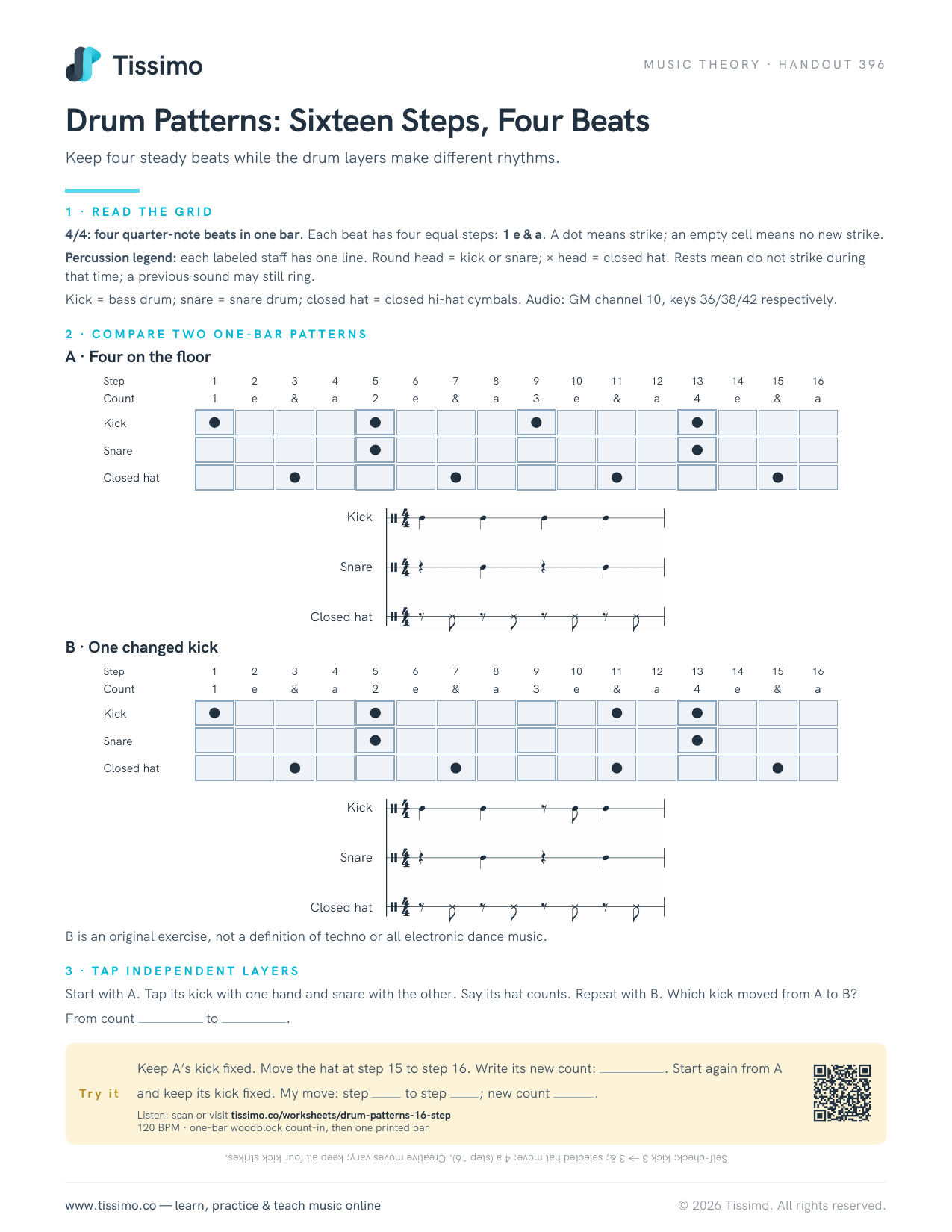
"Bass" on a band list can mean the bass guitar or the bass drum. They are different instruments, one plucked and pitched, the other struck and unpitched, but they lock together so closely that players talk about "the kick and the bass" as a team. Find the kick drum's place among the hi-hat and snare in Drum Patterns: Sixteen Steps, Four Beats.
Common questions
Why is the bass drum called a kick drum?
In a drum kit it is played with the foot, through a pedal that swings a beater against the head. Drummers call it the kick drum or simply the kick; it is the same instrument as the bass drum.
Where is the bass drum written in drum music?
In a drum-kit part it sits in the bottom space of the five-line percussion staff, usually with stems down. Check the key at the start of your drum book, because layouts vary a little between publishers.
Comments