Styles, Genres & Eras
Funk
Funk is a rhythm-driven, bass-heavy style of African American music that grew out of soul in the mid-1960s. Its bands lock into short, repeated sixteenth-note patterns with a heavy accent on beat 1, "the one".
Funk is dance music in which rhythm comes first. It grew out of soul and rhythm and blues in the mid-1960s, and in the 1970s it formed a bridge between 1960s soul and disco. In a funk band almost everyone plays rhythm: guitar, keyboards and horns become rhythm instruments that lock into short, repeated patterns over the bass and drums.
The word came from African American slang, where "funky" meant earthy and raw. By the late 1960s it named the grittiest, most danceable Black music.
James Brown and "the one"
Credit for funk's beginnings usually goes to James Brown. His "Papa's Got a Brand New Bag" (1965) is often counted among the first funk records: the accent moved from the backbeat on beats 2 and 4 to the first beat of the bar, "the one", as Brown called it. Records such as "Cold Sweat" and "Funky Drummer" stripped the music down to interlocking, repeated patterns. Musicians from his bands, among them Maceo Parker, Fred Wesley and Bootsy Collins, went on to shape the funk of the 1970s.
The sound of funk
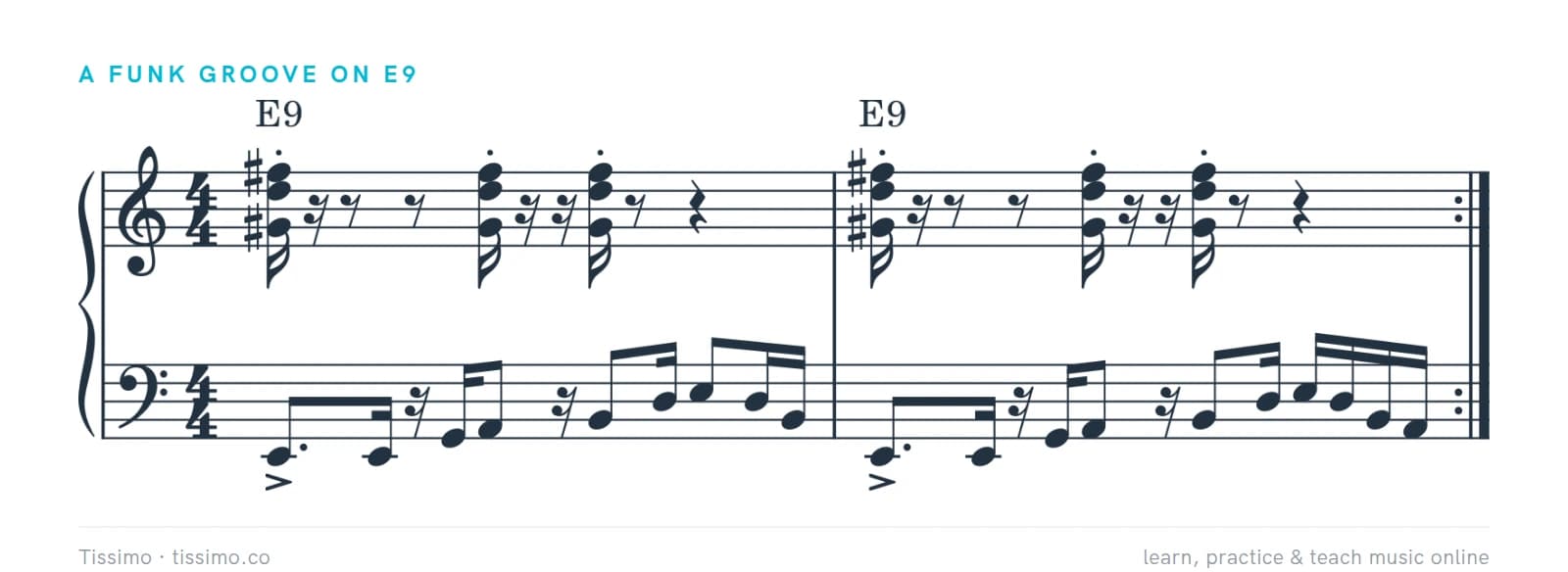
- Sixteenth notes: the beat is felt in sixteenths, and syncopation puts many accents on the second and fourth sixteenth of a beat ("e" and "a" in "1 e and a").
- The one: however busy the parts get, the band lands together on beat 1, which frees the other beats for syncopated accents.
- The bass: a prominent, syncopated electric bass line, often a one- or two-bar riff that is repeated with small variations.
- Guitar and keyboards: short, percussive chords, played as rhythm parts rather than as a harmonic cushion.
- Horns: short, staccato accents that punch the groove.
After James Brown
Sly and the Family Stone, Parliament-Funkadelic (led by George Clinton) and Curtis Mayfield took funk in new directions, soul stars such as Stevie Wonder and Marvin Gaye absorbed it, and jazz musicians including Miles Davis and Herbie Hancock fused it with jazz. By the late 1970s the steadier beat of disco had overtaken it. From the late 1980s, hip-hop producers sampled classic funk records, and the drum break of "Funky Drummer" became one of the most-sampled recordings ever made.
Playing funk
Set a metronome to quarter notes and count sixteenths aloud ("1 e and a, 2 e and a"). Play the example slowly with that count, keep every short note short and every rest exact, and make the first note of the bar the strongest. A funk groove only works when it is tight, so speed up only when the pattern stays locked to the click. Syncopation and the sixteen-step grids of Drum Patterns train the same skills, and Turn chords into grooves shows how a chord symbol becomes a rhythm pattern.
Common questions
What does "on the one" mean in funk?
It means putting the strongest accent on beat 1, "the one", where the whole band lands together. James Brown made it the center of his groove, in place of the backbeat on 2 and 4 that soul and rhythm and blues usually stress.
What is the difference between funk and soul?
Funk grew out of soul in the mid-1960s. Soul centers on the singer and the song; funk centers on the groove, with the bass, drums, guitar and horns locked into short, repeated sixteenth-note patterns.
Practice it: free worksheets
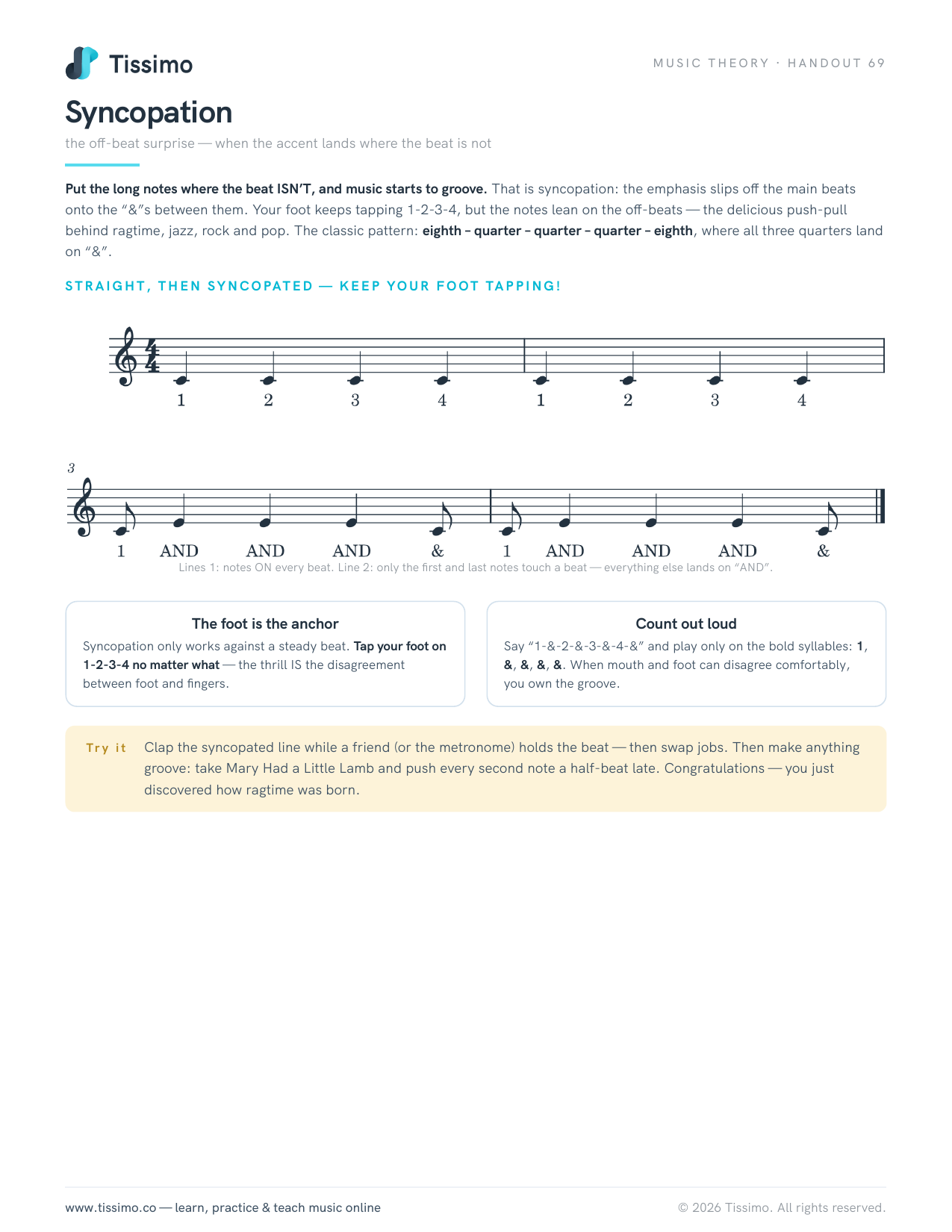 Syncopationthe off-beat surprise — when the accent lands where the beat is not
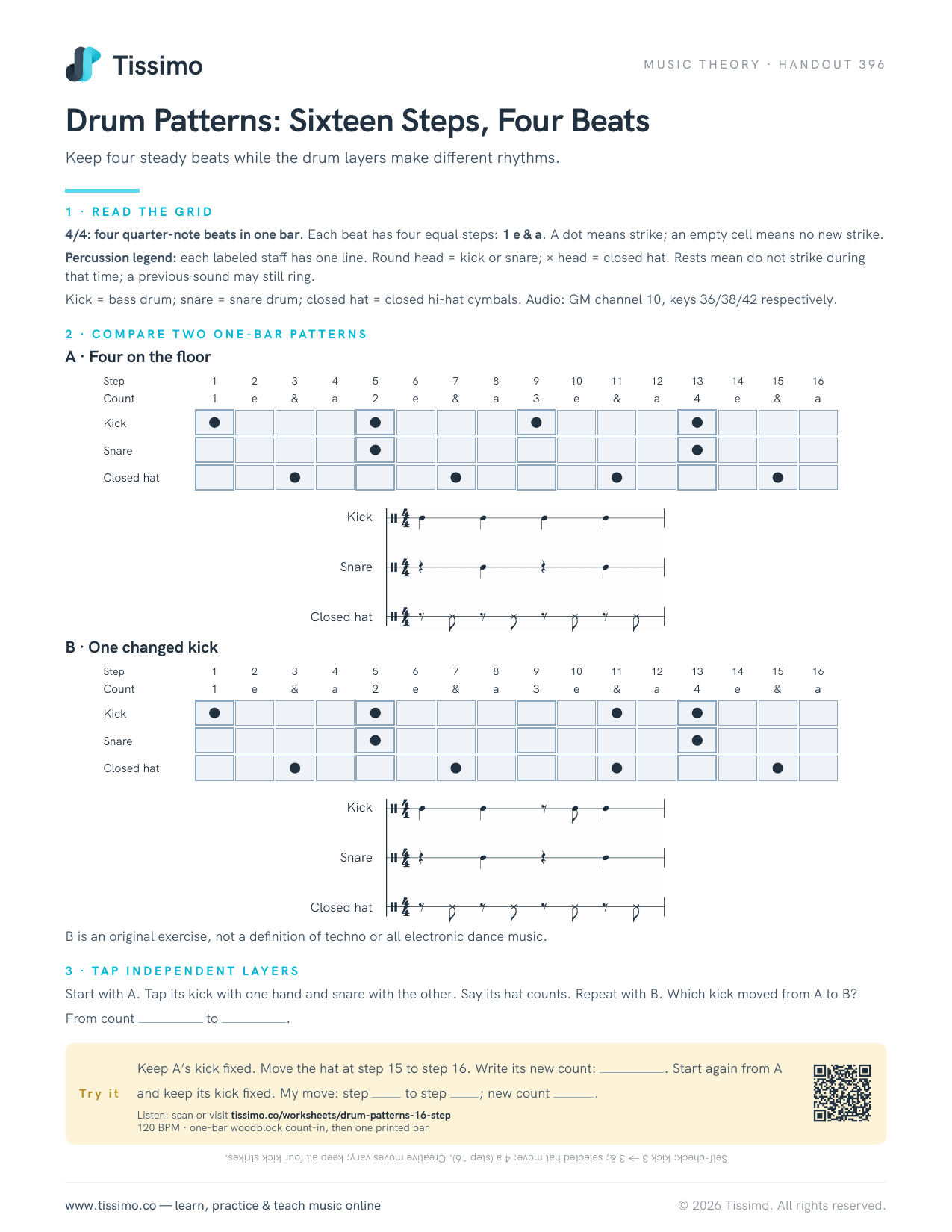 Drum Patterns: Sixteen Steps, Four BeatsKeep four steady beats while the drum layers make different rhythms.
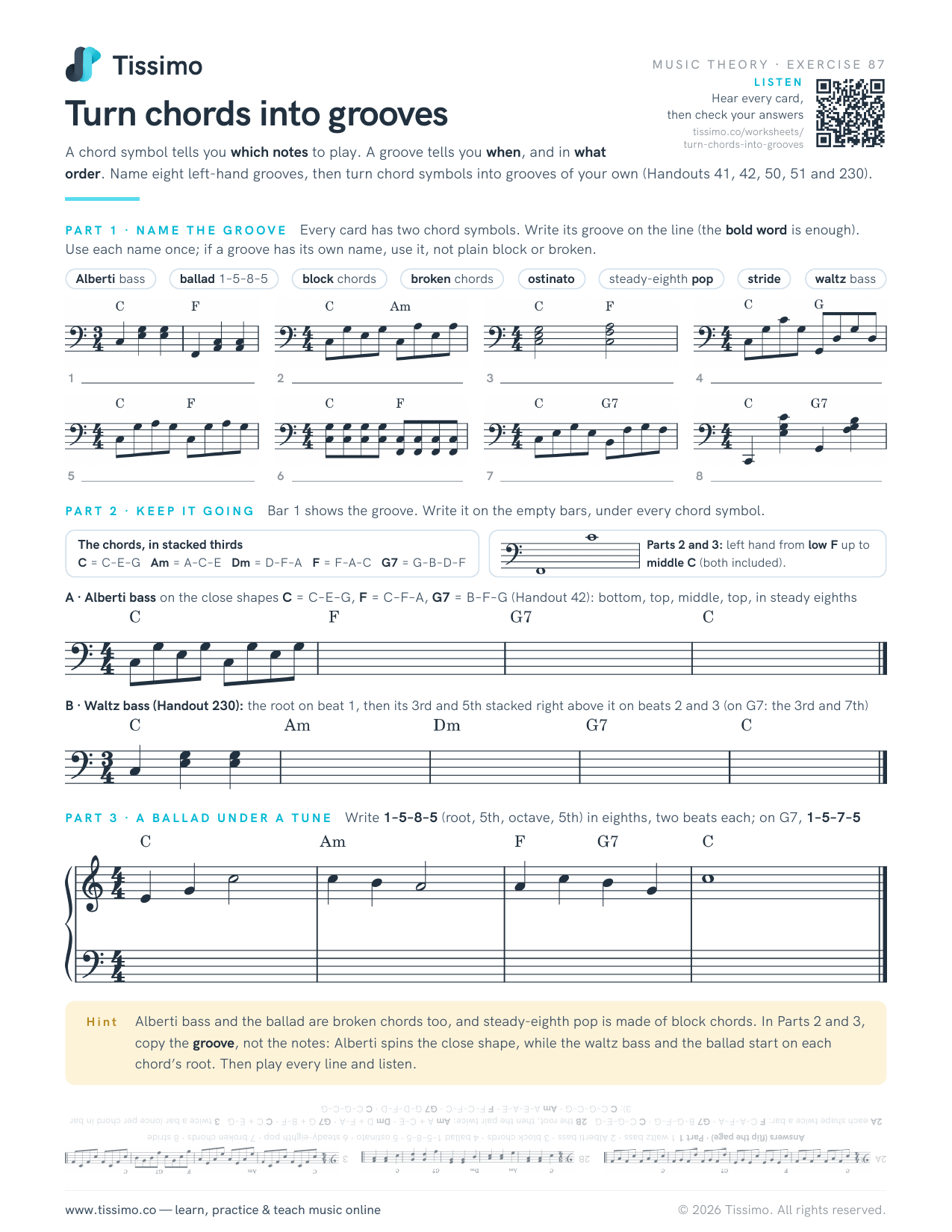 Turn chords into groovesA chord symbol tells you which notes to play. A groove tells you when, and in what order. Name eight left-hand grooves, then turn chord symbols into grooves of your own (Handouts 41, 42, 50, 51 and 230).
Comments