Styles, Genres & Eras
Soul Music
Soul music is African American popular music that joined rhythm and blues with gospel singing. It emerged in the late 1950s and early 1960s, with artists such as Ray Charles, Aretha Franklin and Otis Redding.
Soul music grew in the late 1950s and early 1960s from a meeting of two kinds of African American music: the rhythm and blues of the cities and the gospel of the church. Its classic period runs from about 1960 to 1975, when it was also a soundtrack to the civil rights movement. Singers often described soul as a feeling more than a set of rules: depth of emotion, and the freedom to show it.
From church to the charts
Ray Charles is often called the father of soul. In the mid-1950s he turned gospel songs into secular hits, and in "What'd I Say" (1959) he traded phrases with his backing singers, the Raelettes, over a driving R&B band. Sam Cooke came to pop from the gospel group the Soul Stirrers.
Three sounds, three record labels
- Motown (Detroit): Berry Gordy's label built polished, pop-leaning soul with teams of songwriters and a house band, including James Jamerson on bass. The Supremes, the Temptations, Marvin Gaye and Stevie Wonder recorded there.
- Stax (Memphis): the home of Southern soul, a looser, grittier sound built on organ, guitar and horns, with Booker T. and the MGs as the house band and Otis Redding as its biggest star.
- Atlantic (New York): the label of Ray Charles in the 1950s and, from 1967, of Aretha Franklin's hit records. The first of them, "I Never Loved a Man (The Way I Love You)", was recorded at Rick Hall's FAME studio in Muscle Shoals, Alabama; she became known as "the Queen of Soul".
The sound of soul
- A gospel-trained lead voice: raw, emotional singing, free with the melody, with shouts and moans.
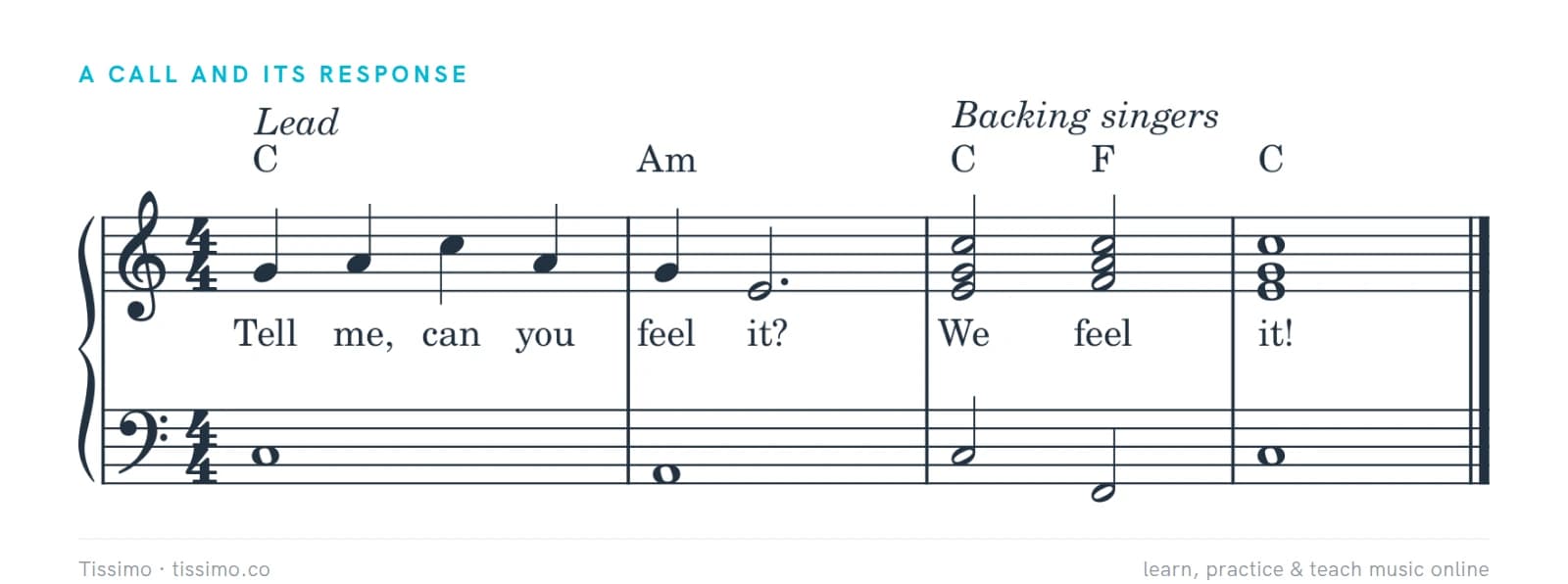
- Call and response between the lead singer and the backing singers, taken straight from the church.
- Close harmony from the backing singers.
- A tight band of bass, drums, guitar and keyboards, often with horns or strings.
After the classic years
In the early 1970s Marvin Gaye (What's Going On, 1971) and Stevie Wonder made personal, socially conscious albums. Funk, which had grown out of soul in the mid-1960s, put the rhythm section in front. In the 1990s a revival of live instruments and classic soul feeling, led by Erykah Badu, D'Angelo, Maxwell and Lauryn Hill, was marketed as neo-soul, a name usually credited to the record executive Kedar Massenburg.
Soul and R&B
The names overlap. Soul is one style within the larger R&B family, and much of today's R&B singing, with its gospel runs and ad-libs, comes straight from soul. To try the call-and-response idea, sing or play a short phrase and have a friend (or your left hand) answer it with a two- or three-note chord.
Common questions
What is the difference between soul and R&B?
Soul is one style within the R&B family: the 1960s and 70s blend of rhythm and blues with gospel singing. R&B is the wider name, covering 1940s rhythm and blues before soul and contemporary R&B after it.
What is the difference between Motown and Southern soul?
Motown, in Detroit, made polished, pop-leaning soul. Southern soul, centered on the Stax label in Memphis, was looser and grittier, built on organ, guitar and horns, with singers such as Otis Redding.
Comments