Instruments & Voices
Banjo
The banjo is a plucked string instrument whose strings pass over a thin drumhead stretched across a round rim. The five-string banjo, usually tuned to open G with a short, high fifth string, is central to bluegrass and old-time music.
The banjo is a string instrument with a drum for a body. A thin head, today usually made of plastic, is stretched over a round rim, and the bridge stands on that head. The light, quick head gives the banjo a bright, snappy sound that fades fast and carries over other instruments.
Where it comes from
The banjo was developed by enslaved Africans in the Caribbean and North American colonies, who made instruments based on the plucked lutes of West Africa, relatives of today's akonting, xalam and ngoni. The earliest known description of a banjo-like instrument in the Americas, the banza played for dances on Martinique, dates from 1654. Early banjos were made from gourds, wood and animal hide. In the 19th century white performers took up the banjo in minstrel shows, a racist form of stage entertainment, and factories began to make it in large numbers. Today it is best known in bluegrass, old-time and folk music and in country music.
The five-string banjo
Four of the strings run the full length of the neck. The fifth is shorter: it starts at the fifth fret, with its tuning peg in the side of the neck. In the usual open-G tuning, written gDGBD, the strings from the fifth to the first sound G4, D3, G3, B3 and D4, so the open strings make a G major chord. The short fifth string is the highest of all and is seldom fretted, so it often rings above the melody like a drone; players call it the thumb string or the drone string. In standard notation, banjo music is written in treble clef an octave higher than it sounds, as guitar music is.

Playing styles
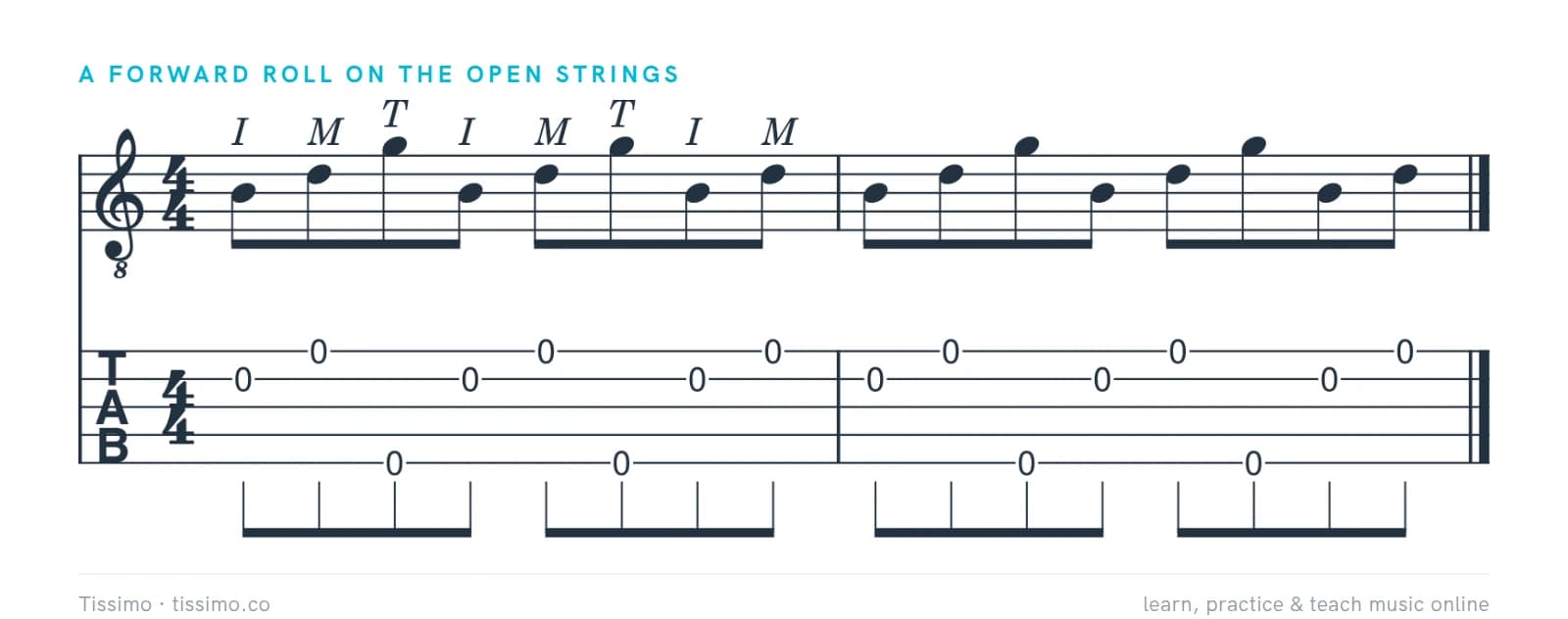
- Three-finger picking, the bluegrass style, uses the thumb, index and middle fingers in steady eight-note patterns called rolls, which turn each chord into a stream of arpeggios.
- Clawhammer, the old-time style, strikes down across the strings, and the thumb catches the fifth string between the strokes.
- Flatpicking with a single pick is the usual way to play the four-string plectrum banjo, and some five-string players use it too.
Most banjo music is written in tablature (TAB): five lines, one per string, with a fret number on the line of each string you play. In a forward roll, the index, middle and thumb pick strings 2, 1 and 5 in turn, so a pattern of three notes runs across beats of two eighth notes.
Other banjos
The four-string tenor banjo, tuned C, G, D, A like a viola, has a long history in jazz and in Irish music, where many players tune it G, D, A, E, an octave below a mandolin. The four-string plectrum banjo is a five-string with the short string left off, played with a pick. There are also six-string banjos tuned like a guitar, and banjo ukuleles tuned like a ukulele.
A common confusion
In bluegrass, "banjo" means the five-string. A tenor banjo is a different instrument, with four full-length strings, another tuning and its own music, so check which one a teacher or a book means.
Common questions
How is a five-string banjo tuned?
Most often to open G. From the short fifth string to the first, the strings sound G4, D3, G3, B3 and D4 (gDGBD), and the open strings make a G major chord. Other tunings, such as C (gCGBD), double C (gCGCD) and open D (aDF♯AD), are common for particular tunes.
Why is the fifth string on a banjo shorter?
It starts at the fifth fret, so it is tuned high, to G4 in open G, and is seldom fretted. The thumb plays it between melody notes, where it works like a drone and gives the banjo much of its syncopated sound.
Comments