Technique & Performance
Tonguing
Tonguing is how wind and brass players start notes with the tongue, as if saying "t" or "d". Double and triple tonguing alternate a front and a back stroke (t-k) to play fast notes cleanly.
On a wind or brass instrument the breath makes the sound, and the tongue shapes how each note begins. To tongue a note, the tip of the tongue touches the roof of the mouth just behind the upper front teeth (on a reed instrument, it touches the reed) and holds back the air for an instant. When it drops away, the air starts the note, much as when you whisper "too" or "doo". The tongue works like a valve: it releases the air, while the breath itself keeps flowing.
Tonguing and slurs
Written music rarely says "tongue here". Notes without a slur are each tongued. Under a slur, only the first note is tongued; the others change by fingers (or lips) alone, with no new attack. The syllable changes the character of the note: a "t" gives a crisp start, a "d" a softer, more legato one. Articulation marks such as staccato, tenuto and accents shape the start and length of each note further.
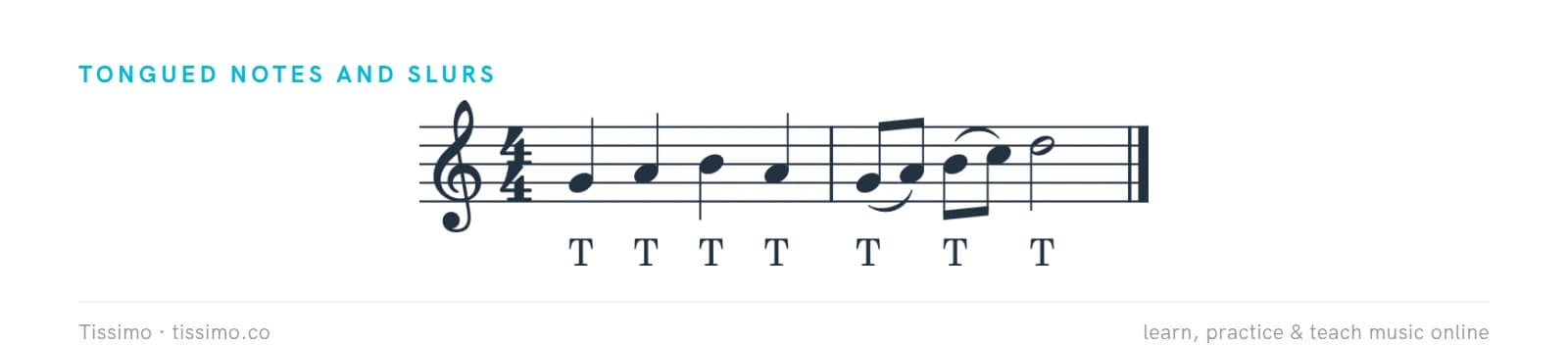
Tongue or Connect? Read the Flute Groups and Flute: One Slur, One Starting Attack practice reading which notes to tongue.
Double and triple tonguing
Ordinary single tonguing has a speed limit. For faster notes, players alternate the tip of the tongue with the back of the tongue, which touches the roof of the mouth further back, as in "k" or "g".
- Double tonguing, for notes in twos and fours: t-k t-k, sung as ta-ka, tu-ku or te-ke, or as du-gu for a softer attack.
- Triple tonguing, for notes in threes: patterns such as t-t-k or t-k-t.
The goal is that a k note sounds exactly like a t note. Teachers often have students practice the k stroke on its own, slowly, and record themselves to check that they cannot tell the strokes apart. The music usually does not ask for double tonguing; you use it when the tempo is too fast to single-tongue. Two Articulations, Even Notes and Which Articulation Comes Next? build the t-k pattern on the flute.
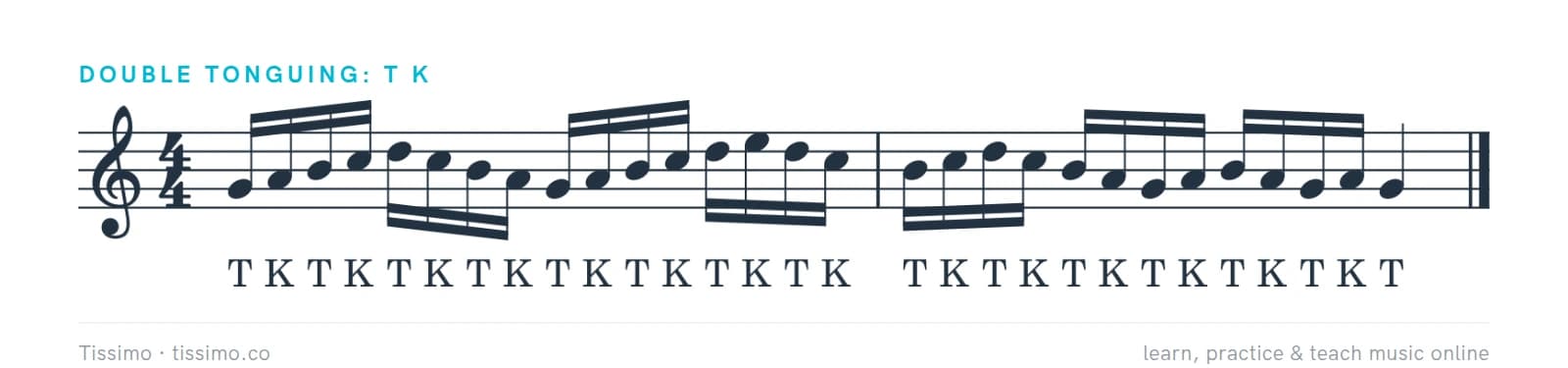
Double and triple tonguing are standard on the flute and on brass instruments such as the trumpet. On the clarinet the reed gets in the way, and they are much harder.
Not the same as flutter-tonguing
Flutter-tonguing rolls an R to make one note buzz; double and triple tonguing start many separate notes. Tonguing is also separate from the embouchure, the shape of the lips, although the two work together on every note.
Common questions
What syllables are used for double tonguing?
A front and a back syllable in turn: ta-ka, tu-ku or te-ke for a crisp attack, du-gu or da-ga for a softer one. Teachers differ, so start with the syllables your teacher uses.
When should I use double tonguing?
When a passage of separate notes is too fast for single tonguing. The part rarely says so; you decide from the tempo.
Practice it: free worksheets
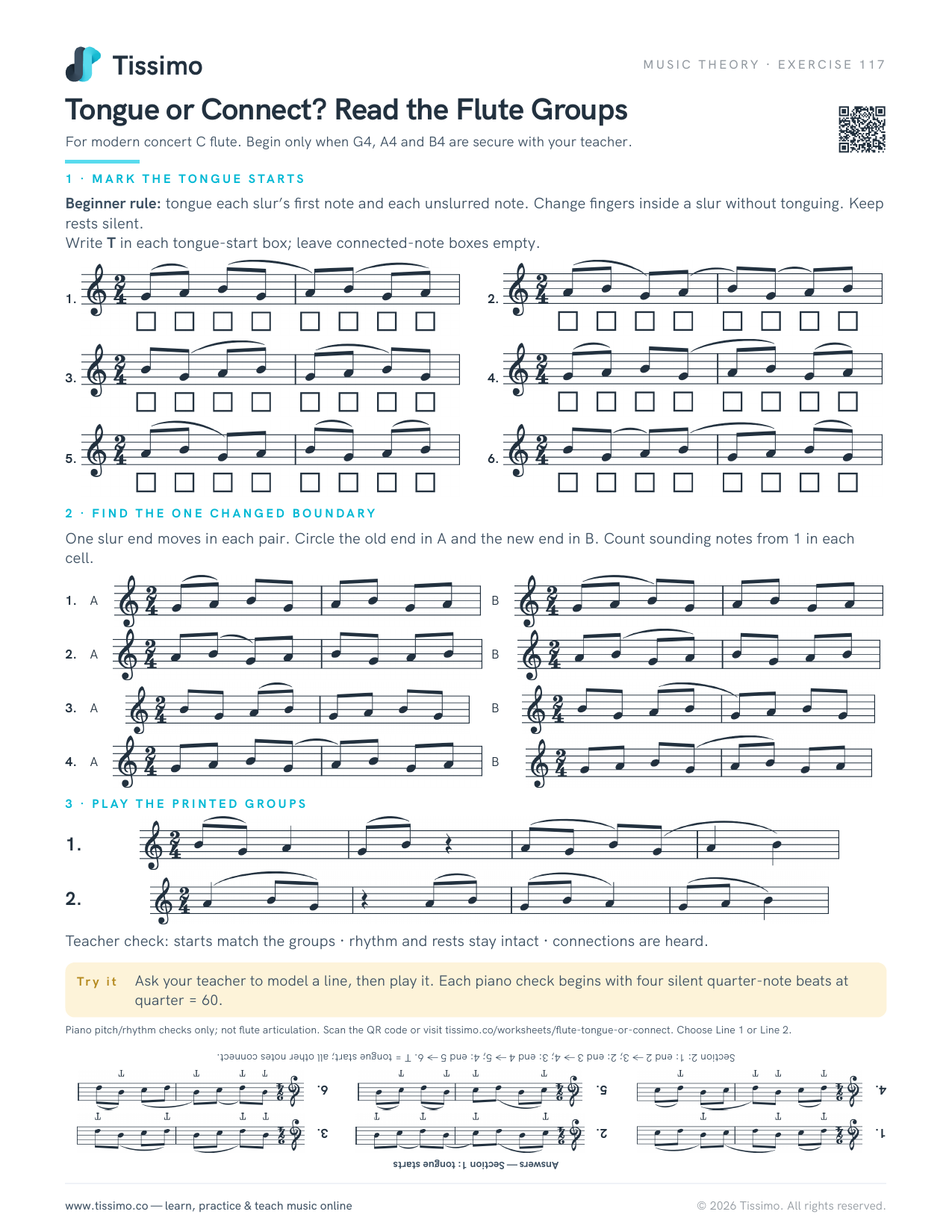 Tongue or Connect? Read the Flute GroupsFor modern concert C flute. Begin only when G4, A4 and B4 are secure with your teacher.
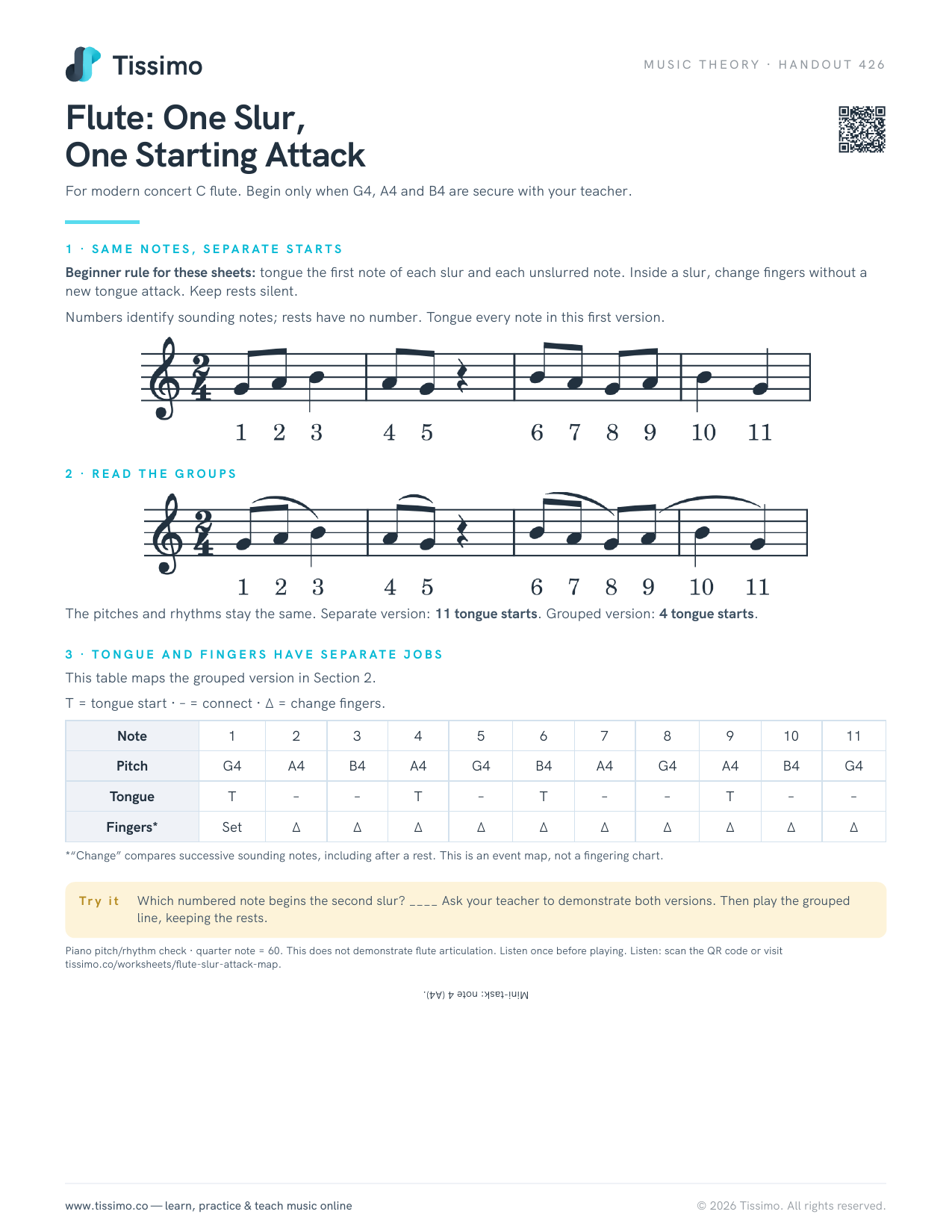 Flute: One Slur, One Starting AttackFor modern concert C flute. Begin only when G4, A4 and B4 are secure with your teacher.
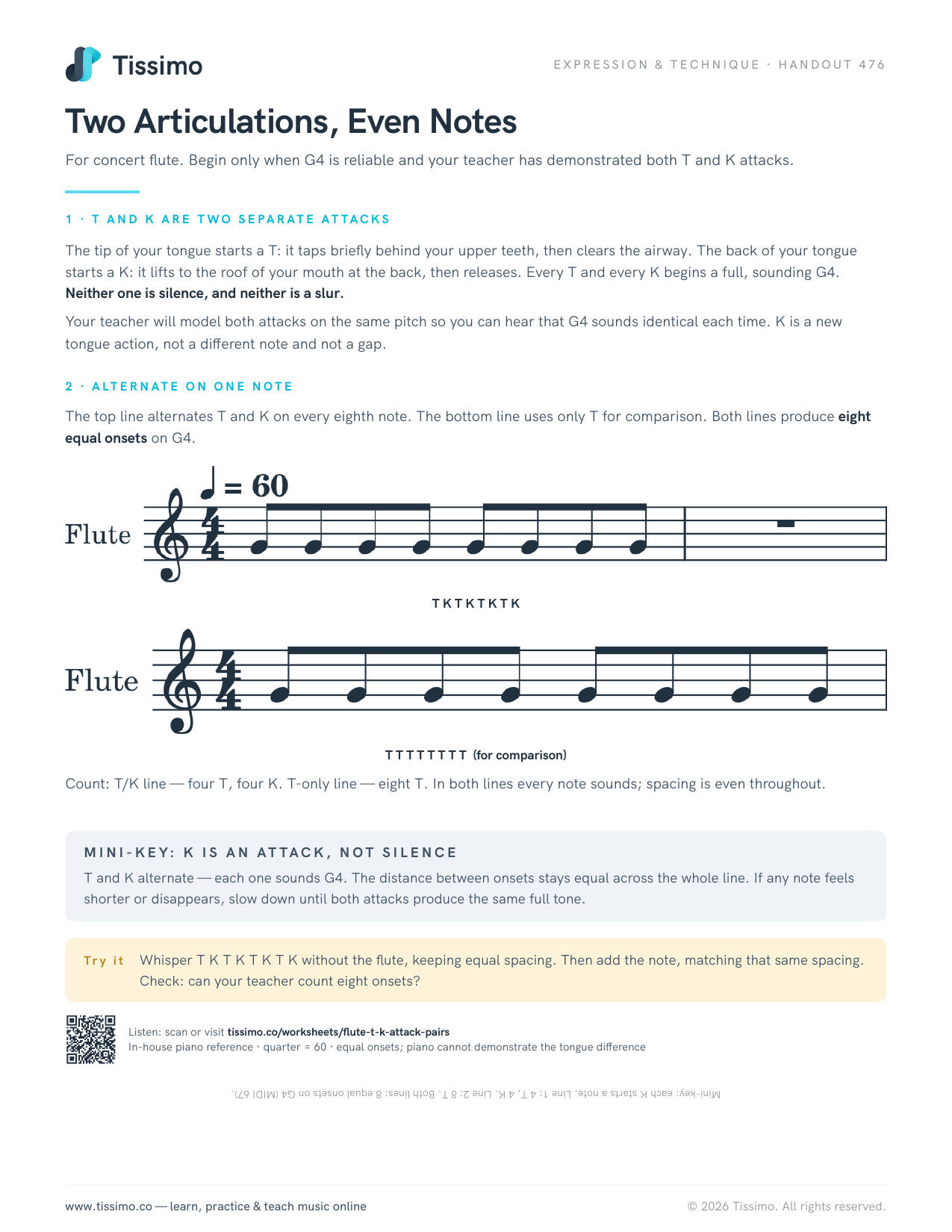 Two Articulations, Even NotesFor concert flute. Begin only when G4 is reliable and your teacher has demonstrated both T and K attacks.
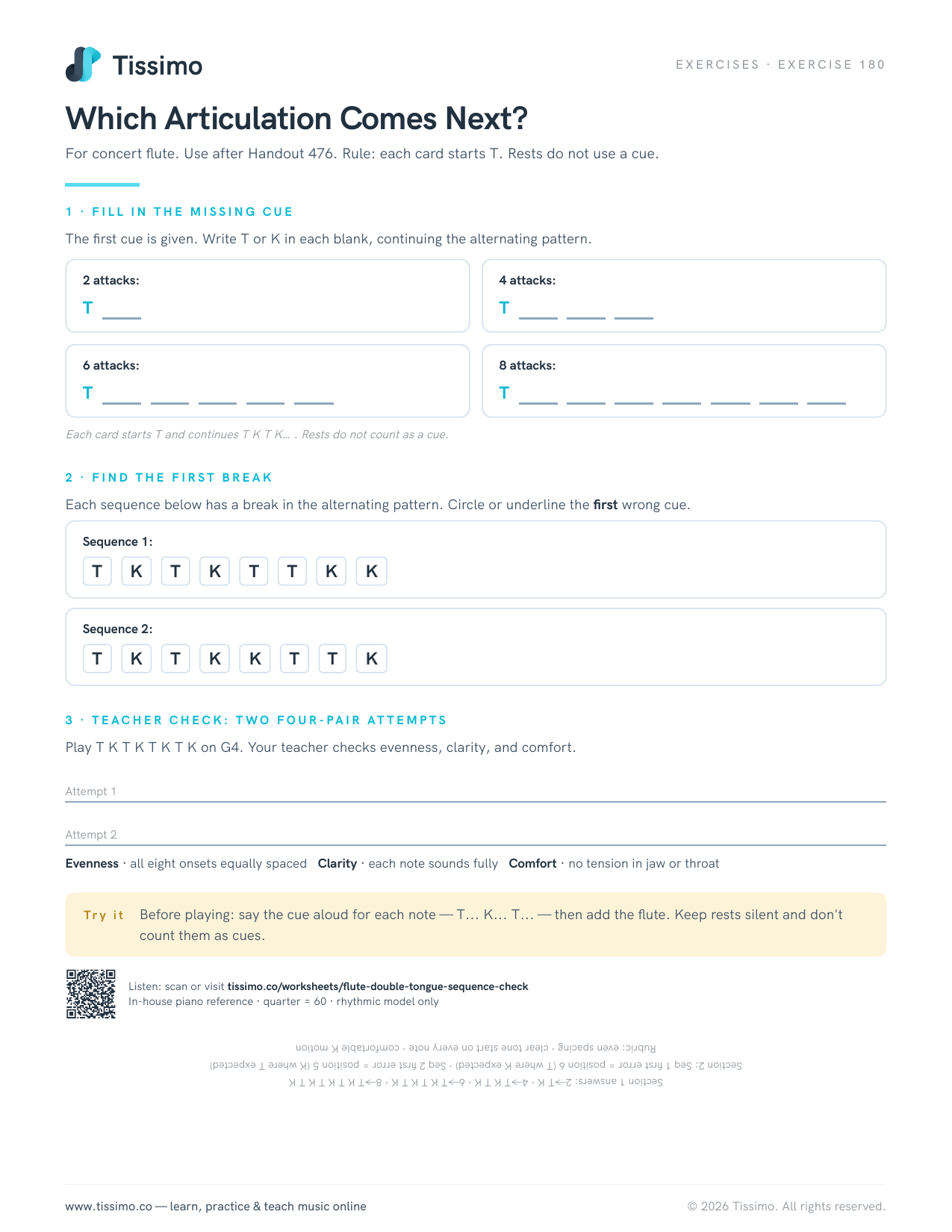 Which Articulation Comes Next?For concert flute. Use after Handout 476. Rule: each card starts T. Rests do not use a cue.
Comments