Chords & Harmony
Tone Cluster
A tone cluster is a chord of neighboring notes, each usually a whole step or half step from the next, played together. On the piano it is often played with the flat of the hand, the fist or the forearm.
A tone cluster is a chord made of notes that sit right next to each other, each usually a major or minor second from the next, sounded at the same moment. Instead of the gaps of a triad (C, skip D, E, skip F, G), a cluster fills everything in: C D E F G all at once. The result is a thick, buzzing block of sound, a strong dissonance in which you hear color and weight more than separate notes. "Tone cluster" is the usual American term; British books often just say cluster.
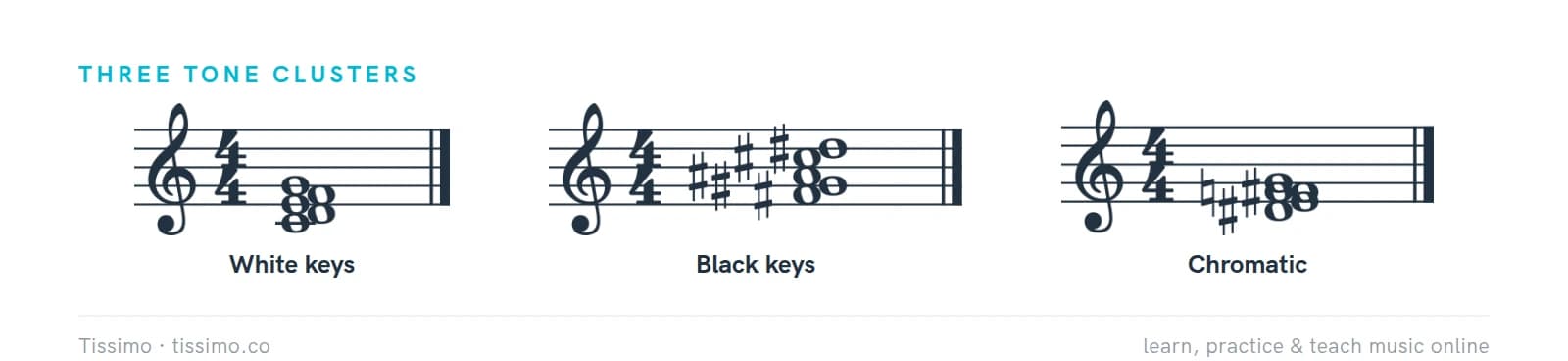
Kinds of cluster
- White-key clusters use only white keys, a run of whole and half steps.
- Black-key clusters use only black keys. Because the black keys are grouped in twos and threes, neighbors here are a whole step or a minor third apart.
- Chromatic clusters take every key, white and black, between two notes, so every note is a half step from the next.
How to play one
Small clusters can be played with the fingers. Larger ones are played with the flat of the hand, the side of the fist, or the whole forearm laid along the keys. Keep the touch firm but relaxed: drop the weight of the arm into the keys and let the fleshy part of the hand or arm do the work, not the bony wrist or elbow.
How it looks on the page
Notation varies between composers. Some write out every note of the cluster, as in the figure. Henry Cowell, who wrote many cluster pieces, usually wrote only the outer notes, with a sign to say whether to play the white keys, the black keys or both. When you meet an unusual sign in modern piano music, check the performance notes at the front of the score.
A short history
The American composer Henry Cowell demonstrated forearm clusters at the keyboard in 1913, and built pieces such as The Tides of Manaunaun on them. He was not the first: František Koczwara's The Battle of Prague (about 1788) is said to ask for groups of notes played with the palm to suggest cannon fire, and Charles Ives, in his Concord Sonata, called for a length of wood to hold down a long row of keys. Béla Bartók asked Cowell's permission before making clusters the basic harmony of "The Night's Music" from Out of Doors (1926), and jazz pianists such as Cecil Taylor took them up as well. Today clusters are part of the everyday vocabulary of 20th-century and later music.
Not every chord with a second
A single second inside a voicing, as in an added-note chord or a sus2 chord, does not make a cluster. A cluster is built from neighboring keys throughout, so that no gap is left in the block.
Common questions
Who invented the tone cluster?
No single person. Earlier composers occasionally asked for groups of neighboring keys, but the American composer Henry Cowell made clusters central to his piano music from 1913 on, and he is usually credited with popularizing them.
Comments