Chords & Harmony
Polychord
A polychord is two or more chords sounded at the same time, usually two triads stacked one above the other, such as D major over C major. Chord charts write it as a fraction with a horizontal line.
A polychord is two chords sounded together, one stacked on top of the other. Most polychords combine two triads, although a seventh chord can take part, and three layers are possible. In a lead-sheet chord symbol a polychord is written like a fraction: the upper chord above a horizontal line, the lower chord below it. The inversion of each layer need not be specified.
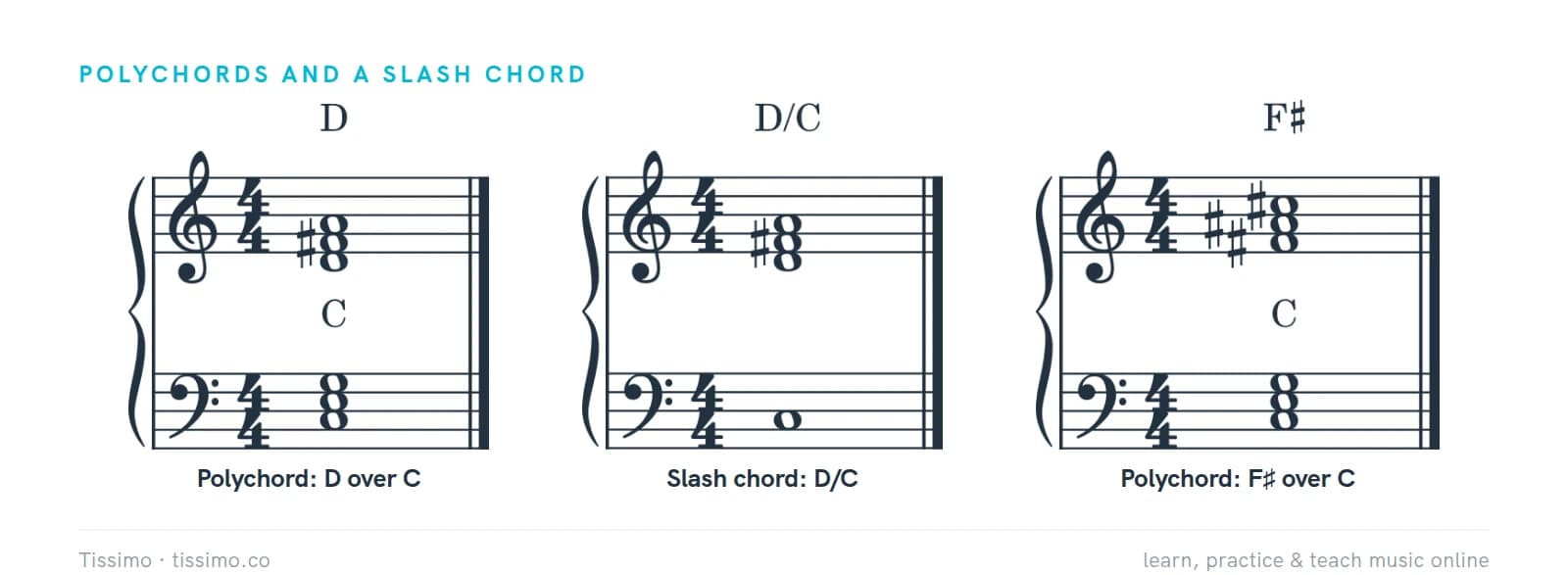
Polychord or slash chord?
The two symbols look alike but mean different things:
- D/C with a diagonal slash is a slash chord: a D major triad over the single bass note C.
- D over C with a horizontal line is a polychord: a D major triad over a complete C major triad (C, E and G).
When does it sound like two chords?
Not every stack sounds double. When the two chords are closely related, as C and D are, the ear tends to hear one big extended chord: D over C contains C, E, G, D, F♯ and A, which is a C chord with a 9th, a raised 11th and a 13th. When the chords are distantly related, three or more steps apart around the circle of fifths, they keep their separate identities and the clash is the point. Composers make the two layers clearer by keeping them in different registers or giving them to different instruments.
Famous polychords
- The Petrushka chord from Stravinsky's ballet Petrushka (1911) combines C major and F♯ major, two triads a tritone apart.
- In The Rite of Spring, the "Dance of the Adolescents" repeats an E♭ dominant seventh chord on top of an F♭ major triad.
- Aaron Copland's Appalachian Spring places an A major chord below an E major chord.
Polychords also appear in jazz, where pianists and arrangers stack a triad above another chord to get rich, bright voicings.
Polychord and polytonality
A polychord is a single sound. Polytonality (or bitonality, with two keys) keeps two or more keys going at once over a longer passage, so it often produces polychords along the way.
Try it
Play C–E–G in the left hand and D–F♯–A in the right: you hear one glowing, Lydian-colored chord. Then keep the left hand and play F♯–A♯–C♯ in the right: now the two triads grind against each other. Listen for the moment the sound splits into two layers.
Common questions
What is the difference between a polychord and a slash chord?
A slash chord such as D/C is one chord over a single bass note. A polychord is a whole chord over another whole chord, written with a horizontal line instead of a slash.
Comments