Technique & Performance
Position and Shifting (String Playing)
Position and shifting describe a string player's left hand: a position is where the hand sits on the fingerboard, from first position near the scroll upward, and a shift moves the hand to a new position.
A violin, viola, cello or double bass has no frets. In each position, the left-hand fingers (1 index, 2 middle, 3 ring, 4 little) cover a small group of notes on every string. To reach other notes, the player shifts: the whole hand, thumb included, slides along the neck to a new position. Finger numbers and positions are separate things: finger 1 plays a different note in every position.
Counting positions
- First position has the hand nearest the scroll, at the top of the fingerboard. With the open strings, it is where beginners play. On the violin, finger 1 plays one step above each open string: B4 on the A string.
- Higher positions move the hand toward the bridge. On the violin and viola each position starts one step higher than the last: in third position, finger 1 on the A string plays D5, and eighth position is an octave above first.
- Half position sits between the open strings and first position. Double bassists learn it early: on the A string, fingers 1, 2 and 4 play B♭1, B1 and C2, a half step apart.
- Thumb position, on the cello and double bass, is used high on the fingerboard: the thumb leaves the neck and presses the string like a finger.
The cello and bass count differently from the violin, because their hands cover less. In the cello's lower positions the fingers usually sit a half step apart, so the hand spans a minor third, and methods differ over how they number the in-between positions.
How a shift works
The thumb slides along the neck with the hand. A shift is easiest when the same finger plays the last note before it and the first note after it. Otherwise, the finger already on the string slides to its place in the new position and the new finger drops onto the string at the moment of arrival. Players find positions by feel and by landmarks: in the cello's fourth position, for instance, the thumb rests where the neck meets the body.
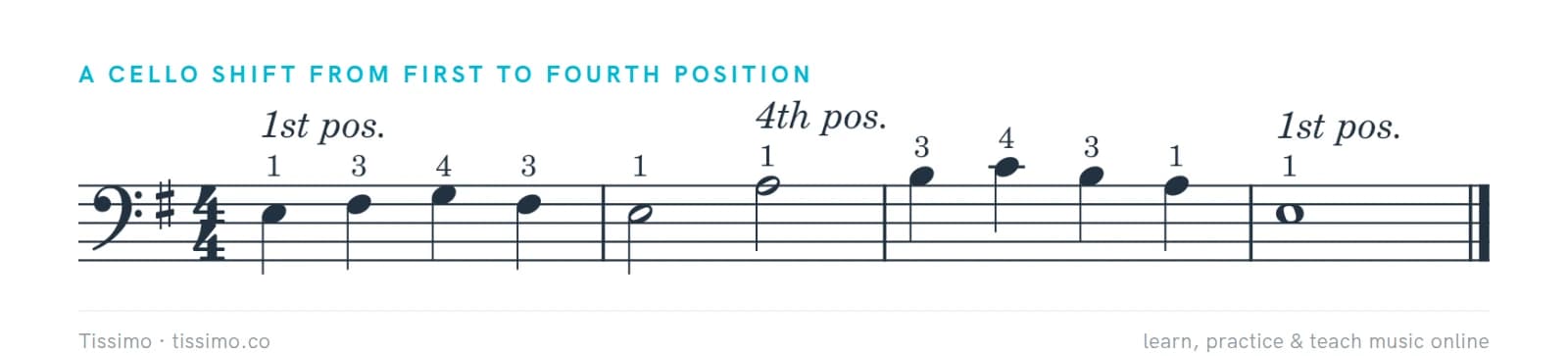
At first, shift during a rest, slowly, and listen for the target note. One Finger, Two Positions and Mark the Position Before the Shift practice this cello shift, and Half Position: 1, 2, 4 and Which String, Which Finger? the bass's half position.
How positions are marked
The main clue is a fingering number on the first note after a shift. Editions may add the position as an ordinal ("3rd pos.") or a Roman numeral ("III"), and the string as "sul D". Watch out: Roman numerals also name strings, counted from the highest. On the cello, I is the A string and II the D string. Check what your edition means.
Shift, glissando or portamento?
A shift should sound like two clean notes, with the slide in between nearly silent. When a player lets the slide be heard on purpose, for expression, it becomes a portamento. A glissando is a slide through all the pitches as an effect. Trombonists also talk about positions, but theirs are slide positions; see trombone.
Common questions
What is first position on the violin?
The hand position nearest the scroll, where finger 1 plays the note one step above each open string: A on the G string, E on the D string, B on the A string and F or F♯ on the E string.
Why do string players shift?
To reach notes higher than first position allows, to avoid awkward fingerings or string crossings, and to keep a phrase on one string for an even tone color.
Practice it: free worksheets
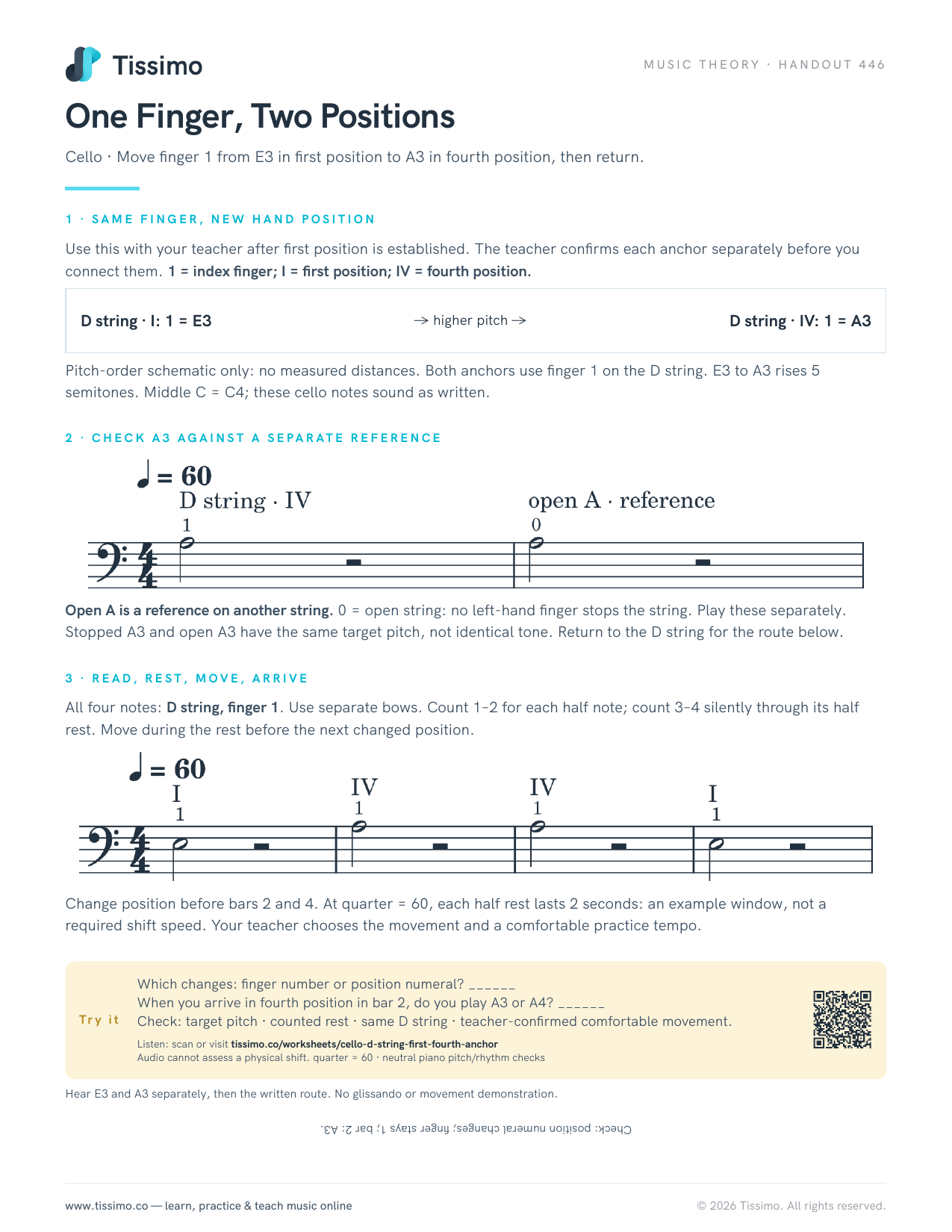 One Finger, Two PositionsCello · Move finger 1 from E3 in first position to A3 in fourth position, then return.
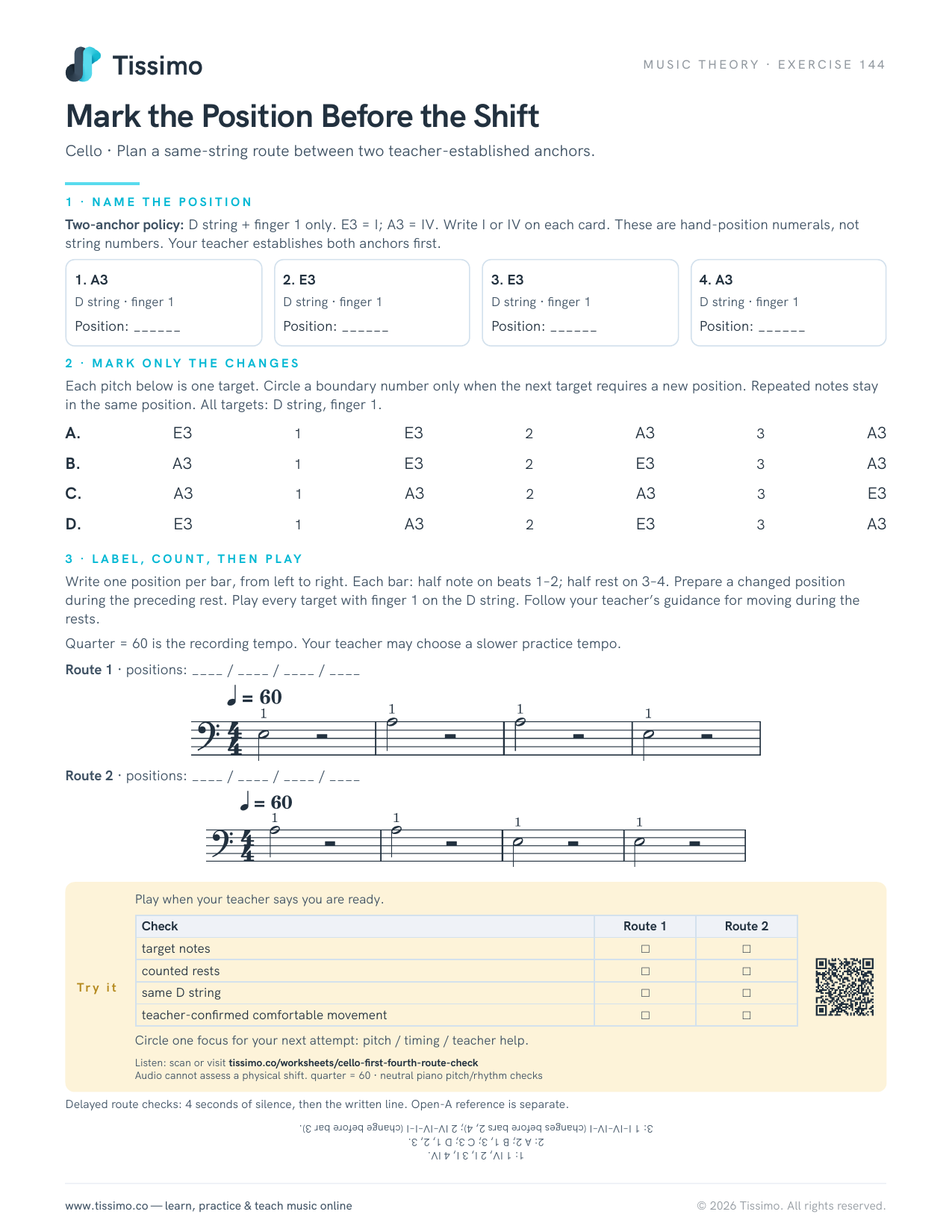 Mark the Position Before the ShiftCello · Plan a same-string route between two teacher-established anchors.
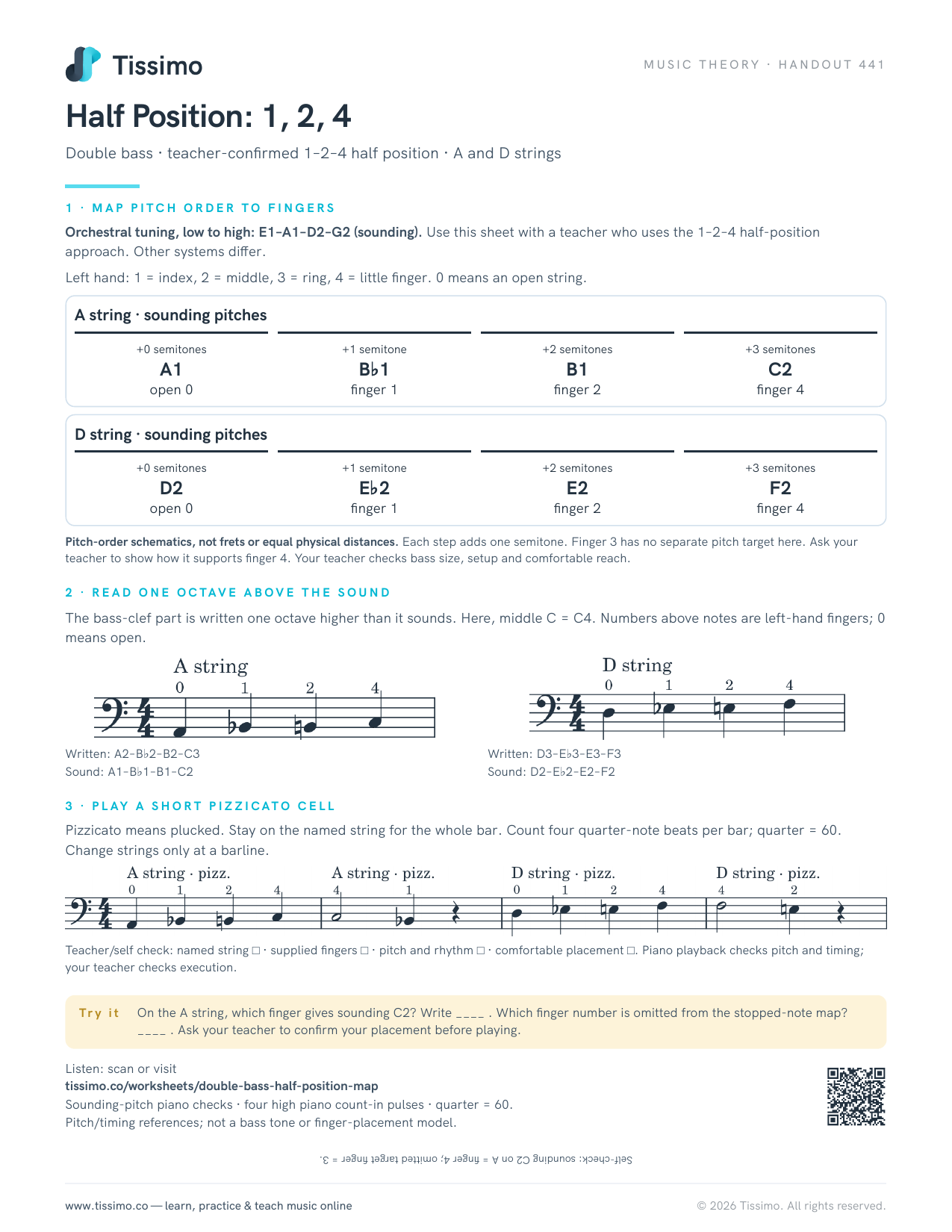 Half Position: 1, 2, 4Double bass · teacher-confirmed 1–2–4 half position · A and D strings
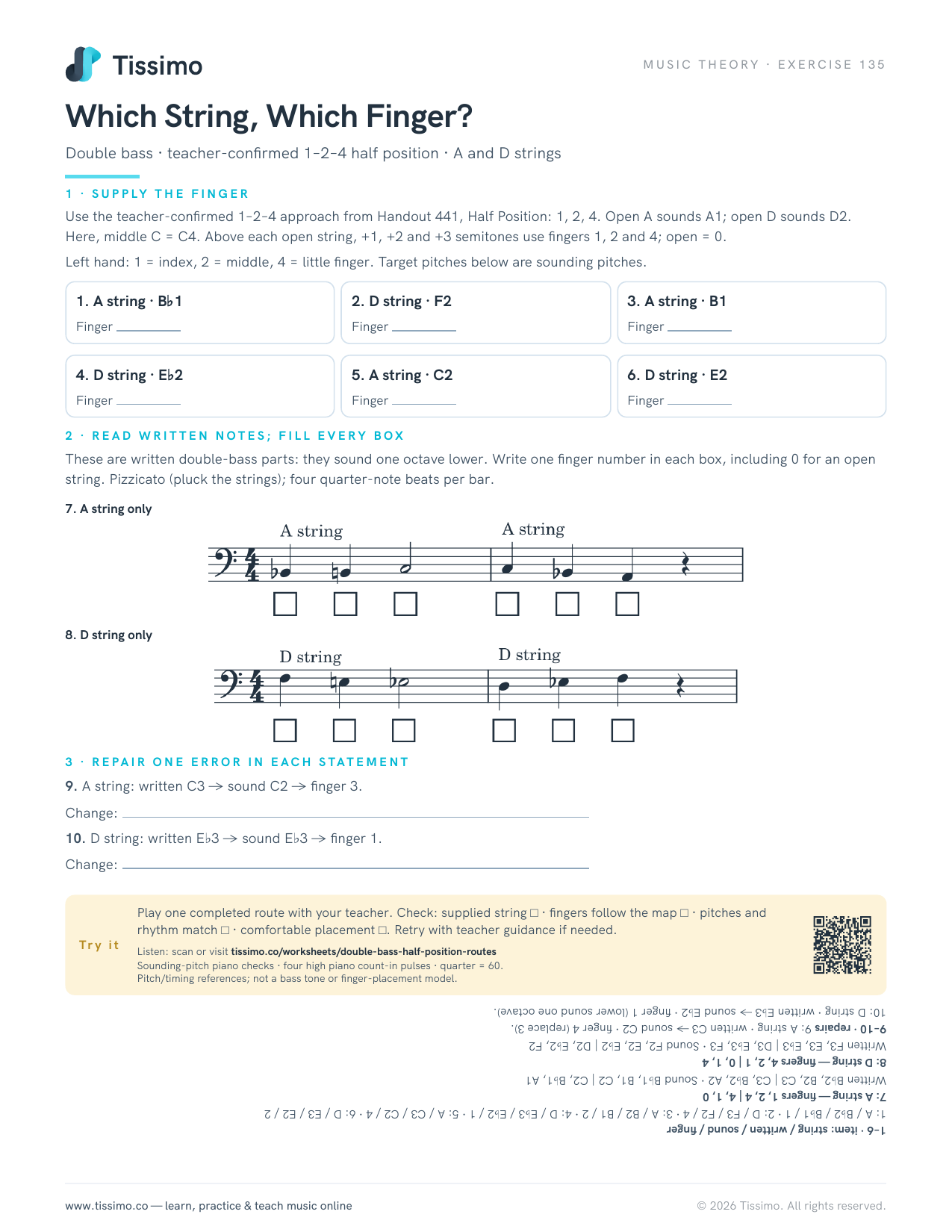 Which String, Which Finger?Double bass · teacher-confirmed 1–2–4 half position · A and D strings
Comments