Scales, Keys & Modes
Polytonality (Bitonality)
Pronounced pol-ee-toh-NAL-ih-tee
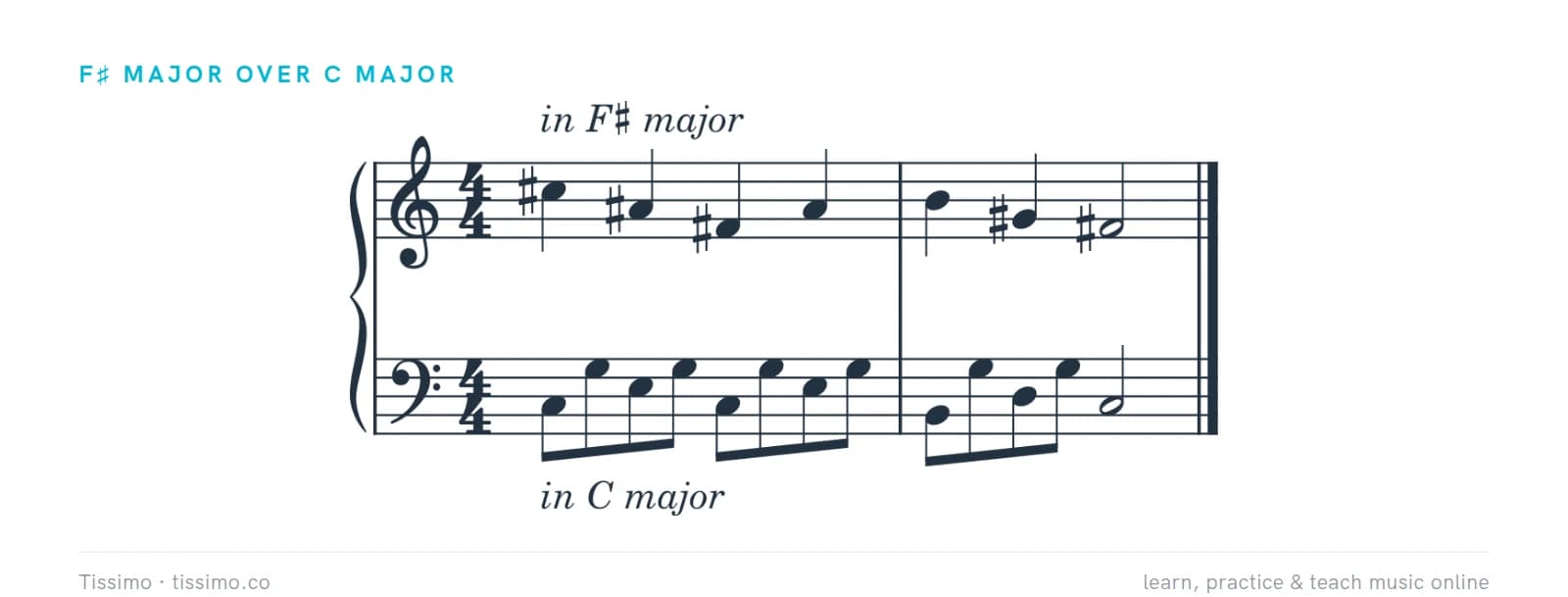
Polytonality is the use of two or more keys at the same time, for example a melody in F♯ major over an accompaniment in C major. With exactly two keys it is also called bitonality.
In polytonal music, two or more keys sound at once, each in its own layer of the texture. With two keys the usual word is bitonality. Each layer on its own is ordinary tonal music with its own tonic; together they rub against each other. The technique belongs above all to the 20th century: Stravinsky, Milhaud, Holst, Bartók and Vaughan Williams are among the composers who used it.
How it looks and sounds
Composers make the layers easy to tell apart. Each key gets its own register, instrument or hand, and often its own clear melody or accompaniment pattern, so that the ear can follow two strands. In the example below, the left hand plays a plain C major pattern and the right hand an equally plain tune in F♯ major. Each hand alone sounds simple; together they clash on almost every beat.
Choosing the keys
The farther apart the keys are on the circle of fifths, the more clearly they stay separate. C major and F♯ major are a tritone apart, as far apart as two keys can be, and they share only two notes, B and F (written E♯ in F♯ major). Keys close together, such as C and G major, share six of their seven notes and tend to blend into a single key with some added color.
Polytonality and polychords
A polychord is a single sound: two chords stacked at one moment, such as the Petrushka chord, C major plus F♯ major, in Stravinsky's ballet Petrushka. Polytonality keeps two keys going through a passage, with melodies and harmonies in each, so it often produces polychords along the way.
Can you really hear two keys?
Theorists disagree. Some have doubted that a listener can hold two keys in mind at once, and hear instead one rich, clashing sound with two layers; others argue that two key areas can be heard together, at least roughly. What is clear from the music is that the effect depends on how clearly the layers are kept apart.
Polytonal or atonal?
The two are close to opposites. Atonal music avoids any tonal center; polytonal music has more than one. Try it at the keyboard: play the left hand of the example alone, then the right hand alone, and then both together, listening for the moment the two keys pull apart.
Common questions
What is the difference between polytonality and bitonality?
Bitonality is polytonality with exactly two keys. Two keys is the usual case, so the two words are often used for the same thing.
Is polytonality the same as atonality?
No, it is close to the opposite. Polytonal music has two or more tonal centers at once; atonal music avoids having any tonal center.
Comments