Melody, Texture & Counterpoint
Melodic Inversion
Melodic inversion turns a melody upside down: every step or leap that went up now goes down by the same interval, and every one that went down now goes up, as in a mirror.
Melodic inversion turns a melody upside down. Each interval keeps its size but changes direction: a step up becomes a step down, a leap down of a fifth becomes a leap up of a fifth. The shape is still recognizable, only flipped. In the simplest case the inversion starts on the same note as the original, which then acts as the line of the mirror.
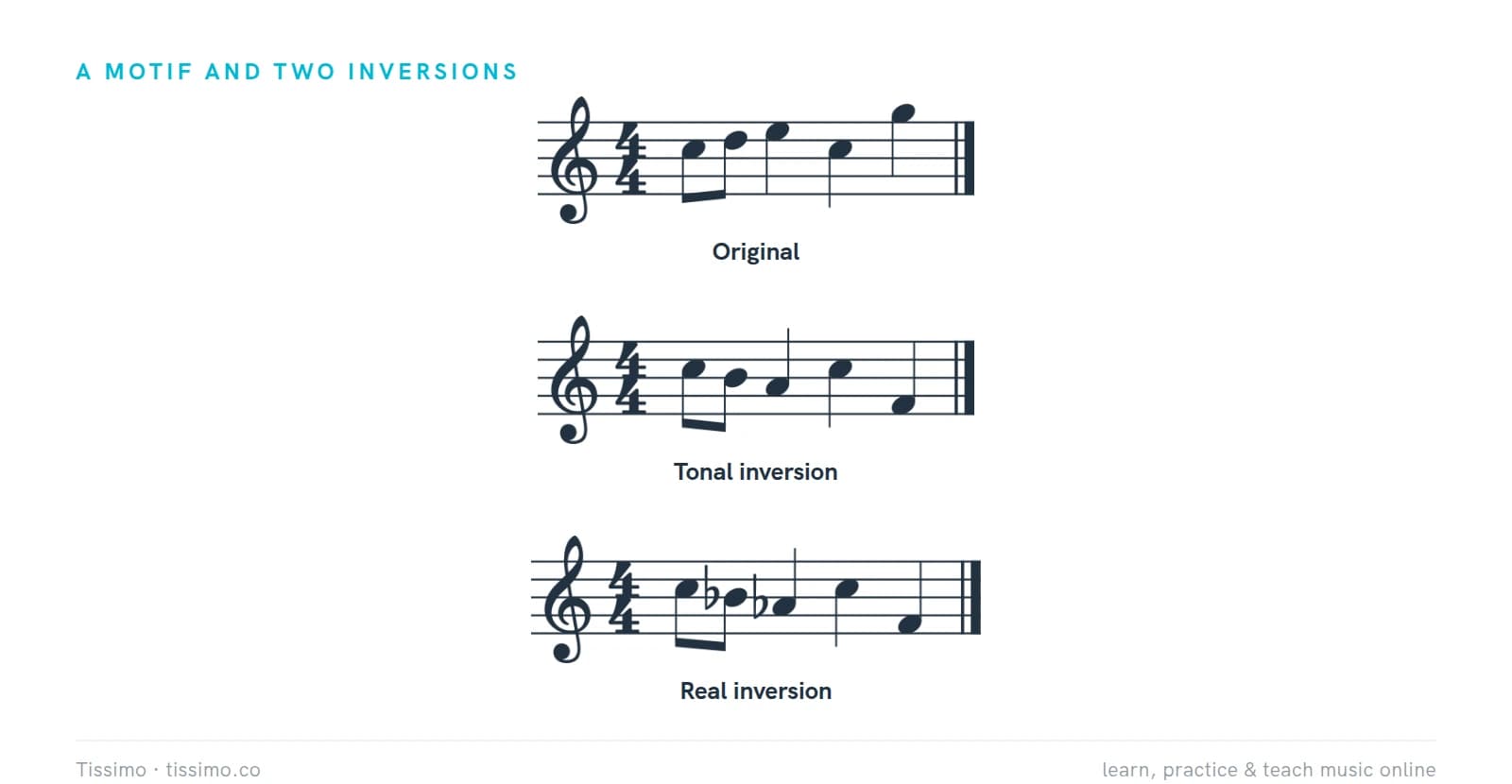
Tonal and real inversion
There are two ways to measure "the same interval":
- Tonal (diatonic) inversion keeps to the notes of the key. A step stays a step, a third stays a third, but a whole step may come back as a half step, or a major third as a minor third. Inversions in tonal music are usually of this kind.
- Real (exact) inversion mirrors every interval to the half step, so the inversion may need sharps or flats that are not in the key. Twelve-tone composers use exact inversion as one of the standard forms of a row (see serialism).
Where you find it
Bach's Invention No. 1 in C major is a famous example: the first seven notes of bar 1 come back upside down in bar 3. In a canon by inversion, the following voice imitates the leader in mirror image, and a fugue may bring back its subject upside down in a later entry (see imitation and fugue). Inversion is one of the standard ways to develop a motif, together with sequence, augmentation and diminution and retrograde.
Three different "inversions"
The word inversion is used for several different things, so read the context. Three that students meet most often:
- Melodic inversion: a melody turned upside down, as here.
- Chord inversion: a chord with a note other than its root in the bass.
- Interval inversion: the lower note of an interval moved up an octave, so a third becomes a sixth.
Melodic inversion is also different from contrary motion, where two parts move in opposite directions at the same time. Inversion transforms one line; you may hear the original and its inversion at different moments.
At the piano, exact inversion is a mirror image on the keyboard. Mirror the Passage asks you to reflect right-hand passages into the left hand around D (and A♭), and The Mirror Keyboard: D and A♭ shows why D and A♭ are the two mirror points of the keyboard. For inversion as a way of developing a motif, see Motif and sequence.
Common questions
What is the difference between melodic inversion and chord inversion?
Melodic inversion turns a melody upside down, so its rises become falls. Chord inversion rearranges the notes of a chord so that its third or fifth is in the bass. The two share a name and nothing else.
Does an inversion have to start on the same note?
No. Starting on the same note is the clearest way to show it, but an inversion can begin on any note, as long as each interval is mirrored.
Practice it: free worksheets
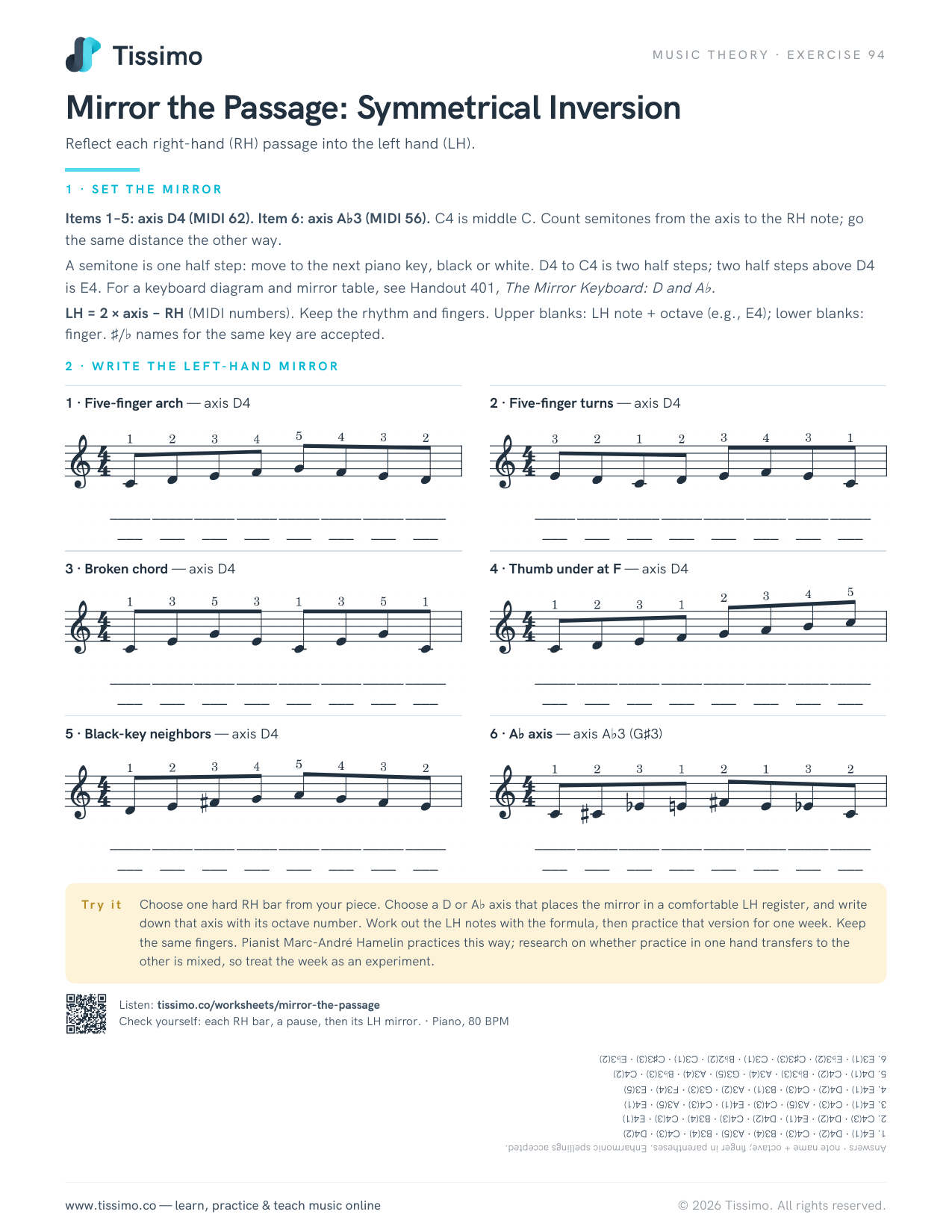 Mirror the Passage: Symmetrical InversionReflect each right-hand (RH) passage into the left hand (LH).
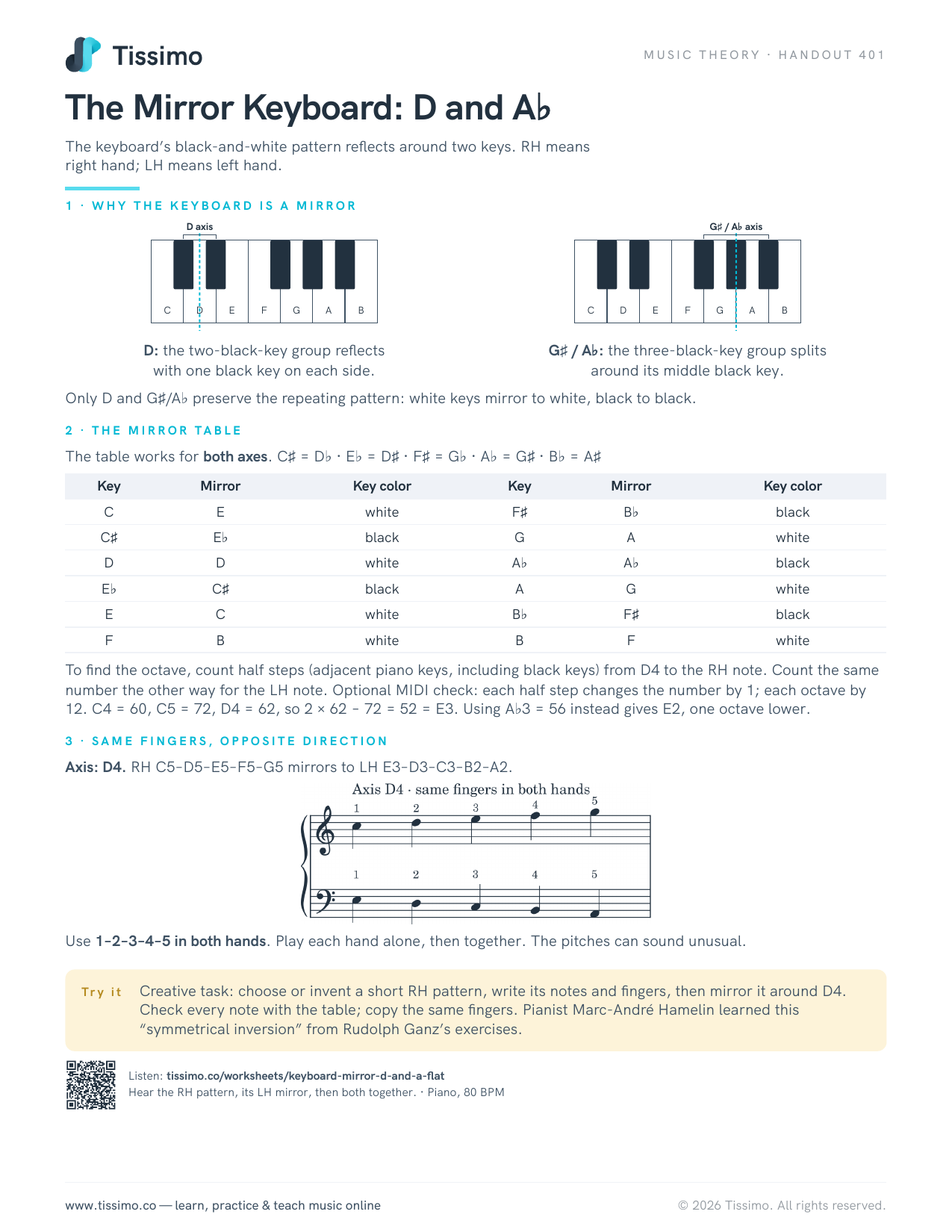 The Mirror Keyboard: D and A♭The keyboard’s black-and-white pattern reflects around two keys. RH means right hand; LH means left hand.
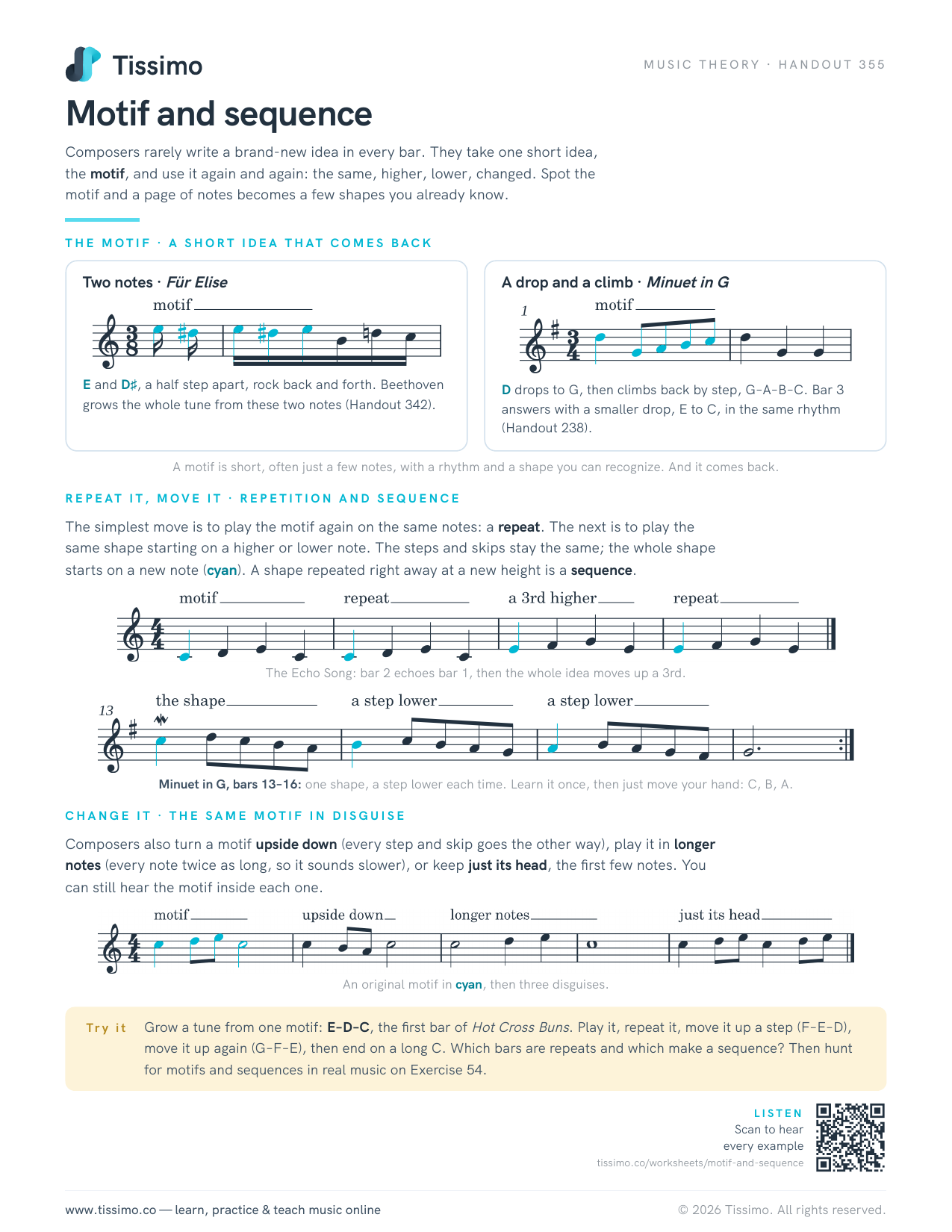 Motif and sequenceComposers rarely write a brand-new idea in every bar. They take one short idea, the motif, and use it again and again: the same, higher, lower, changed. Spot the motif and a page of notes becomes a few shapes you already know.
Comments