Melody, Texture & Counterpoint
Augmentation and Diminution
Augmentation and diminution are ways of changing a motif's rhythm while keeping its notes. Augmentation lengthens every note value, usually doubling it; diminution shortens them, usually halving them.
Augmentation and diminution are two of the classic ways a composer develops a motif or a theme. The pitches stay the same, in the same order; only the rhythm changes. In augmentation every note value gets longer, most often exactly twice as long, so eighth notes become quarter notes and quarter notes become half notes. In diminution every value gets shorter, most often exactly half as long. Some writers also call a freer shortening diminution, as long as the motif is still recognizable.
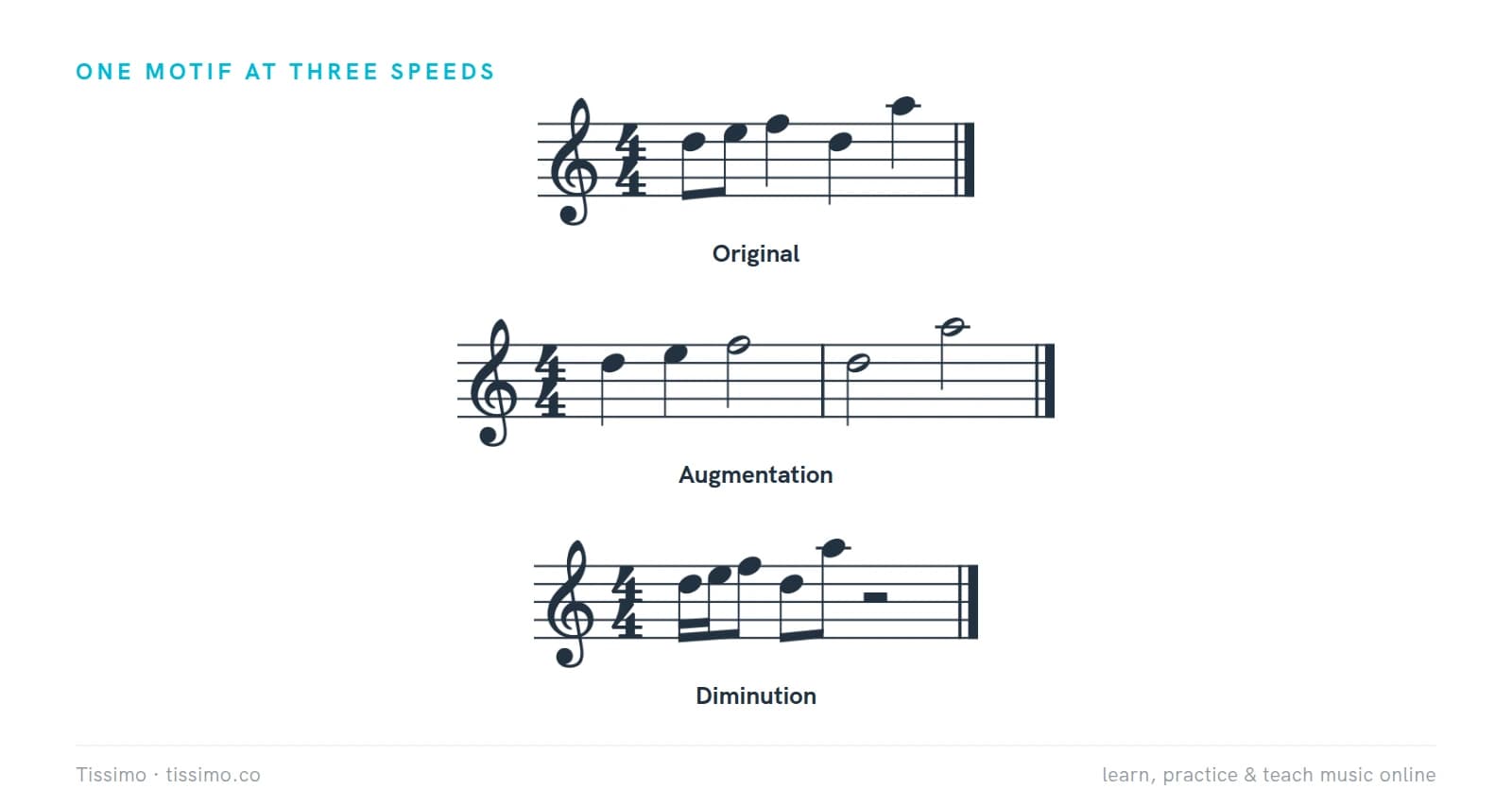
What you hear
The beat itself does not change. A motif in augmentation sounds slower and broader because each note lasts longer against the same pulse; a motif in diminution sounds hurried and excited. So augmentation can make a short idea sound grand and weighty, and diminution can build energy.
Because the notes and their order stay the same, you recognize the idea even at the new speed. Try singing the motif in the figure, then clap the augmentation while counting the same beat: it takes twice as many beats.
Where you find them
- In counterpoint. In a canon by augmentation the following voice sings the leader's melody in longer notes, and in a canon by diminution in shorter ones. Some fugues and other imitative pieces bring back their subject in augmentation or diminution (see imitation and fugue).
- In motivic development. Bach's Invention No. 1 in C major brings back a fragment of its opening idea in augmentation, and Holst's "Uranus" from The Planets compresses its opening notes into shorter values.
- In early music. Renaissance and Baroque players also used diminution for a kind of ornamentation: dividing a long note into many shorter, faster notes. English players called the same practice divisions.
A common confusion
Augmentation here is not the augmentation dot, which lengthens a single note by half, and it has nothing to do with an augmented interval or chord. Diminution is likewise unrelated to diminished intervals and diminished chords. In this sense the words describe the rhythm of a whole idea.
Motif and sequence introduces playing a motif in longer notes alongside the other ways of changing it. To practice finding a motif each time it comes back, try Find the motif and the sequence.
Common questions
What is augmentation in music?
Augmentation is restating a melody or motif with longer note values, usually twice as long, while keeping the same notes. It sounds slower and broader although the beat has not changed.
What is the difference between diminution and a faster tempo?
A faster tempo speeds up everything. Diminution shortens the note values of one idea while the beat and the other parts keep going at the same speed, so you hear the motif squeezed against an unchanged pulse.
Practice it: free worksheets
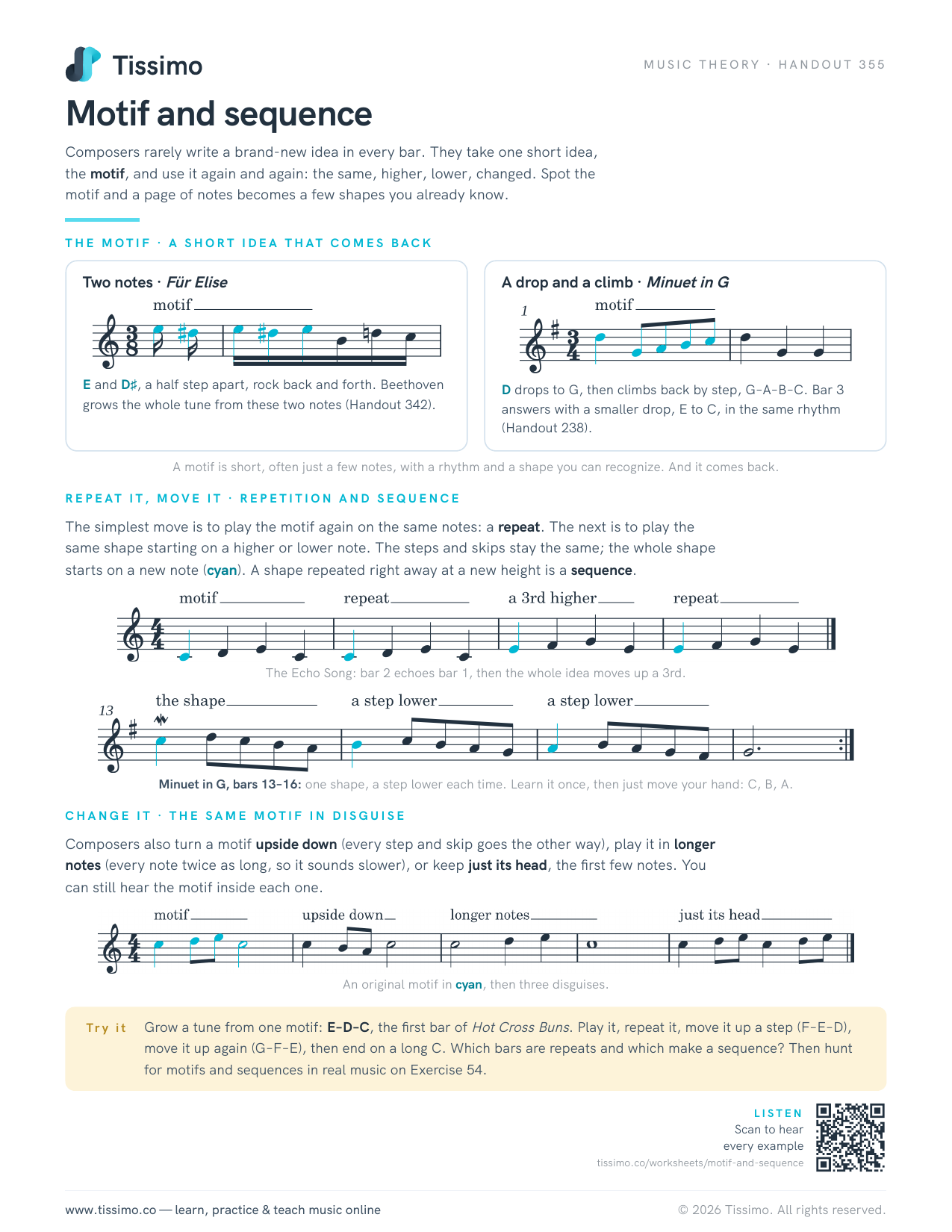 Motif and sequenceComposers rarely write a brand-new idea in every bar. They take one short idea, the motif, and use it again and again: the same, higher, lower, changed. Spot the motif and a page of notes becomes a few shapes you already know.
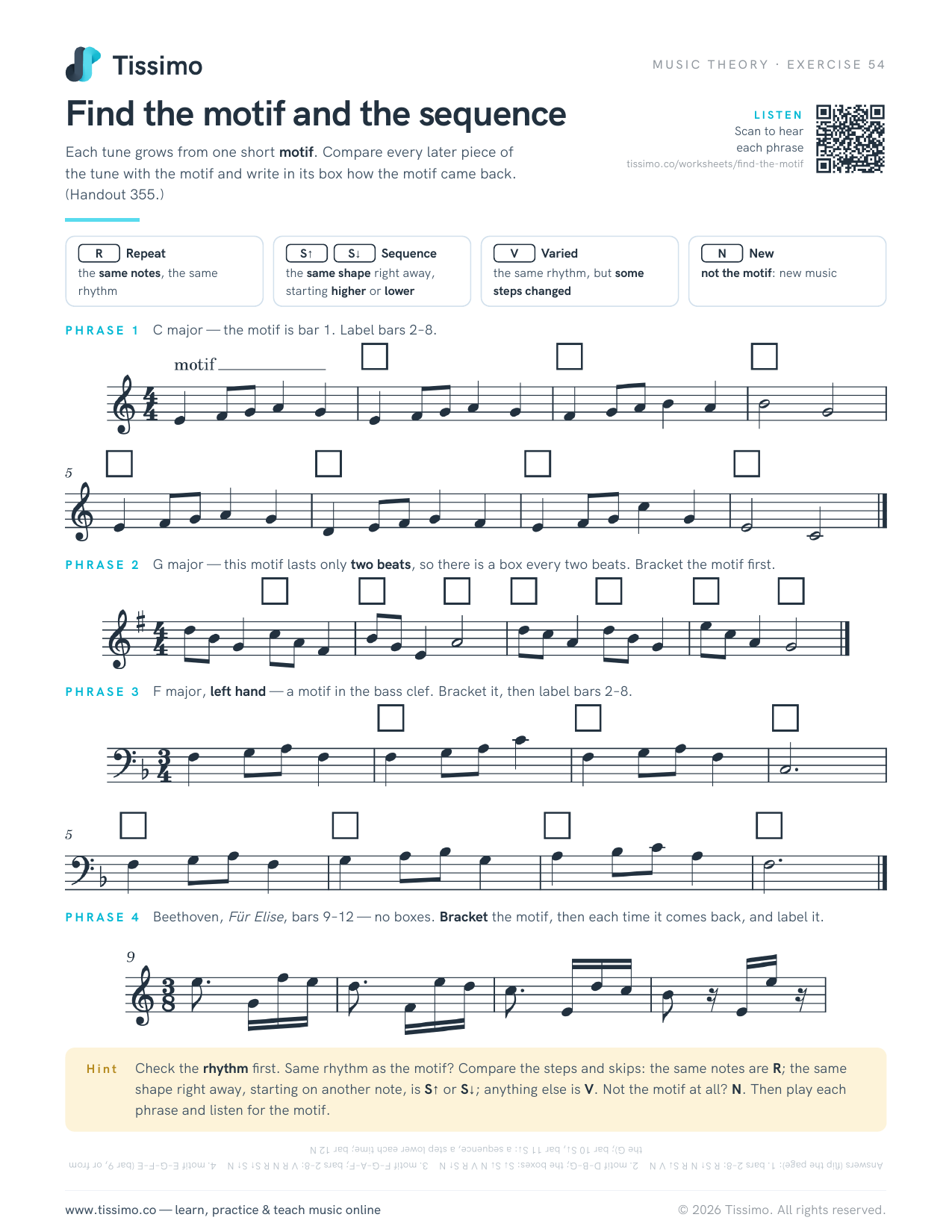 Find the motif and the sequenceEach tune grows from one short motif. Compare every later piece of the tune with the motif and write in its box how the motif came back. (Handout 355.)
Comments