Melody, Texture & Counterpoint
Retrograde
Retrograde is a melody played backwards: the same notes in reverse order, from the last note to the first. A canon in which one voice sings the melody backwards is a crab canon.
A retrograde is a melody played backwards: the notes of the original in reverse order, starting with the last one and ending with the first. In the strictest form the rhythm is reversed too, so a long note followed by two short ones becomes two short notes followed by a long one. The word comes from the Latin for "going backwards".
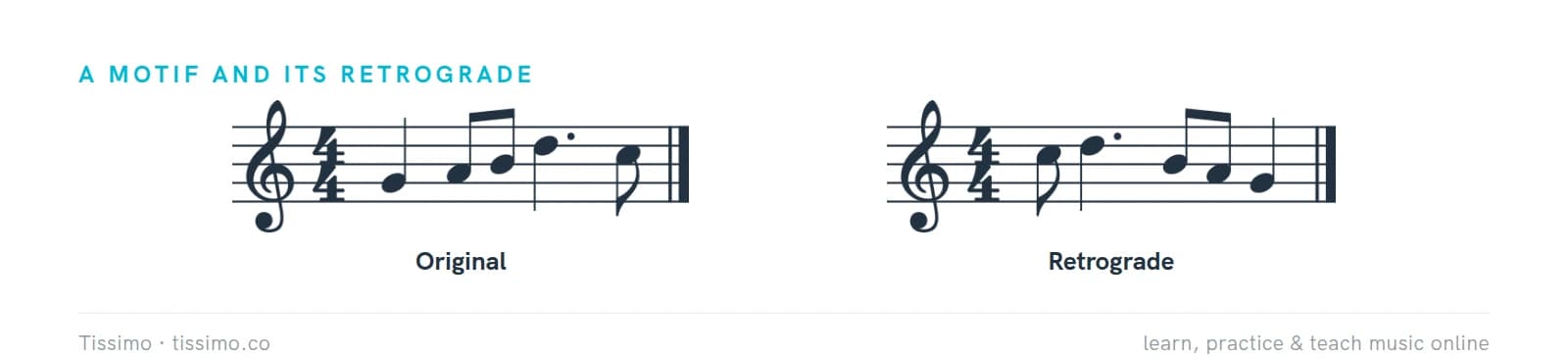
Hard to hear, easy to see
Played backwards, even a familiar tune is hard to recognize: its rhythm, its rises and falls and its sense of direction all come out differently. Retrograde is rare in tonal music, far less common than sequence, inversion or augmentation. Where it does appear, it is usually something a performer or analyst discovers on the page as much as something a listener hears.
Crab canons
The best-known use is the crab canon, also called a retrograde canon or canon cancrizans: a canon in which one voice sings the melody forwards while the other sings it backwards at the same time. Cancrizans comes from the Latin cancer, a crab, although, as one dictionary points out, crabs actually walk sideways. J. S. Bach's Musical Offering includes a famous crab canon for two voices.
Retrograde in twelve-tone music
In twelve-tone music the retrograde is one of the four basic forms of a row: the prime (the original order), the retrograde (the prime backwards), the inversion (the prime upside down) and the retrograde inversion (the inversion backwards). Here retrograde applies to the order of pitches; the composer gives the reversed row whatever rhythm the music needs. The serialism entry shows one row as prime, retrograde and inversion.
Try it
Write a short motif of four or five notes. Copy it backwards, last note first, and reverse its rhythm. Then play the two versions one after the other: the backwards version uses the same notes but makes a new melody. Compare it with an inversion of the same motif, which keeps the order and flips the direction instead.
Common questions
What is the difference between retrograde and inversion?
Retrograde reverses the order of the notes, so the melody runs backwards in time. Inversion keeps the order but turns every interval upside down. A retrograde inversion does both.
What is a crab canon?
A canon in which one voice plays the melody forwards and another plays it backwards at the same time. It is also called a retrograde canon or canon cancrizans, from the Latin for crab.
Comments