Chords & Harmony
Retardation
A retardation is a prepared non-chord tone held or repeated from the previous harmony, then resolved upward by step. It resembles a suspension, but the resolution rises rather than falls.
A retardation delays a voice's upward move into a new chord. First the note belongs to the old harmony. It stays in place while the harmony changes, creating a non-chord tone, and then steps upward to a note of the new chord. The delayed note usually occupies a relatively strong beat or subdivision.
Three stages to hear
Consider G major moving to C major in a passage understood as triadic harmony:
- Preparation: B4 sounds as a member of the G major chord.
- Delay: the accompaniment changes to C major, but the melody holds or repeats B4.
- Resolution: B4 rises by half step to C5 while the C harmony continues.
Against a C bass, this is the familiar 7–8 pattern: the seventh resolves up to the octave. The figures describe intervals, not scale degrees. Octave doublings do not change the basic pattern.
Compare the terms
In the usual distinction, a suspension resolves downward and a retardation resolves upward. Both have preparation, delay and resolution. An upward step by itself is not enough: a neighbor tone returning upward has a different approach, and a stable major-seventh chord need not contain a retardation at all. Harmonic context determines the label.
Do not confuse retardation with ritardando, which asks the performer to slow the tempo.
Try it
Play the three stages slowly at an even pulse. Sing B–B–C while changing the accompaniment on the second B. Then remove the delay and move to C immediately. Listen to how postponing one voice changes the arrival without slowing the beat.
Common questions
Is retardation another word for slowing down?
No. In harmony, retardation names a prepared note whose resolution is delayed and moves upward by step. Ritardando is the instruction to slow the tempo.
Practice it: free worksheets
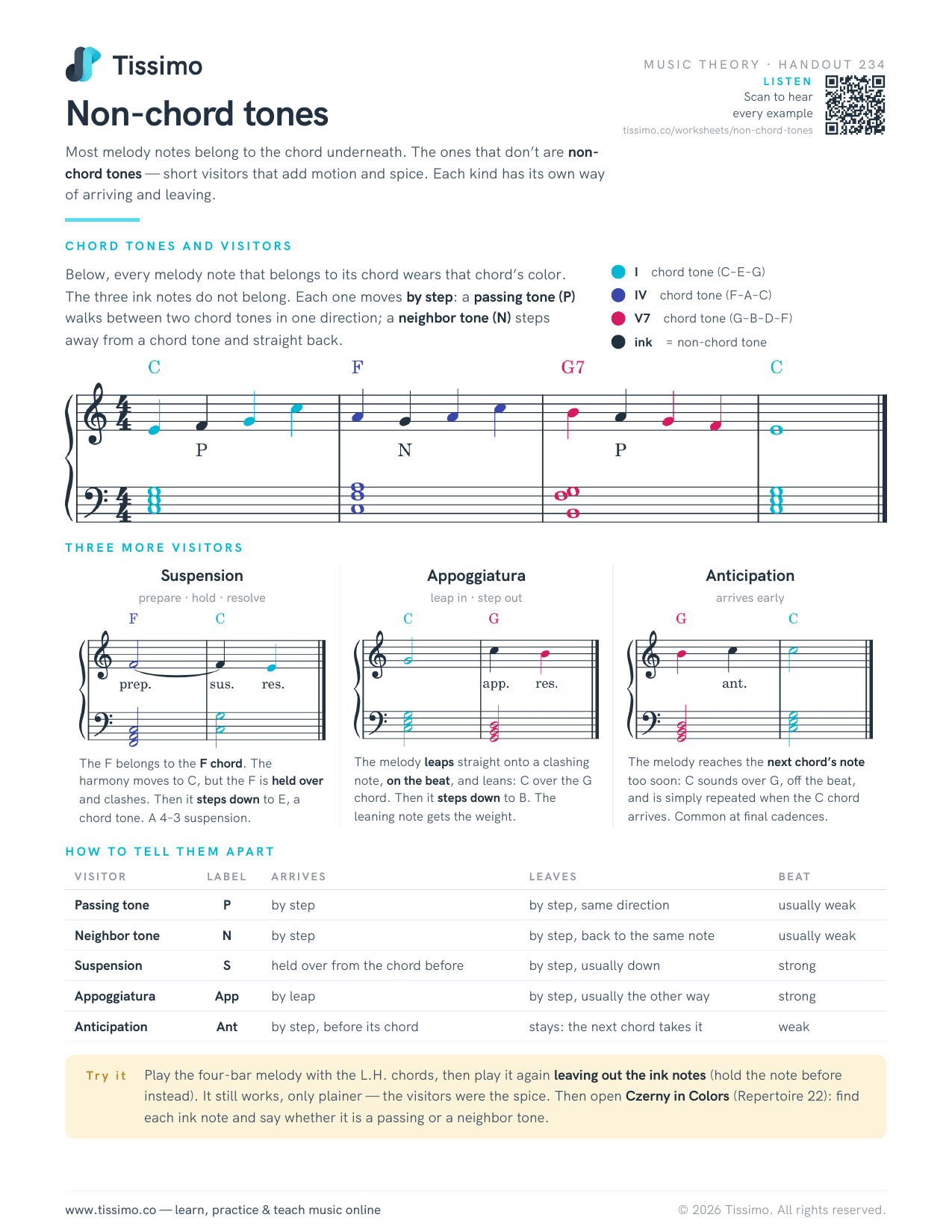 Non-chord tonesMost melody notes belong to the chord underneath. The ones that don’t are non-chord tones — short visitors that add motion and spice. Each kind has its own way of arriving and leaving.
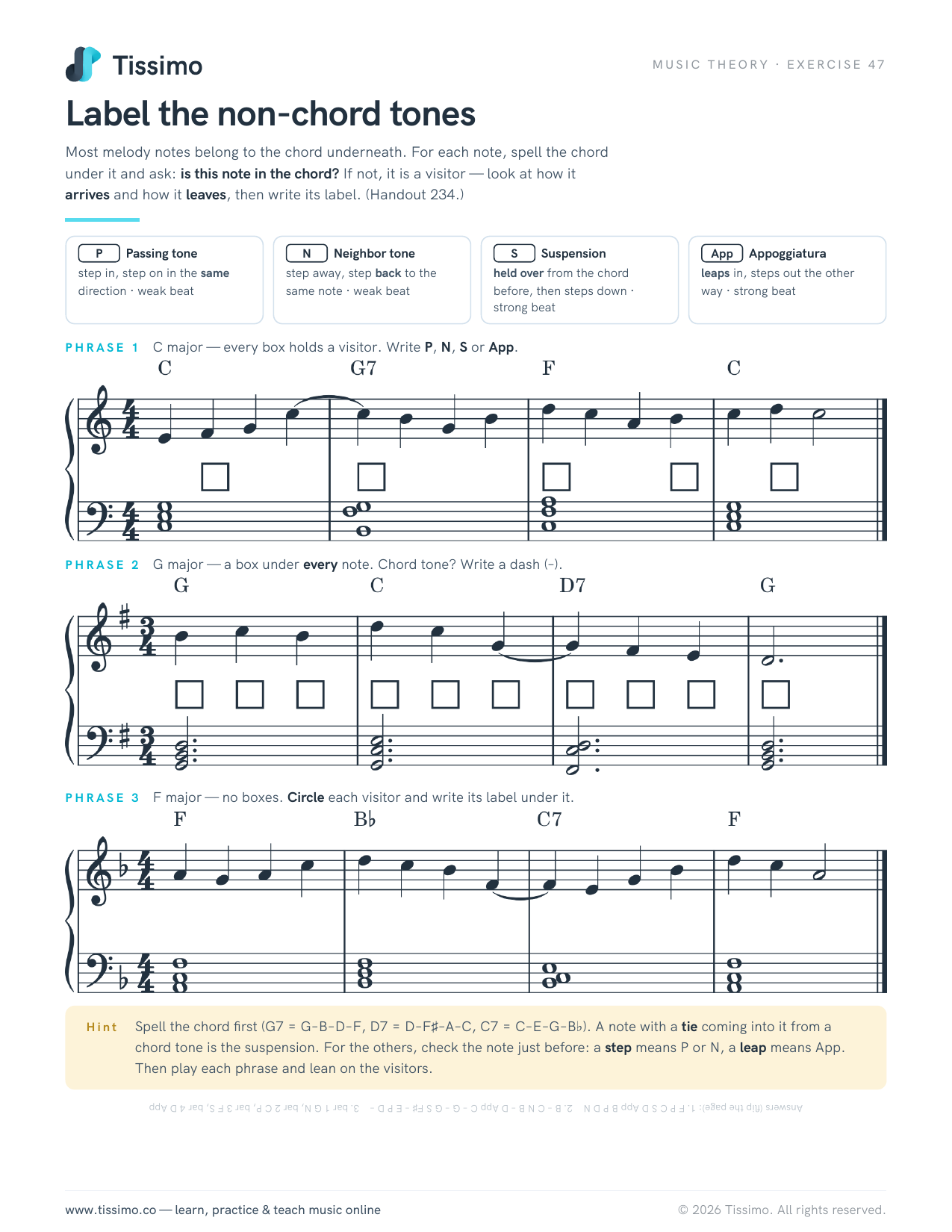 Label the non-chord tonesMost melody notes belong to the chord underneath. For each note, spell the chord under it and ask: is this note in the chord? If not, it is a visitor — look at how it arrives and how it leaves, then write its label. (Handout 234.)