Chords & Harmony
Anticipation
An anticipation is a non-chord tone that belongs to the next harmony and arrives before that harmony does. It stays on the same pitch as the new chord arrives, becoming a chord tone.
An anticipation lets one voice arrive early. The note does not belong to the current chord, but it belongs to the chord that follows. When the accompaniment changes, the same pitch is held or repeated and now fits the harmony.
A note before its chord
Imagine a cadence from G major to C major. Just before the C chord arrives, a melody moves from B4 to C5 while G major is still sounding. C5 is not part of the G–B–D triad. When the harmony changes to C–E–G and the melody stays on C5, that early C has functioned as an anticipation.
Anticipations often occur on a weak beat or subdivision before a stronger chord change. Stepwise approach is common, but the important identifying feature is the early arrival of the next chord's note, not a single mandatory melodic interval.
Early arrival or delayed departure?
A suspension carries a note from the old chord into the new one and then resolves. An anticipation brings a note of the new chord into the old one. Both require you to track the harmony, not just the melody.
Try it
Play the G-to-C example twice. First, move the melody and chord together. Then move only the melody early. Tap a steady pulse so the difference is clear. Circle the early C in your written version and draw a line to the moment the harmony catches up.
Common questions
Is every note played early an anticipation?
Not in the non-chord-tone sense. The early note must be outside the current harmony and become part of the following harmony. Rhythmic anticipation is a broader expression.
Practice it: free worksheets
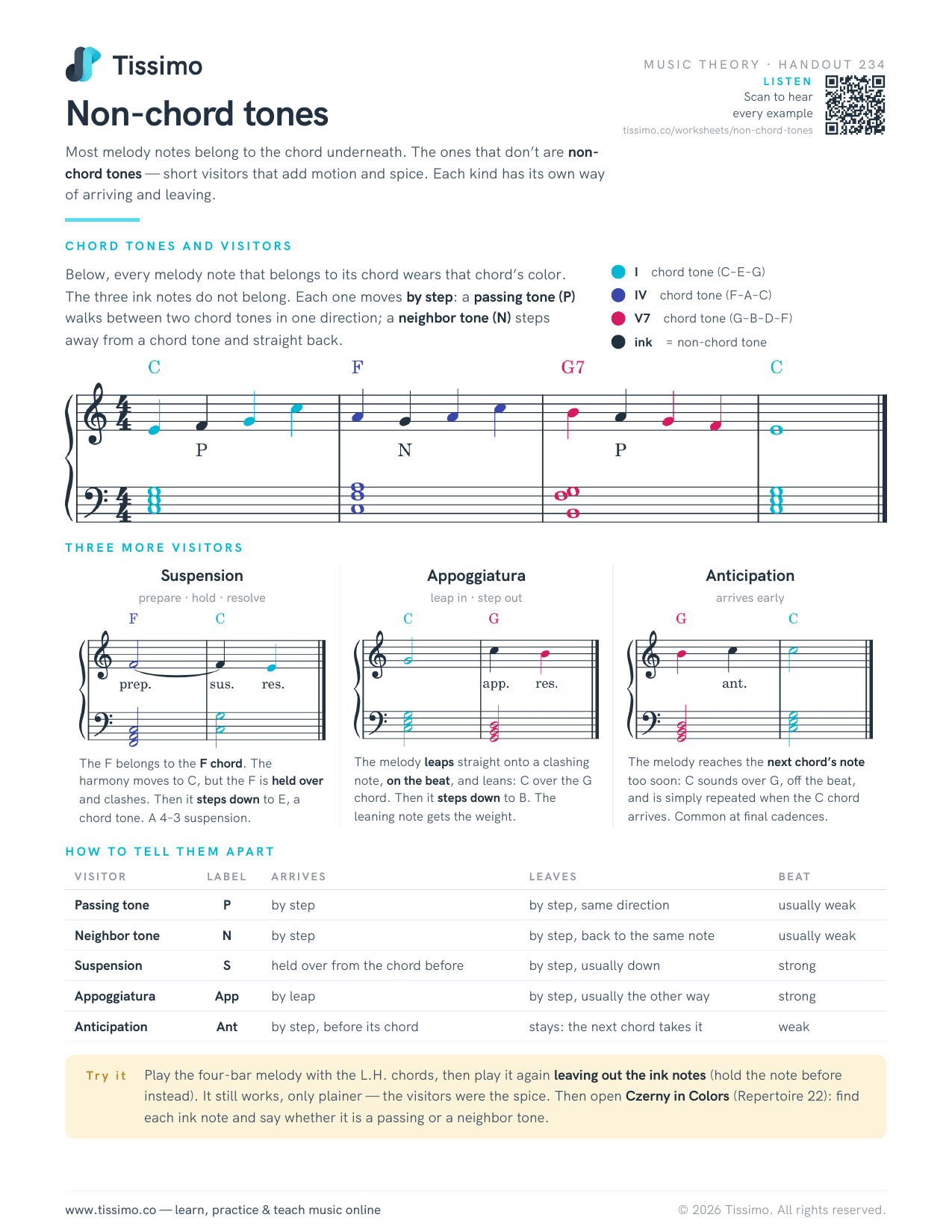 Non-chord tonesMost melody notes belong to the chord underneath. The ones that don’t are non-chord tones — short visitors that add motion and spice. Each kind has its own way of arriving and leaving.
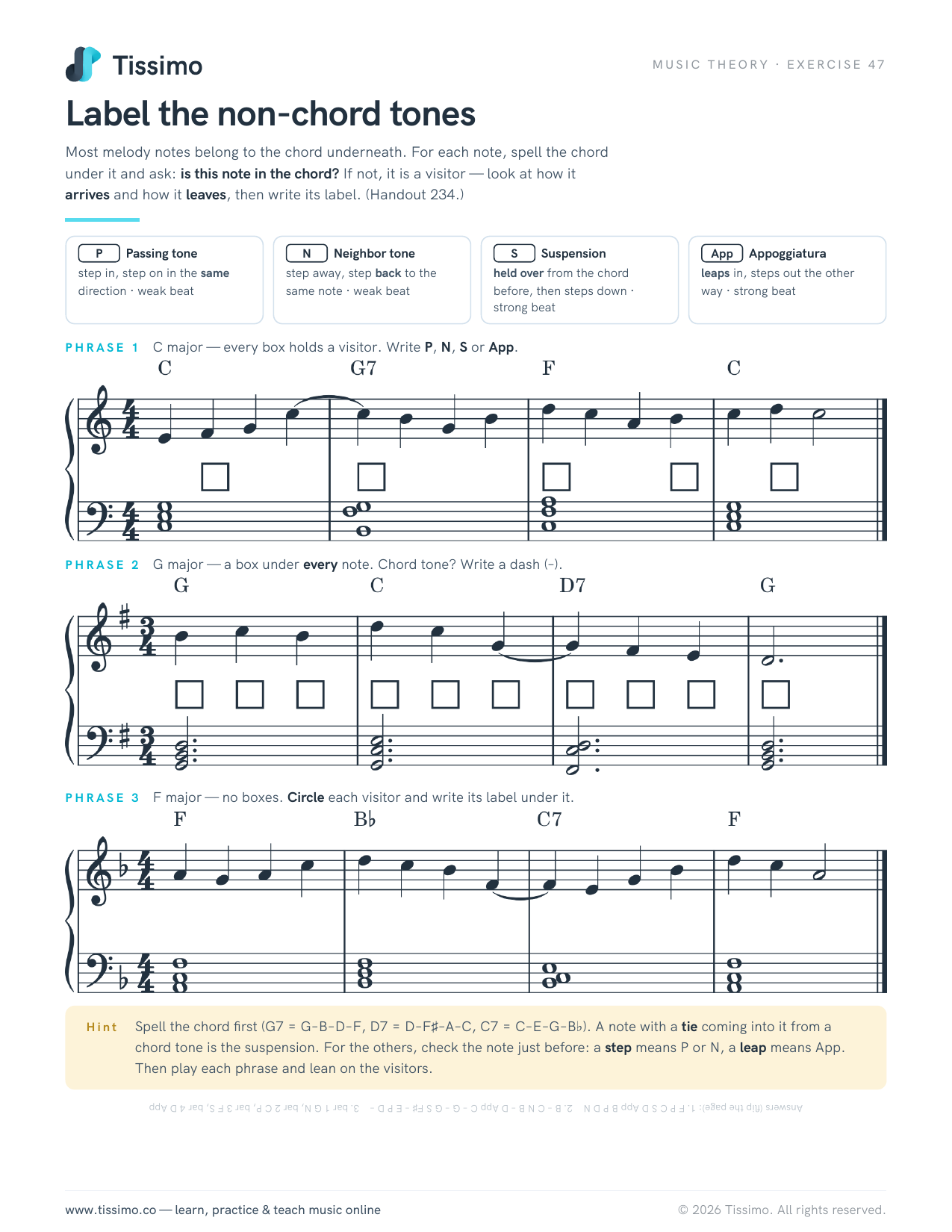 Label the non-chord tonesMost melody notes belong to the chord underneath. For each note, spell the chord under it and ask: is this note in the chord? If not, it is a visitor — look at how it arrives and how it leaves, then write its label. (Handout 234.)