Chords & Harmony
Lament Bass
A lament bass is a bass line that falls step by step through a fourth, from the tonic down to the dominant of a minor key (A–G–F–E in A minor), often chromatically and often repeated as a ground bass.
A lament bass is a bass line that walks down by step from the tonic of a minor key to its dominant, four notes spanning a perfect fourth: in A minor, A – G – F – E. Musicians call this falling four-note group a descending tetrachord. Its chromatic form fills in every half step: A – G♯ – G – F♯ – F – E. In the 17th century composers tied this line to songs of mourning, the laments of early opera, which is where its name comes from.
A Baroque emblem of grief
Early opera composers often repeated the falling tetrachord again and again as a ground bass, an ostinato in the bass with changing music above it. Purcell's "When I am laid in earth" (Dido's Lament) from Dido and Aeneas is the most famous example: the whole aria is built on a five-bar ground in G minor whose bass descends chromatically, heard eleven times. The Crucifixus of Bach's Mass in B minor also rests on a repeated chromatic descending bass. Passacaglias and chaconnes, Baroque forms built over a repeating bass, are its close relatives.
The chromatic version has a name of its own in Baroque theory. The 17th-century composer and theorist Christoph Bernhard called a line that rises or falls by half steps a passus duriusculus, a "harsh step", and the chromatically falling fourth is a familiar form of it.
Harmonizing it
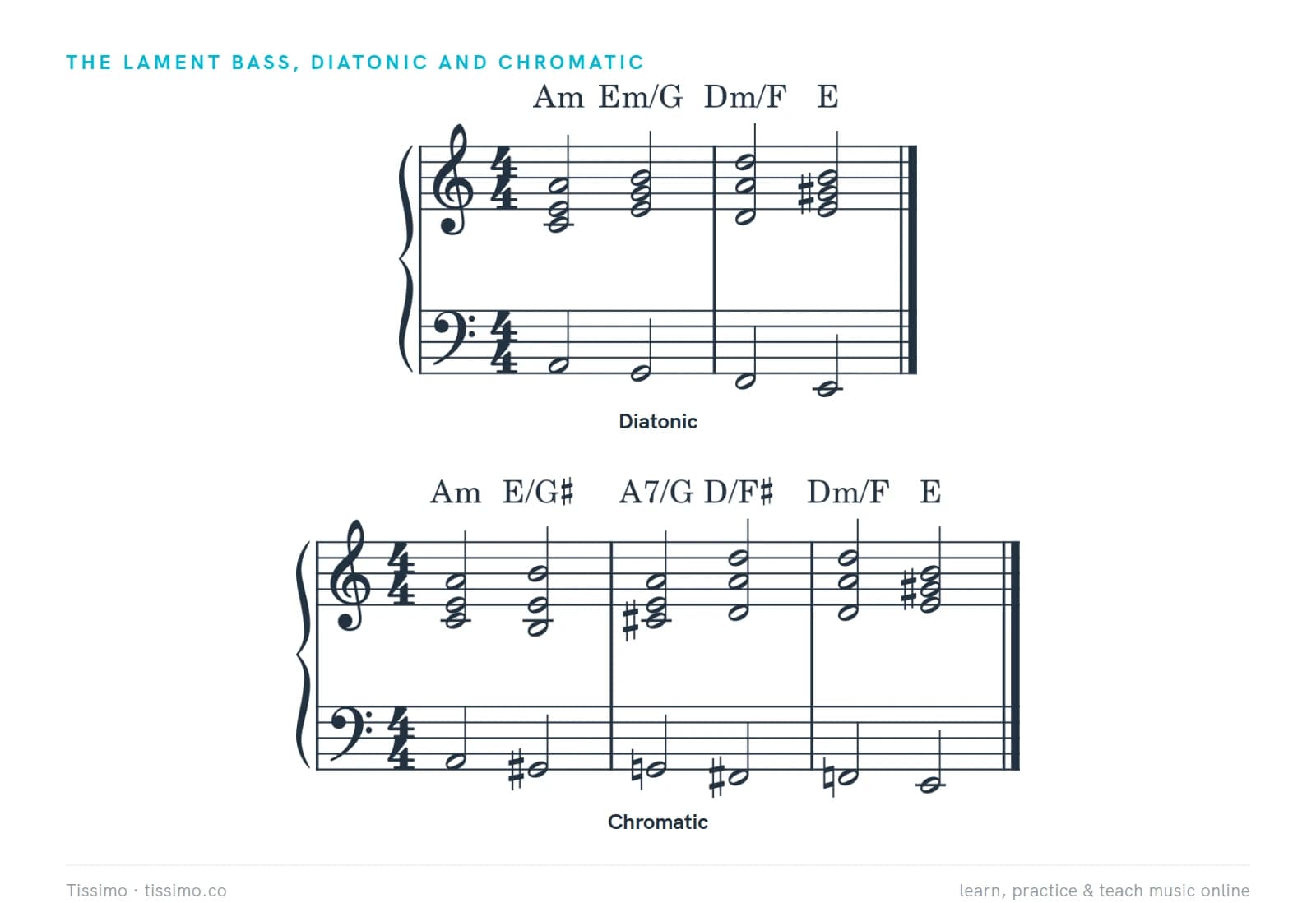
The bass alone does not fix the chords. Two common ways to harmonize it are shown in the figure:
- Diatonic: i – v⁶ – iv⁶ – V (Am – Em/G – Dm/F – E). The last two chords make the Phrygian cadence, with the bass falling a half step to the dominant.
- Chromatic: i – V⁶ – V⁴₂ of iv – IV⁶ – iv⁶ – V. This is the chord pattern of Purcell's lament, moved to A minor.
Harmonized with root-position chords instead (Am – G – F – E), the same diatonic bass becomes the Andalusian cadence of flamenco.
Beyond the Baroque
The line never went away. Beethoven's 32 Variations in C minor, WoO 80, are built on a chromatic descending bass, and music theory textbooks find the same descent in rock songs such as "Stairway to Heaven" and "While My Guitar Gently Weeps". Open Music Theory's pop chapters call the diatonic version, harmonized i – ♭VII – ♭VI – V, the lament schema.
Listening for it
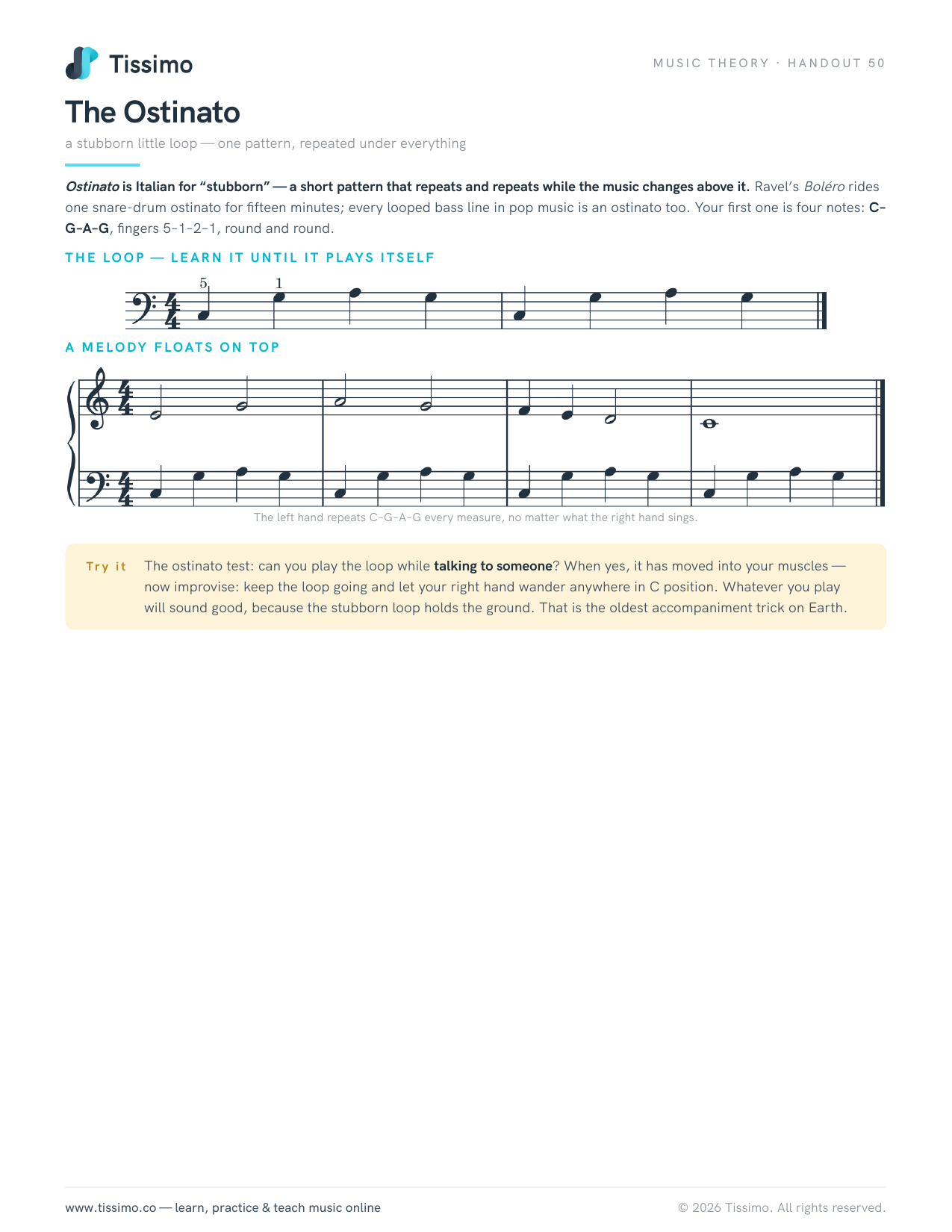
Follow the lowest part. If it falls slowly by step from the home note and stops four notes lower, on the dominant, and then starts again, you are probably hearing a lament bass. Learn how a repeating bass carries a piece with The Ostinato.
Common questions
What is the bass line in Dido's Lament?
A five-bar ground bass in G minor that begins by falling chromatically from the tonic, G, to the dominant, D, and is repeated throughout the aria.
What is the difference between a lament bass and the Andalusian cadence?
The lament bass is a bass line: a falling fourth from tonic to dominant, often chromatic. The Andalusian cadence is one way of harmonizing its diatonic form, with root-position chords such as Am – G – F – E.
Comments