Chords & Harmony
Andalusian Cadence
The Andalusian cadence is a four-chord progression that steps down from a minor chord, such as Am–G–F–E. Its bass falls by step through a fourth and ends with a half step down onto a major chord, a sound at the heart of flamenco.
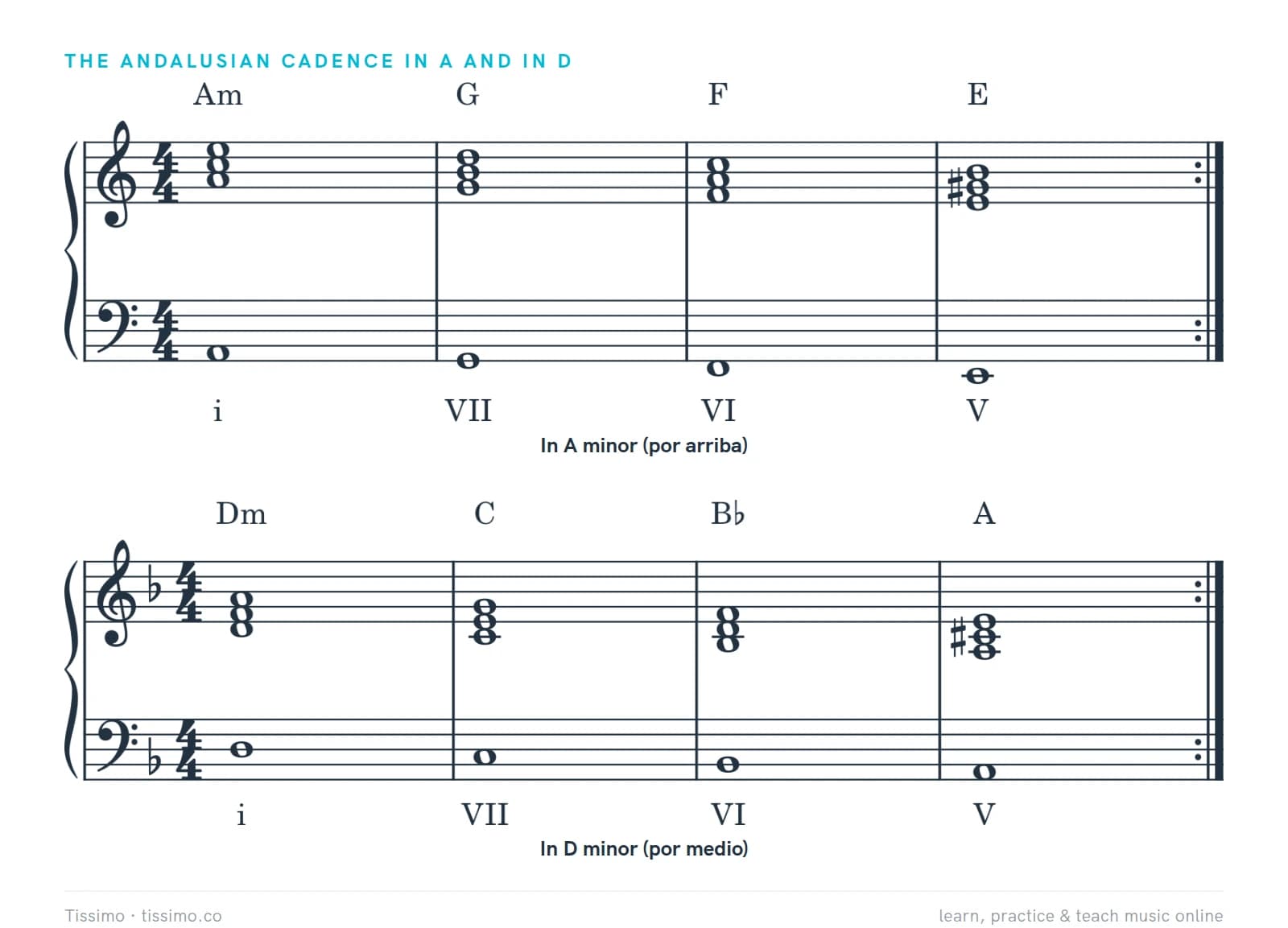
The Andalusian cadence is a progression of four chords whose roots step down the scale: in A minor, Am – G – F – E. The bass falls A – G – F – E, a fourth from top to bottom, with a half step between the last two notes. The name comes from Andalusia, the region of southern Spain where flamenco developed, and it is one of the most characteristic chord patterns of flamenco. Despite the word "cadence", it is usually a whole progression, often repeated as a loop, rather than just the ending of a phrase.
Two ways to name the chords
How you number the chords depends on which chord you hear as home.
- In A minor: i – VII – VI – V. The last chord, E major, borrows G♯ from harmonic minor, so the progression ends on the dominant, a half cadence that pulls back to Am.
- In the flamenco key: the final E major chord is the tonic of a Phrygian-based key, and the chords are numbered iv – III – II – I. Heard this way, the progression ends at home, and the F to E step is the characteristic half step of the Phrygian scale.
Both readings are in use; flamenco guitarists usually hear E as home.
In flamenco
Flamenco guitarists play the progression in two main positions: por arriba, Am – G – F – E with E as the home chord, and por medio, Dm – C – B♭ – A with A as home. In forms such as soleares, the guitar often rocks between the home chord and the chord a half step above it (E and F, or A and B♭) and then runs down the Andalusian cadence to land on the home chord again.
Relatives
The descending bass A – G – F – E is the same falling tetrachord as the diatonic lament bass of Baroque music, where it is usually harmonized differently. The Phrygian cadence of classical harmony has the same final bass step, F down to E in A minor, but it is a two-chord ending, iv⁶–V (Dm/F to E).
Playing it
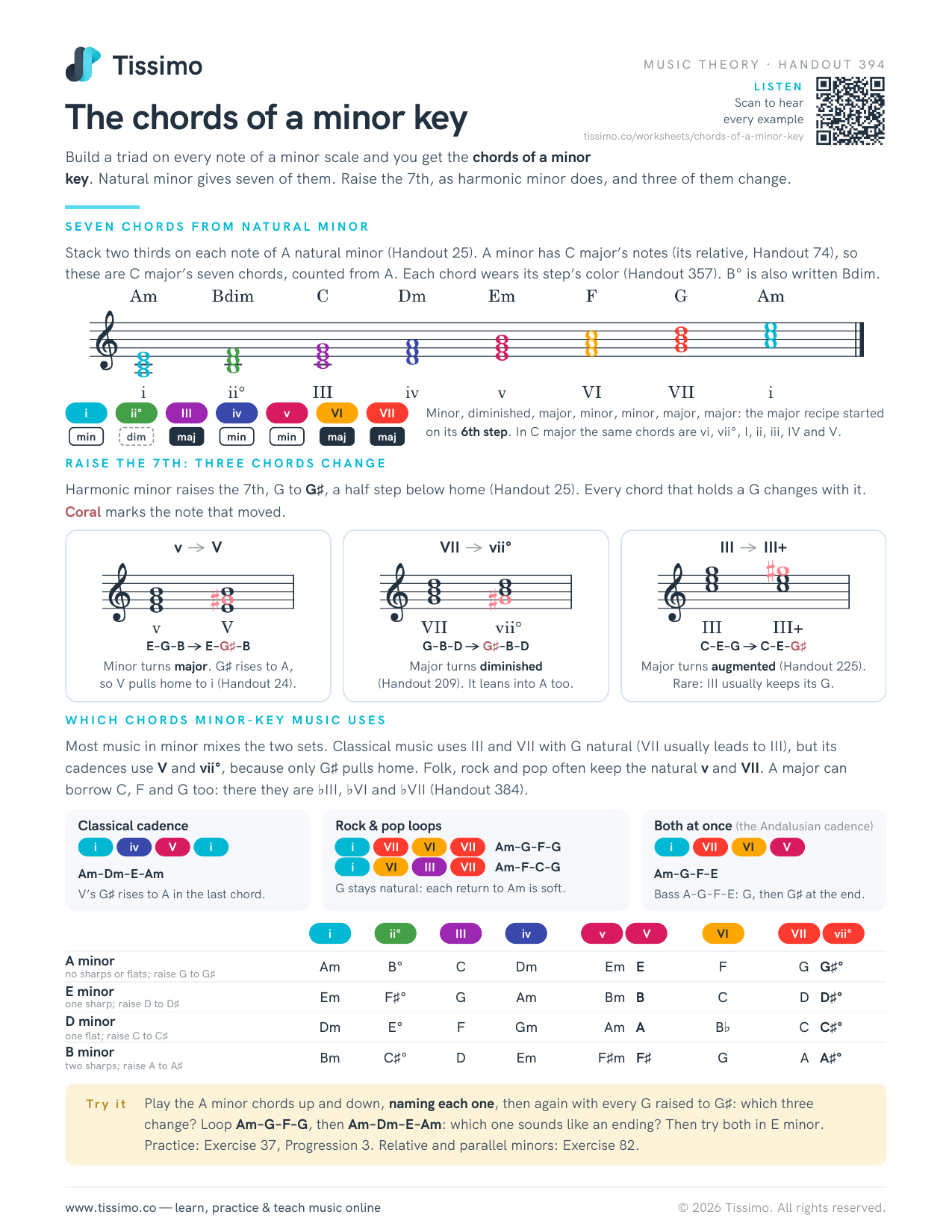
On guitar, play Am, G, F and E in first position; F needs a small barre. At the keyboard, play root-position triads that slide down together (parallel chords are part of the sound) over a bass that steps down A – G – F – E. The chords come from the natural minor scale except the final E major. Build them yourself with The chords of a minor key.
Common questions
Why is it called a cadence if it is four chords?
The name is traditional. The pattern ends with a half step down in the bass to a major chord, a strong arrival that works like a cadence, but in practice it is usually played as a complete, repeating progression.
Is the Andalusian cadence in a minor key or in Phrygian?
Both readings are common. In A minor, Am – G – F – E is i – VII – VI – V and ends on the dominant. In flamenco, E is usually heard as the home chord of a Phrygian-based key, so the same chords are iv – III – II – I.
Comments