Dynamics & Expression
Lamentoso (Lacrimoso)
Pronounced lah-men-TOH-soh
Lamentoso means 'lamenting': play like a voice in mourning, with weeping, drooping phrases and a soft, heavy-hearted tone. Lacrimoso, 'tearful', asks for much the same.
Lamentoso means "lamenting" or "mourning", from lamento, a lament. Lacrimoso (also spelled lagrimoso) means "tearful", from lacrima, a tear, and asks for much the same: music that weeps. Lamentando, "lamenting", is another form.
Lamentoso in real music
The finale of Tchaikovsky's Symphony No. 6 in B minor, the Pathétique (1893), is headed Adagio lamentoso. Ending a symphony with a slow movement was unusual, and Tchaikovsky knew it: in a letter of February 1893 he wrote that the finale would be "not a noisy allegro, but on the contrary, a long drawn-out adagio".
How to play lamentoso
- Weep in sighs. Slur falling pairs of notes, lean on the first and let the second fade, as in the example below.
- Let the line sink. A line that falls by half steps has been tied to grief since the 17th century (see lament bass). Give each step its weight.
- Soft but intense. Keep the tone warm and full of feeling, even at p.
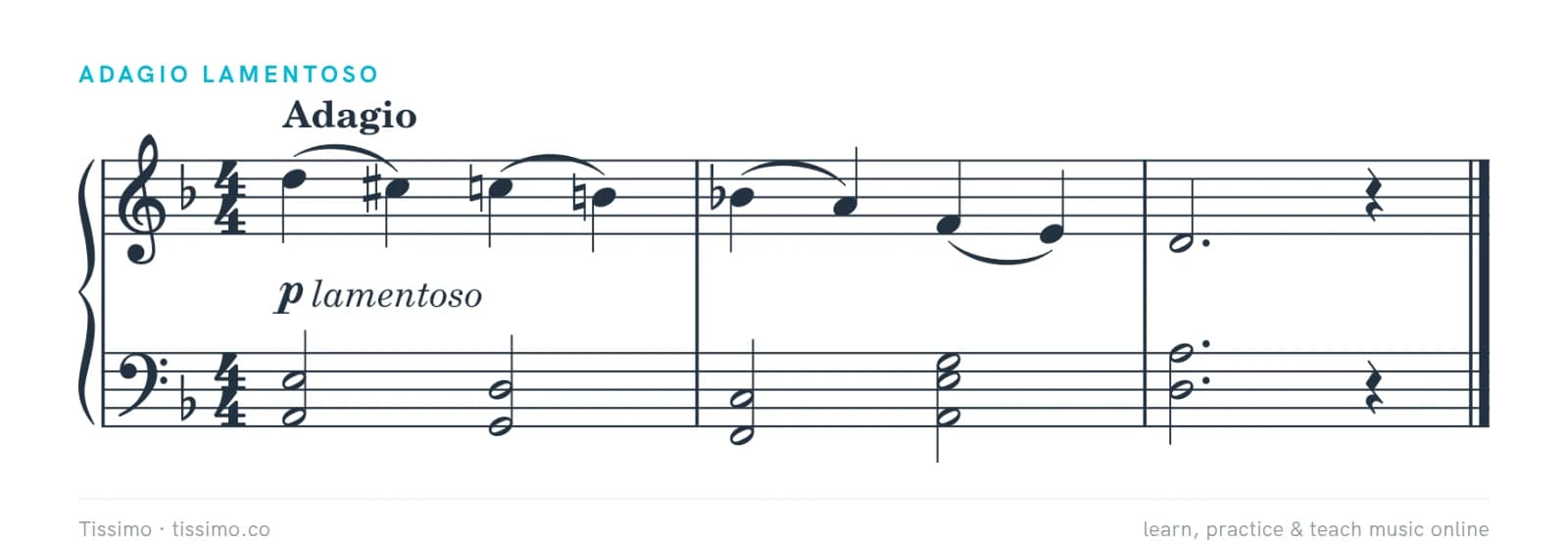
The sighs in the example fall a fourth by half steps, from D down to A: the same line as a chromatic lament bass, here in the melody.
Lacrimoso is not Lacrimosa
Don't confuse lacrimoso with Lacrimosa, a section of the requiem Mass, part of the sequence Dies irae. That is a Latin text, named after its first word, not a direction for how to play.
Lamentoso, dolente and mesto
Dolente is sorrowful, grieving with pain, mesto is sad and mournful, and triste is simply sad. Lamentoso is the most outspoken: grief expressed aloud, like a lament.
Common questions
What does lamentoso mean in music?
Lamenting, mourning: play with weeping, drooping phrases and a soft, heavy-hearted tone. Lacrimoso (tearful) asks for much the same.
Comments