Dynamics & Expression
Mesto
Pronounced MEH-stoh
Mesto means 'sad' or 'mournful': play with a grieving, melancholy character, usually soft and slow, with a warm, quiet tone. It often joins a slow tempo word, as in Largo e mesto.
Mesto means "sad" or "mournful". It asks for a grieving, melancholy character: a quiet, heavy-hearted tone, unhurried phrasing and a feeling of lament. It is usually joined to a slow tempo word, as in Largo e mesto, and the music it marks is often in a minor key. The adverb mestamente means "sadly" or "plaintively".
How it looks on the page
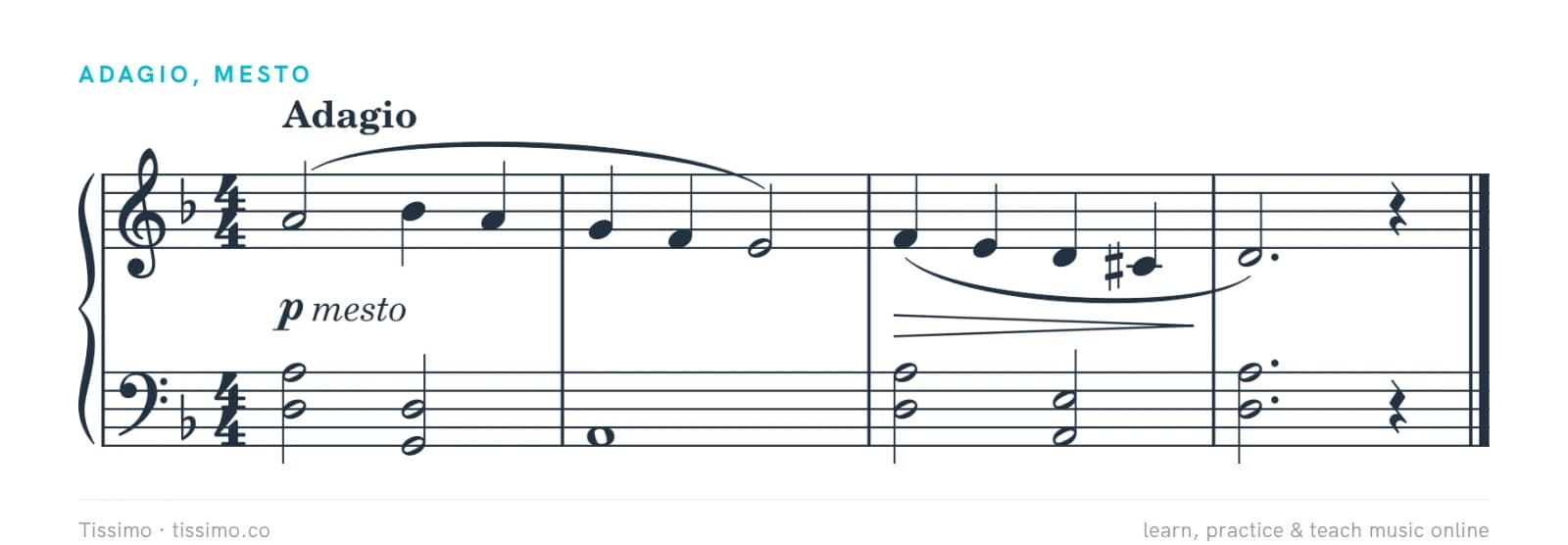
Mesto is printed in italics: as part of a tempo heading at the start of a movement, or below the staff beside a soft dynamic, as in p mesto. Like dolce, it is an expression word: it names the feeling, and the dynamic and tempo words set the level and speed.
Mesto in real music
- Beethoven, Piano Sonata in D major, Op. 10 No. 3: the slow movement, in D minor, is headed Largo e mesto.
- Brahms, Six Piano Pieces, Op. 118: the last piece, an Intermezzo in E-flat minor, is headed Andante, largo e mesto.
- Bartók, String Quartet No. 6 (1939): the heading of each of the four movements begins with Mesto, and the last movement is headed Mesto alone.
How to play mesto
- Take time, but keep a pulse. Sadness is slow, but it still moves; don't let the music stop.
- Use a warm, covered tone. Avoid bright, hard attacks and sudden accents.
- Let falling lines sink. Many mournful melodies descend; shape them so each phrase fades at its end, as in the example below.
- Keep the accompaniment soft and even, so the melody can sound like a voice.
Mesto and espressivo
Espressivo invites you to show feeling of any kind. Mesto names the feeling: sorrow. A mesto passage is usually expressive, but its expression points one way, toward grief. Its opposite in mood is giocoso, merry and playful.
Common questions
What does mesto mean in music?
Sad or mournful: play with a grieving, melancholy character, usually soft and unhurried. Largo e mesto means slow and sad.
Comments