Rhythm & Meter
Double Time and Half Time
Double time and half time are drum feels in which the kick and snare hit twice as often or half as often as usual, so the music feels faster or slower while the tempo, the bar length and the time signature stay the same.
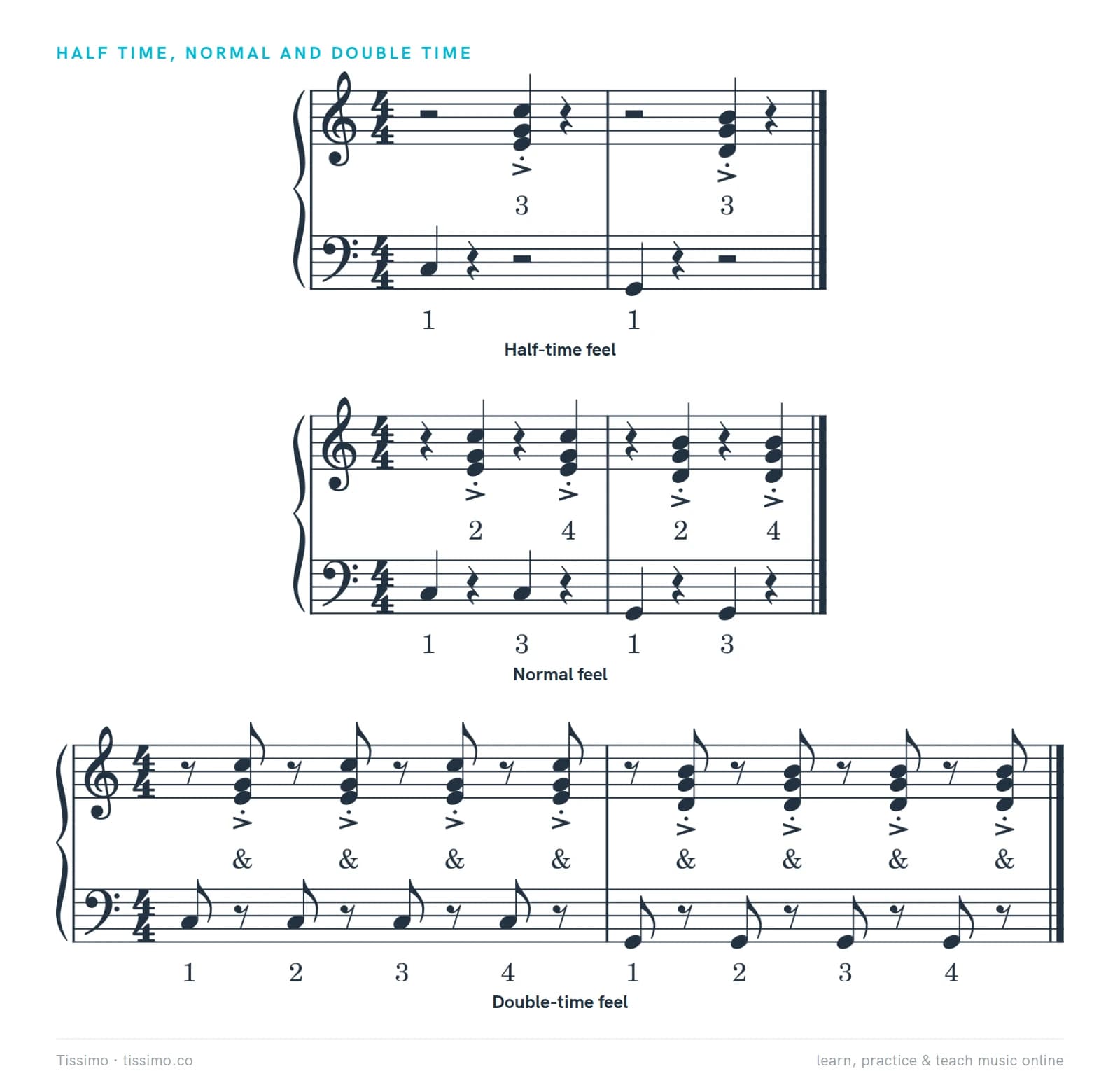
In much rock and pop, the drums mark the beat in a familiar way: the bass drum on beats 1 and 3, the snare drum on 2 and 4, the backbeat. A half-time feel or a double-time feel keeps the tempo, the time signature and the chords exactly where they were, but changes how often the bass drum and snare drum play. The groove then feels half as fast, or twice as fast, although the click has not moved.
Half-time feel
In a half-time feel each bar has half as many bass-drum and snare hits. Typically the bass drum plays on beat 1 and the snare on beat 3 only, so the backbeat comes once a bar instead of twice. A song at 140 BPM starts to feel like 70: heavier, broader and more spacious. Dubstep, for example, is usually described as about 140 BPM with a half-time feel.
Double-time feel
A double-time feel is the opposite: twice as many hits per bar, for example the bass drum on every beat and the snare on every "&". The snare is what makes it double time: a bass drum on every beat with the snare still on 2 and 4 is four on the floor at the normal feel. The backbeat now runs twice as fast as the beat you tap your foot to, which can give fast rock and metal a frantic, driving energy.
Feel, not tempo
The tempo itself does not change. The bars stay the same length, the time signature stays the same, and the bass line and chords usually carry on as before; the hi-hat may change, but it does not decide the feel. What changes is how the drums sit against the beat that listeners feel. Listeners tend to lock onto a comfortable pulse somewhere around 80 to 160 BPM. When the backbeat runs much slower or faster than that pulse, we hear half time or double time. A real tempo change is different: if the metronome moves from 80 to 160 BPM, the music has doubled its tempo; in a double-time feel the click stays at 80.
Double time in jazz
Jazz musicians also use double time for a soloist who plays twice as fast while the band stays at the slower tempo, for example running sixteenth-note lines over a slow ballad. The whole band can also move into double time together.
Not to be confused with
- Cut time (alla breve) is a written meter, 2/2, counted in two half-note beats. Half time is a way of playing a groove, not a time signature.
- Doubling the tempo: a new tempo mark or BPM really makes everything faster, chords included.
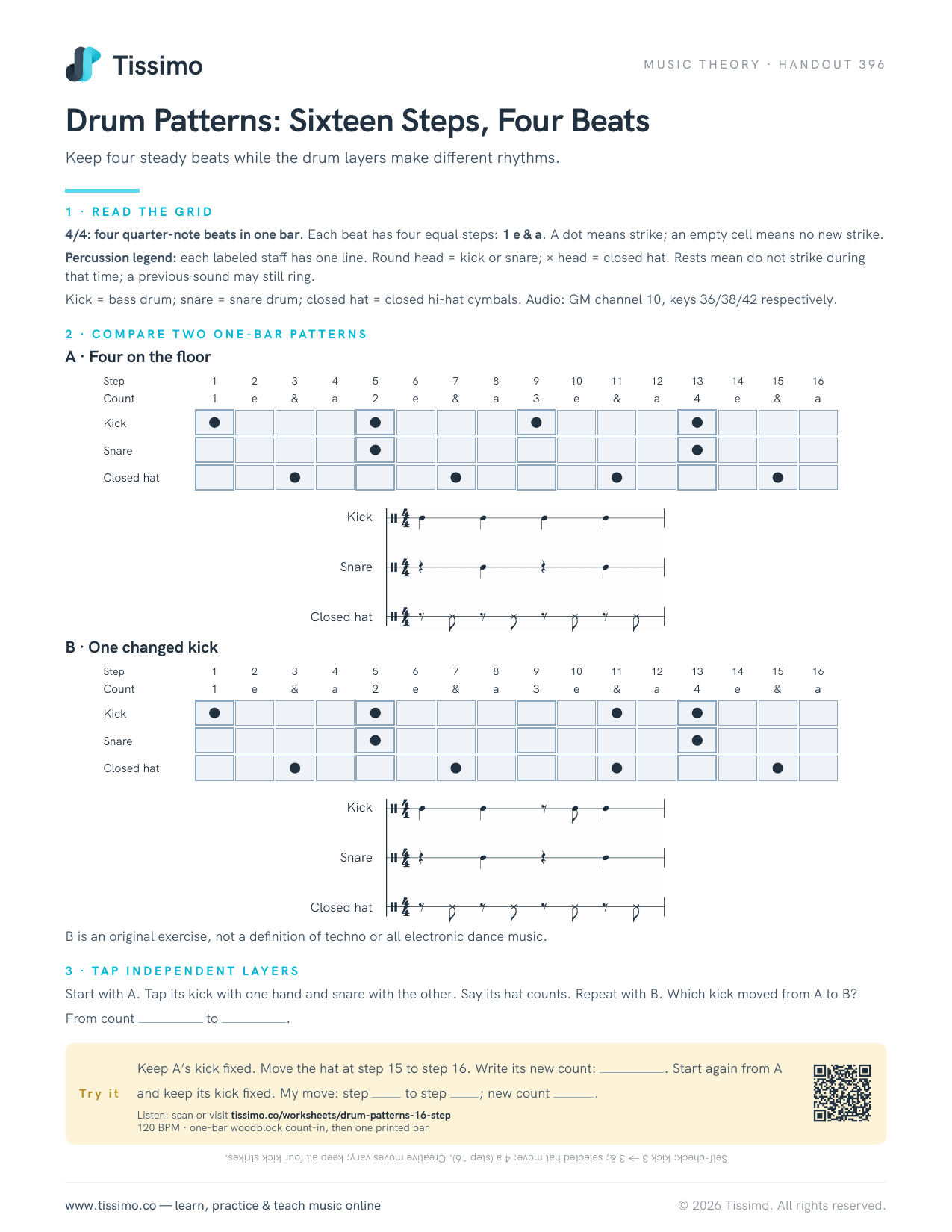
Feel the layers of a groove against a steady count with Drum Patterns: Sixteen Steps, Four Beats.
Common questions
What is a half-time feel?
A drum groove with half as many bass-drum and snare hits per bar, typically bass drum on 1 and snare on 3. The tempo and the bar stay the same, but the music feels half as fast.
Does double time change the tempo?
No. In a double-time feel the drums play twice as many hits per bar, so the music feels faster, but the tempo, the bar length and the chord changes stay where they were.
Comments