Technique & Performance
Conducting (Conductor)
Conducting is leading an ensemble with gestures of the hands, often holding a baton: the conductor beats time, sets the tempo, cues entries and shapes the dynamics. The person who does it is the conductor.
A conductor stands in front of an orchestra, a choir or a band and leads it without playing. One hand, usually the right, shows the beat and the tempo, often holding a thin stick called a baton. The other hand can cue entries, shape crescendos and diminuendos, or simply rest. Much of the work happens before the concert, in studying the score and in rehearsal, where the conductor decides how the piece should go.
The basic beat patterns
Each meter has a pattern, a path the hand traces once in every bar. The point where the hand marks a beat, with a small rebound, is called the ictus. Two rules hold in every pattern: beat 1 goes straight down (the downbeat), and the last beat goes up (the upbeat), ready for the next bar. For the right hand, as the conductor sees it:
- Two beats (2/4, cut time): down, then up.
- Three beats (3/4): down, out to the right, then up.
- Four beats (4/4): down, across to the left, out to the right, then up.
These three patterns are understood by ensembles almost everywhere, so they are the place to start. Conduct along with a recording, count aloud, and make the bottom of each beat clear and even. Two Beats in a Bar: 2/4 & Cut Time gives you music in two to practice with.
Other meters
Longer bars are beaten as groups of these patterns. A fast 6/8 is usually conducted in two, one beat per dotted quarter, with a rounded, swinging motion that suggests the three eighth notes inside each beat; a slow one may be beaten in six. Five beats can be shown in several ways, often as two groups, 2 + 3 or 3 + 2, to match the music. In an irregular meter such as 7/8 grouped 2 + 2 + 3, the long beat takes a slower movement than the short ones. Whatever the pattern, the players must always see where beat 1 is. Feeling 5/8 and 7/8 and Find the New Downbeat train the same skill from the player's side.
Starting and stopping
Before the first note, the conductor gives a preparatory gesture, one beat in the tempo and character of the music, so that everyone breathes or lifts the bow at the same moment and starts together. At the end of a held note, such as a fermata, the conductor shows the release, often with a small circular motion, so that everyone stops together.
Playing with a conductor
Keep your eyes up from the music often enough to see the beat, and play when the hand reaches the ictus, not at the top of the gesture. If the conductor slows down or speeds up, follow, even where your part has no rit. printed. Groups with one player on each part, such as a string quartet, usually play without a conductor and lead each other with breaths and small movements instead.
Common questions
What are the basic conducting patterns?
In two: down, up. In three: down, out to the right, up. In four: down, left, right, up. Beat 1 always goes down and the last beat always goes up.
How do you conduct 5/4?
Usually as two groups that match the music, 2 + 3 or 3 + 2, with beat 1 clearly down. Some conductors beat all five beats separately, especially at slow tempos.
Do conductors have to use a baton?
No. Many conductors, especially of choirs, use only their hands. A baton makes the beat easier to see in a large ensemble, but it is a personal choice.
Practice it: free worksheets
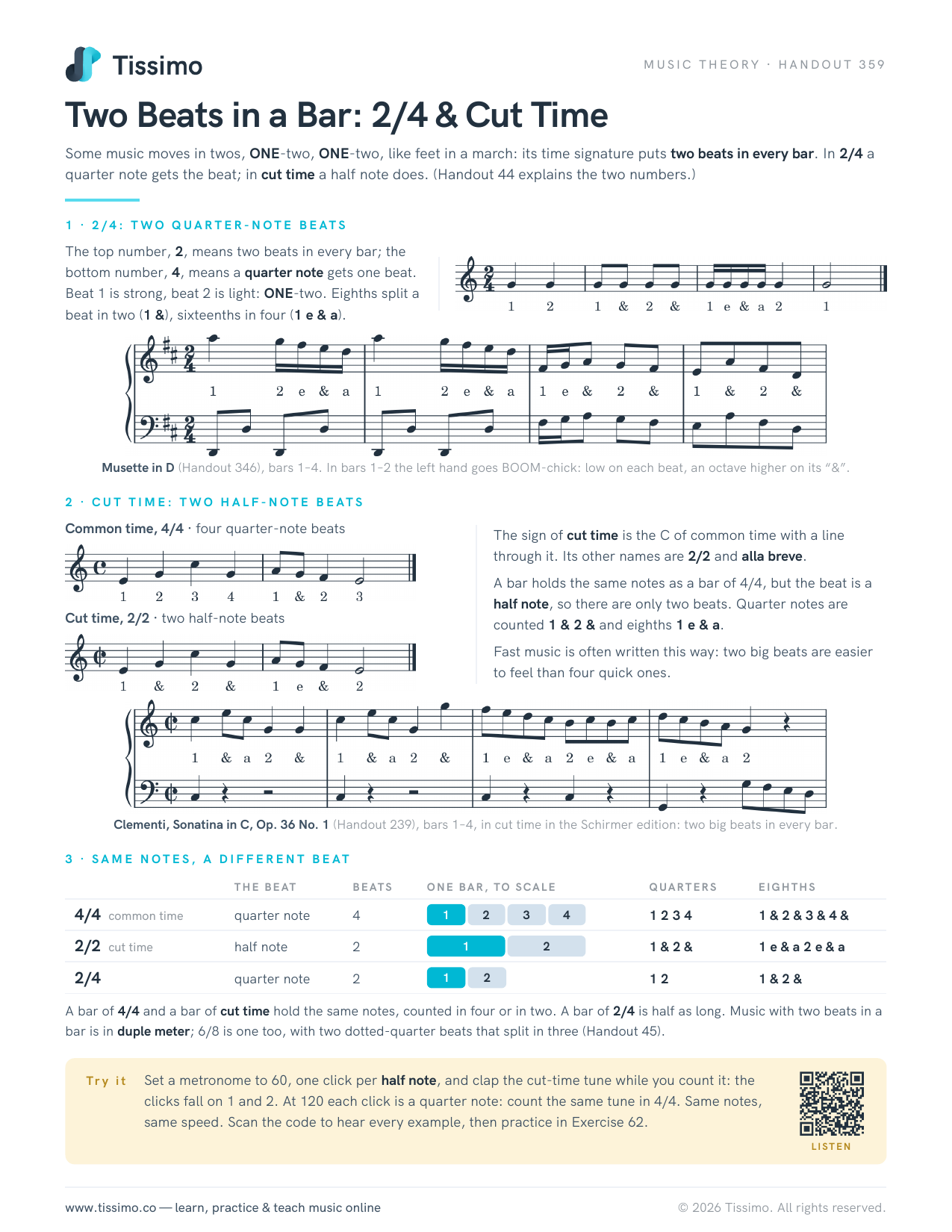 Two Beats in a Bar: 2/4 & Cut TimeSome music moves in twos, ONE-two, ONE-two, like feet in a march: its time signature puts two beats in every bar. In 2/4 a quarter note gets the beat; in cut time a half note does. (Handout 44 explains the two numbers.)
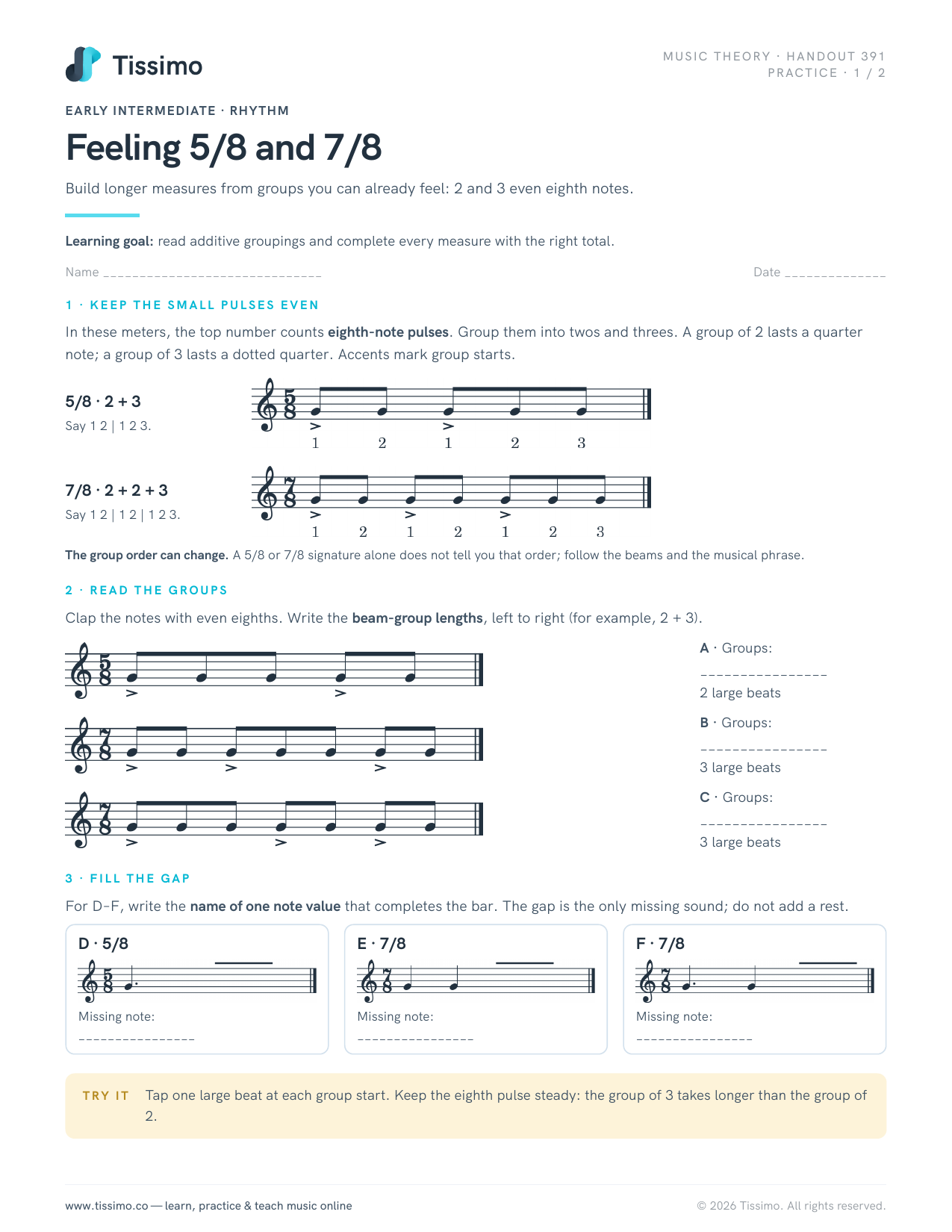 Feeling 5/8 and 7/8Build longer measures from groups you can already feel: 2 and 3 even eighth notes.
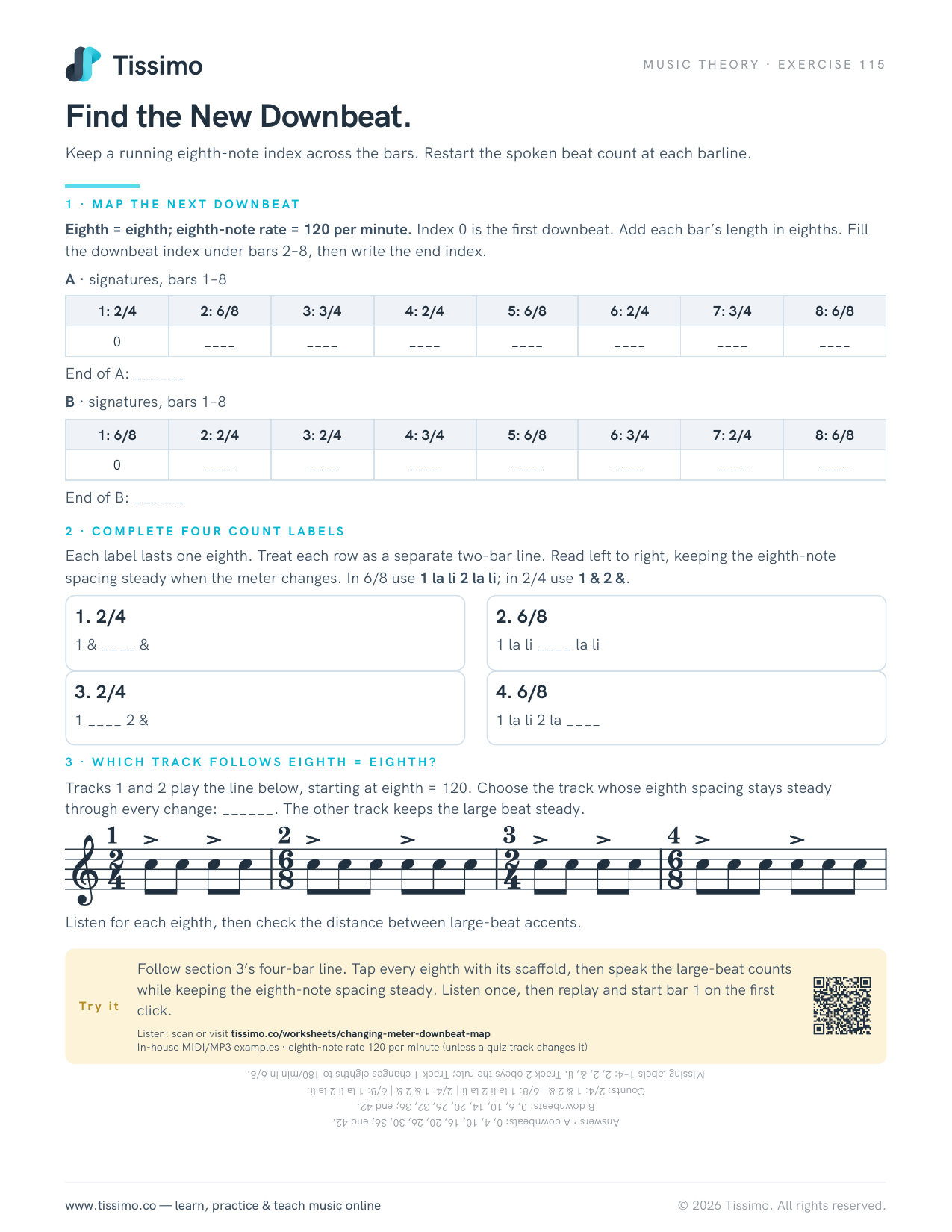 Find the New Downbeat.Keep a running eighth-note index across the bars. Restart the spoken beat count at each barline.
Comments