Notation & Symbols
Cue Note
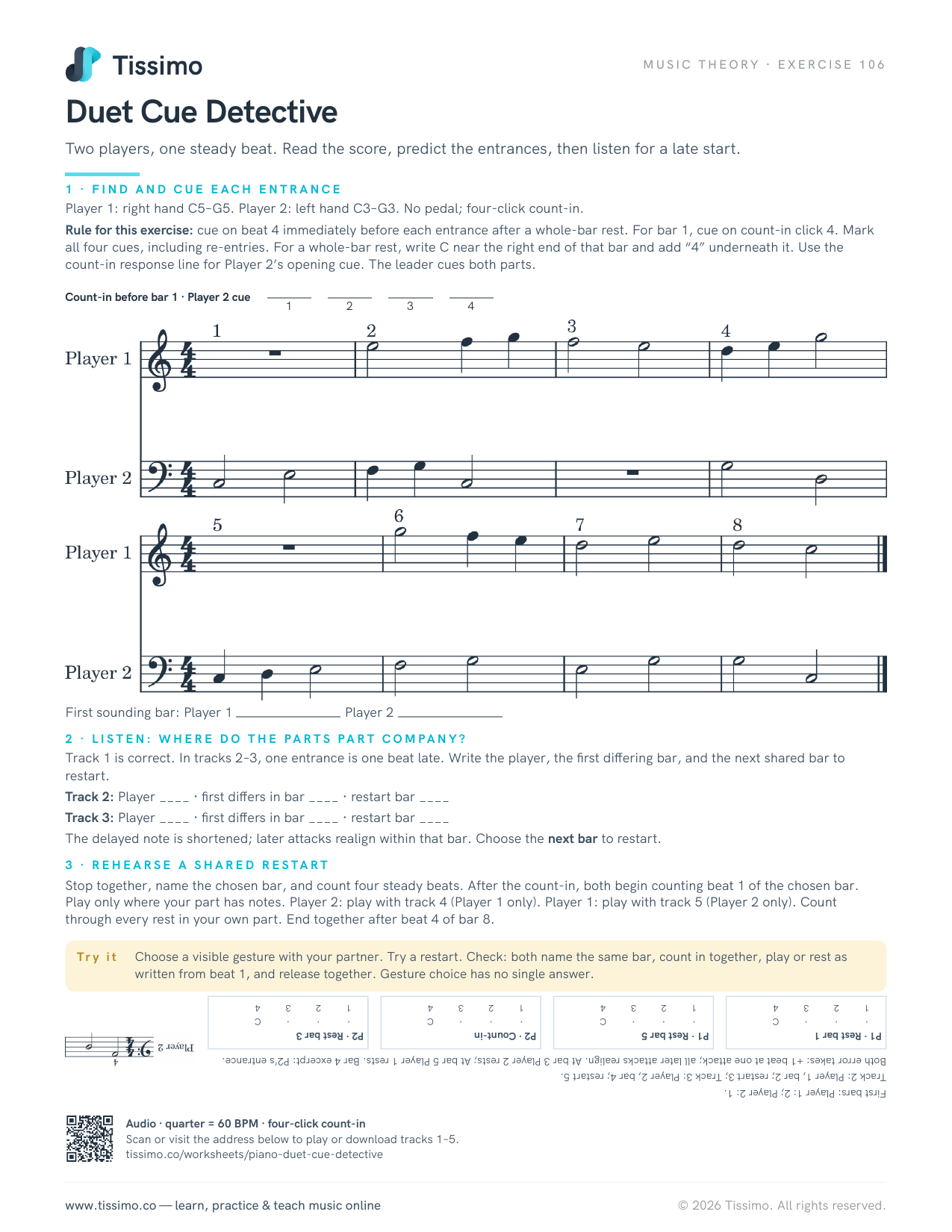
Cue notes are usually small printed extracts of another performer's music, included in a part to help the reader follow the ensemble and locate an entrance. Ordinary entrance cues are listened for rather than played by that reader.
After several bars of silence, a player may recognize another instrument's melody more easily than a bar count alone. An entrance cue prints that recognizable music in the resting player's part, usually with small notes and a label naming the source instrument. The cue supplements counting; it does not replace the player's own written rests.
Follow the sound without joining it
Imagine a viola part with two bars of small flute notes above its rests, followed by the viola's normal-size entrance. The violist listens for the flute phrase, keeps track of its rhythm and then plays the viola entrance. The small flute line is not an extra viola solo.
A cue's ordinary note values show where the borrowed music falls in the bar. Unlike ornamental grace notes, they are not simply squeezed in before a main note. A cue can also help with coordination or finding a pitch, not only with an entrance after a long multimeasure rest.
Small print needs context
Not every small note is a silent cue. An ossia offers an alternative passage to play, and some scores explicitly provide cue-sized music for substitution or doubling. Follow the label and performance instruction rather than deciding from size alone. A conductor's physical cue is another meaning of "cue"; it is a gesture rather than this printed excerpt.
When preparing a part, identify the cue's source, your own rests and the exact point where your playing resumes. If a cue is hard to hear, use another recognizable musical event and confirm the entrance in rehearsal.
Common questions
Should I play the small cue notes in my part?
Usually not when they are ordinary entrance cues from another instrument. Listen for them while observing your own rests. Explicit substitution or doubling instructions can give cue-sized notes a different purpose.
Are cue notes the same as grace notes?
No. A cue shows another part's music in its rhythmic position. A grace note is an ornament whose timing is taken from surrounding music. Small print alone does not identify either function.