Technique & Performance
CAGED System
The CAGED system maps the guitar fretboard with five movable chord shapes taken from the open C, A, G, E and D chords. Played in that order up the neck, the shapes join into one map of any chord.
Most guitarists learn five open chords early: C, A, G, E and D. The CAGED system treats each of them as a shape that can move up the neck, with a finger or a barre taking the place of the nut. Played in the order of the name, C, A, G, E, D and then C again, the five shapes give five places to play the same chord, and they link up, so together they cover the whole fretboard. The same map works for any chord, and for the scales and arpeggios around it.
C major in five shapes
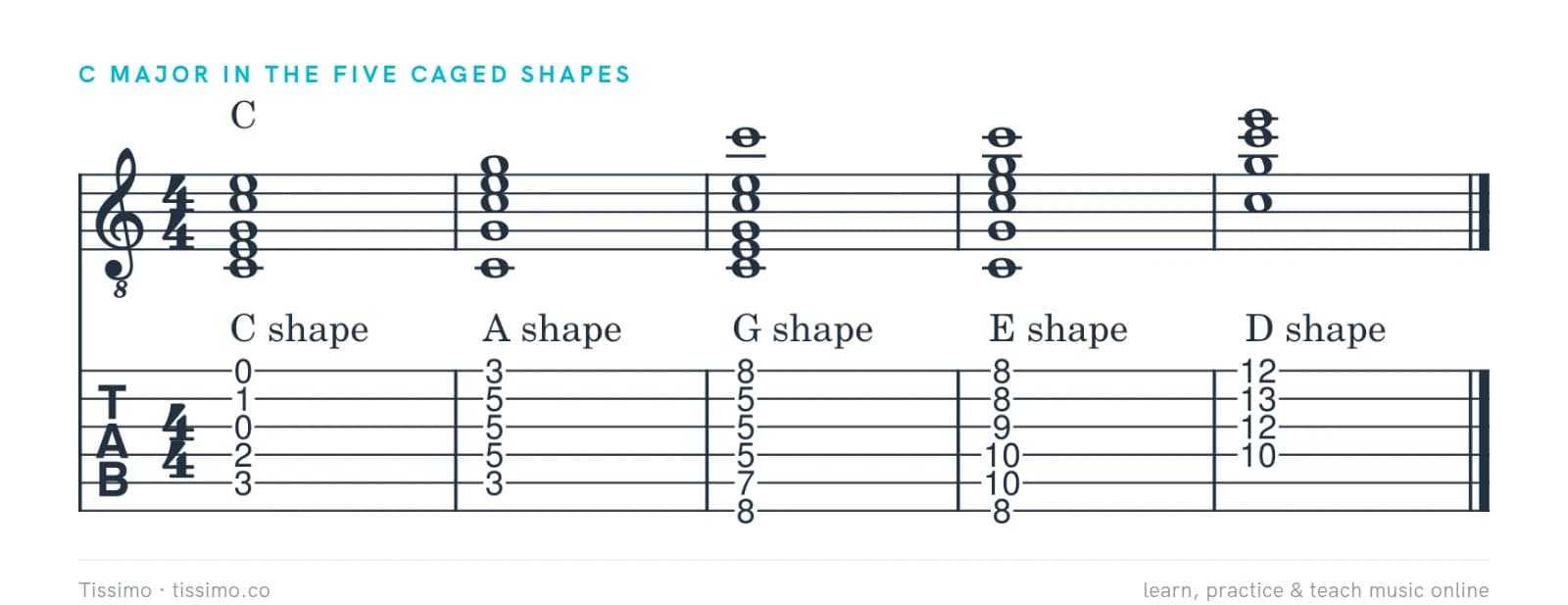
Shapes are written here from string 6 to string 1: a number is a fret, x a string you do not play.
- C shape, frets 0 to 3: the open C chord, x-3-2-0-1-0.
- A shape, frets 3 to 5: an A-shape barre at fret 3, x-3-5-5-5-3.
- G shape, frets 5 to 8: 8-7-5-5-5-8.
- E shape, frets 8 to 10: an E-shape barre at fret 8, 8-10-10-9-8-8.
- D shape, frets 10 to 13: x-x-10-12-13-12.
After the D shape, the C shape comes back an octave higher, at frets 12 to 15 (x-15-14-12-13-12), and the cycle starts again. The A and E shapes are the two barre chords most players already know. The full G and D shapes are awkward stretches, so players often use only part of them.
How the shapes link
Neighboring shapes share notes, so each one leads into the next. The easiest guide is the root: the highest root of one shape on the neck is the lowest root of the next.
- C and A share the root on string 5, fret 3.
- A and G share the root on string 3, fret 5.
- G and E share the roots on strings 6 and 1 at fret 8.
- E and D share the root on string 4, fret 10.
- D and the high C shape share the root on string 2, fret 13.
Other keys
The order never changes, only the starting point. For G major the cycle starts on the open G shape and runs G, E, D, C, A: the E shape at frets 3 to 5, the D shape at frets 5 to 8, the C shape at frets 7 to 10, the A shape at frets 10 to 12, and the G shape again from fret 12. A capo moves all the shapes together.
Scale shapes can be learned the same way. The two-octave pattern in The Movable Major Scale Shape, with its root on string 6, lies around the E-shape chord at the same fret; check its frets with Fret Check: The Major Scale Shape.
A map, not a progression
The name lists shapes, not chords to play in a song: every shape in the example is a C major chord. The shapes come from the open chords of standard tuning, so in other tunings they change. It is one way among several to learn the fretboard, not a rule for fingering.
Common questions
What does CAGED stand for?
The five open chords whose shapes the system uses: C, A, G, E and D. The letters also give the order in which the shapes follow one another up the neck.
Do I have to learn the CAGED system?
No. It is one popular way to learn where chords and scales lie on the neck. Learning the five shapes for one chord, such as C, and how they connect is a good test of whether it suits you.
Practice it: free worksheets
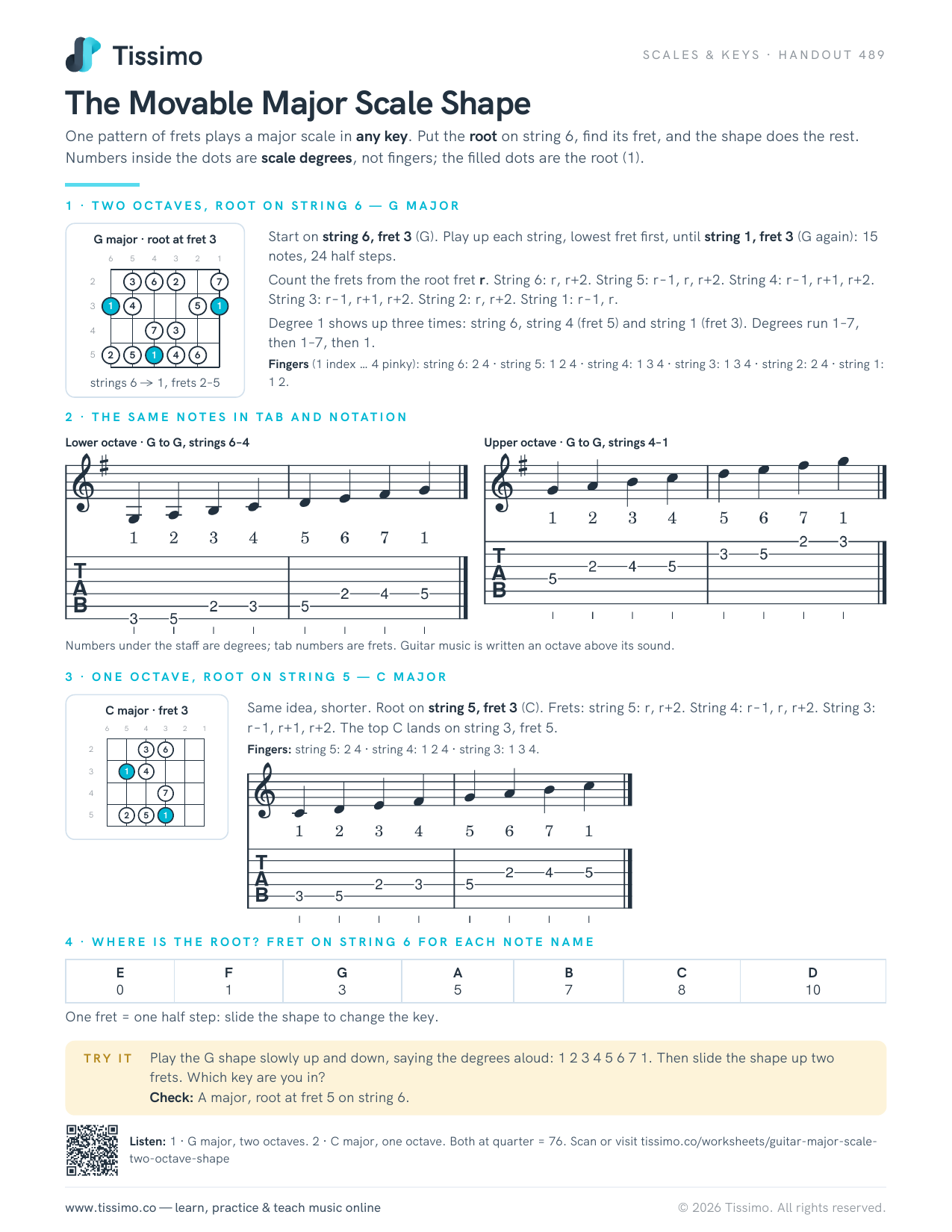 The Movable Major Scale ShapeOne pattern of frets plays a major scale in any key. Put the root on string 6, find its fret, and the shape does the rest. Numbers inside the dots are scale degrees, not fingers; the filled dots are the root (1).
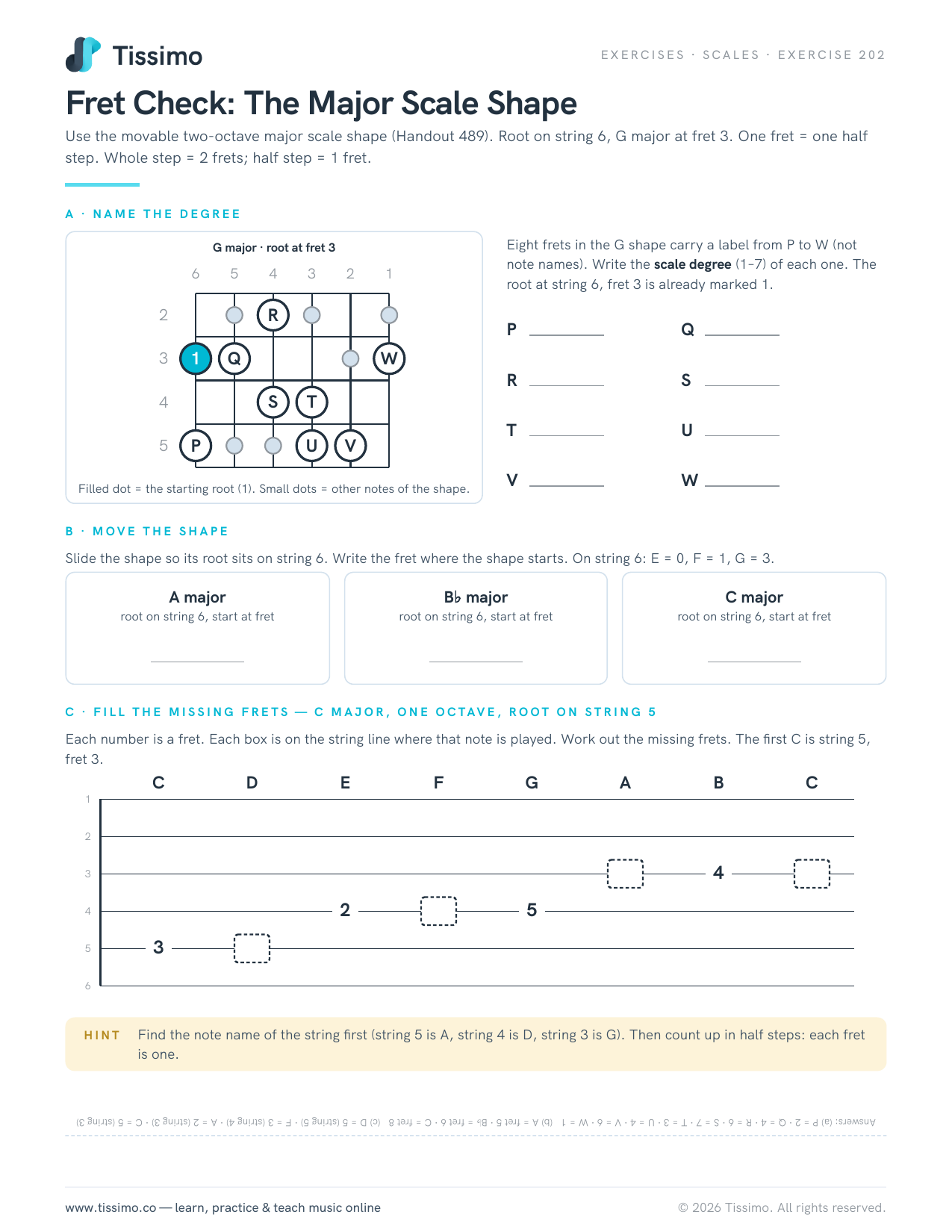 Fret Check: The Major Scale ShapeUse the movable two-octave major scale shape (Handout 489). Root on string 6, G major at fret 3. One fret = one half step. Whole step = 2 frets; half step = 1 fret.
Comments